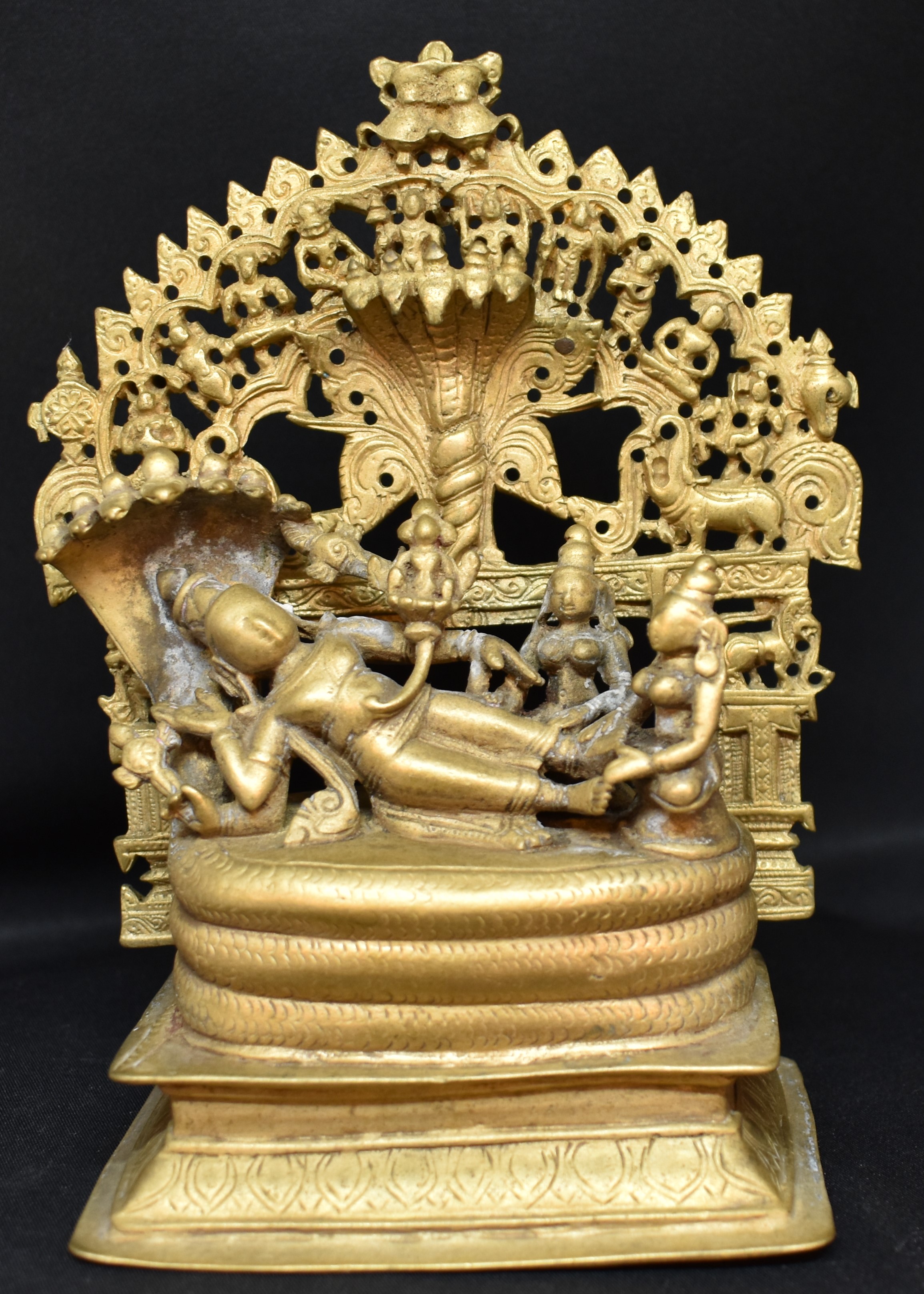
This is Vishnu as Anantasai. Some scriptures refer to this as Jalasayana, and the following is a description from Chaturvarga Chintamani.
“The Jalasayin is an image of Vishnu shown to be lying in the middle of waters, resting on the Adisesha..In reclining upon the serpent, three-fourths of the body of Vishnu is made to lie flat upon it, and the remaining fourth towards the head is slightly lifted up and inclined. One leg…rests upon the lap of Lakshmi, and the other leg is somewhat bent and thrown upon the other leg. One arm..is stretched along the body to reach the navel, while the other, corresponding to it, supports the head; two other hands grasp the santanamanari. On the lotus sprung from the navel of Vishnu is seated Brahma”
Reproduced from the book Vishnu Cult in Karnataka by Shrinivas V Padigar, to indicate how truthfully the iconography follows the prescription.

Despite the quality and rarity of Anantasai, this post is not about him. It is about the Prabhavali.
Take a moment to observe the Prabhavali, and it is a piece of art by itself. It is the Dasavathara that merits closer examination. An almost standardised Dasavathara set till you get to the ninth avatar. Marked in the photo below.


It depicts Jaina Thirthankara in Padmasana. Are you surprised? After the Vijayanagar period, seeing a Thirthankara in the Dasavathara panels is not unusual. The Chennai Museum has an example, shown to our right. The Thirthankara is standing. The Chennai Museum bronze is dated to the 17th century CE.
The Krishna Mutt, Udupi, has silver cladding (presumably over a Dasavathara relief sculpture) over the entrance of an ancillary deity in the main complex. That cladding also shows a Thrthankara as part of the Dasavathara panel. Photography is not permitted inside the Mutt, and I had to overcome the urge to bend the rules.

The mahamantap of Vittala temple, Hampi, depicts Dasavathara on the plinth. In the ninth position is a standing Thirthankara. The photo on our left is by the author. The book ‘Sculpture at Vijayanagara – Iconography and Style’ by Anna Dallpiccola and Anila Verghese confirms that observation.
All these help us in geographical attribution, North Karnataka and in dating the bronze to the post-Vijayanagar period. It may be dated to the seventeenth century. The bronze is about 16 cm tall.
 Bronzes of India - A personal collection