
This is Vishnu sleeping on the five-headed cobra, Anantha. Hence Anathasai. The cobra is also known as Sesha and that gives the alternate name Seshasai. This form, Ananthasai, represents the supreme aspect of Vishnu as the creator of the Universe.
Here Vishnu is sleeping on his back, with his left leg crossed over his right leg. He is attended to by his consorts Sri Devi and Bhu Devi. From his navel a lotus stem emerges and, on the lotus Bramha is seated in Dhyana mudra. In the absence of his attributes, Brahma is identified by the context and his four heads. Garuda, identified by his wings, is standing on the pedestal with his hands in Anjal mudra.
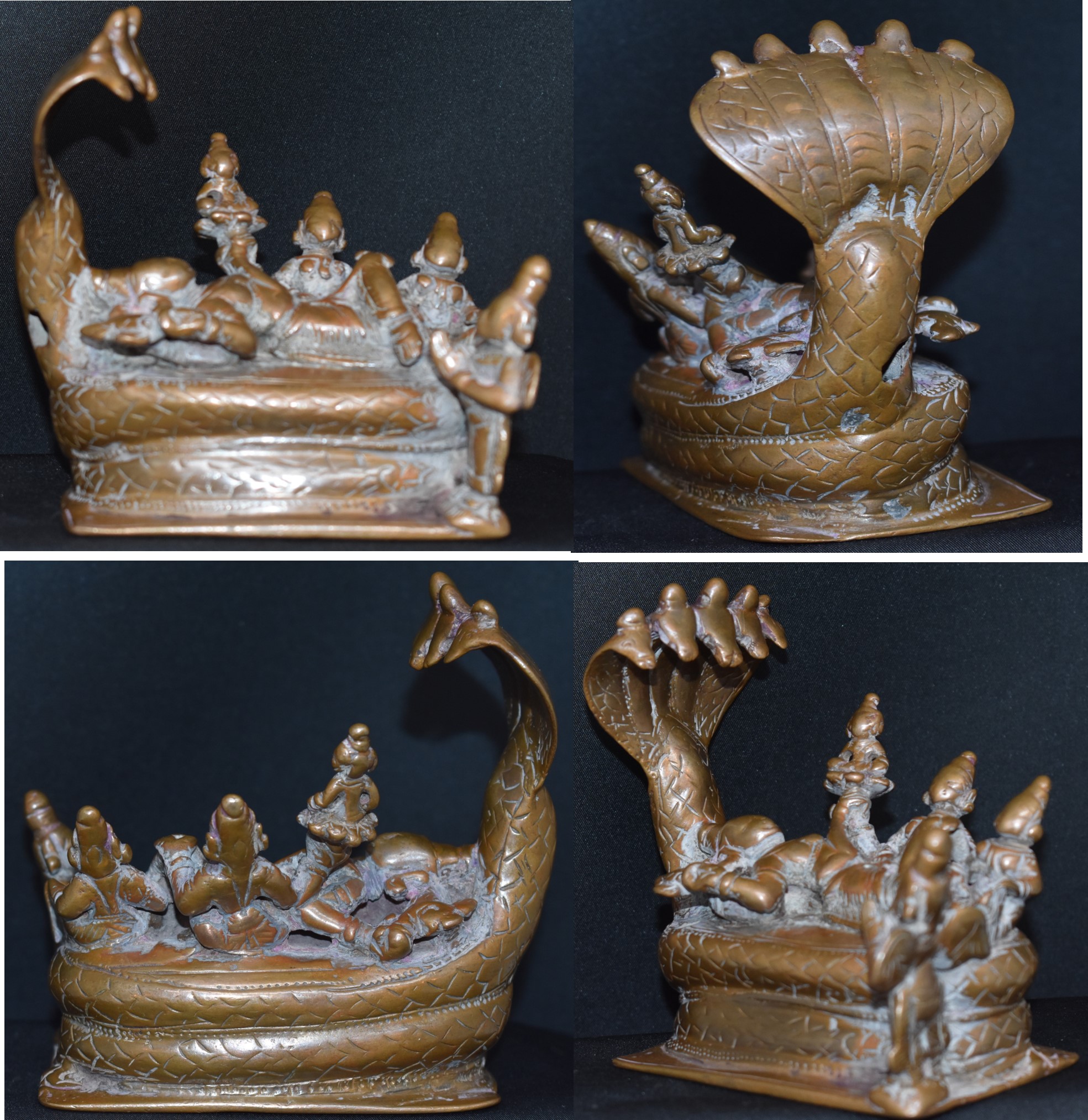
Vishnu is four-armed. The front hands are holding Chakra and Shankha. His right rear arm is supporting his head and left rear arm is extended along his torso, partly obscured by Brahma and his consort. This is a remarkably complete set, including Garuda and Brahma.
The bronze loss, wear to faces and the whitish deposits suggests a lengthy period of worship. The deposit is due to minerals in the water used for ritual cleaning. I made a weak attempt to clean it, without success. I decided to enjoy it as it is as I realized I cannot clean it without affecting the patina.
The crossing over the left leg, material and the peetha suggests this is from Karnataka. This may be dated to the seventeenth century or a bit earlier. The Vigraha is about 11 cm tall and 11 cm wide. The crossing over the left leg is typical of Deccan/Gujarat Aanathasai.
This blogsite has two other Ananthasai, Ananthasayana and Anathasai, and they are below for easy comparison.
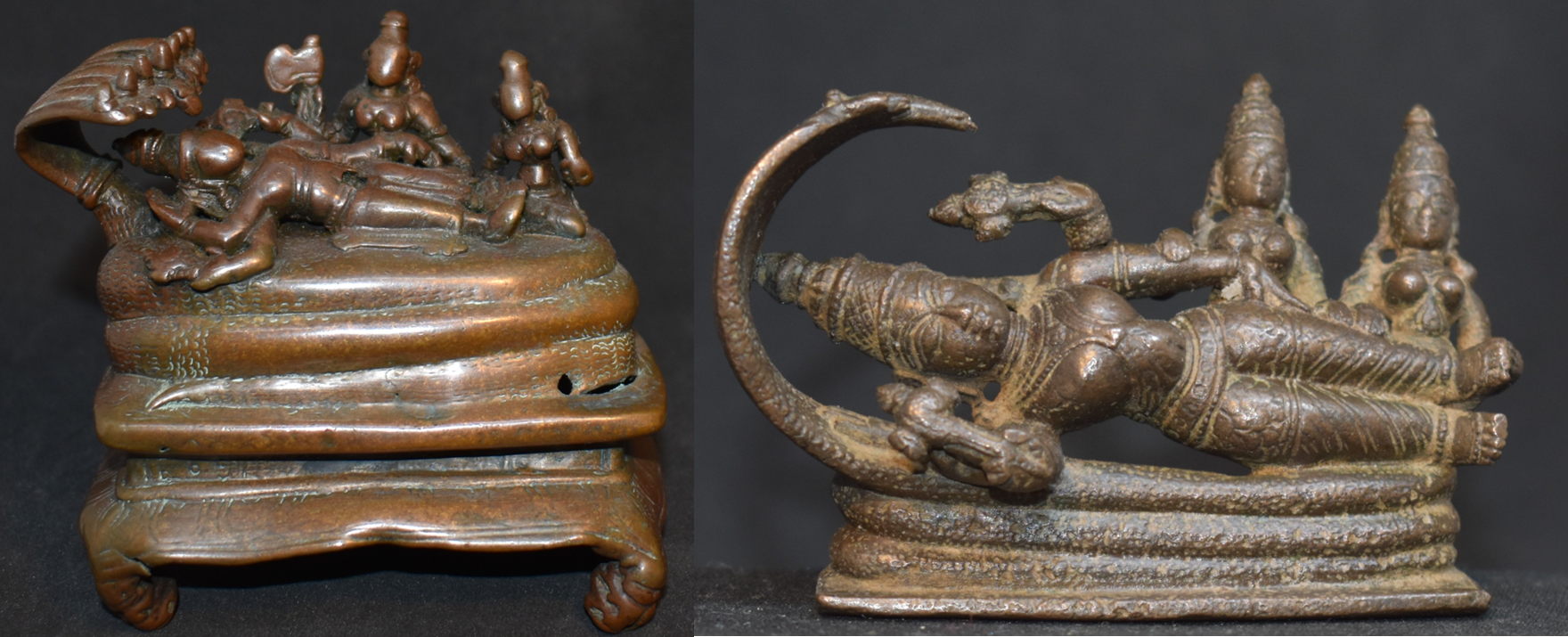
Note: This version of Vishnu is sought after by Sri Vaishnavites and collectors. Every collector and larger museum have one or aspires for one. Larger bronzes, of the size of Utsav Vigrahas, in this subject are even rarer.
 Bronzes of India - A personal collection