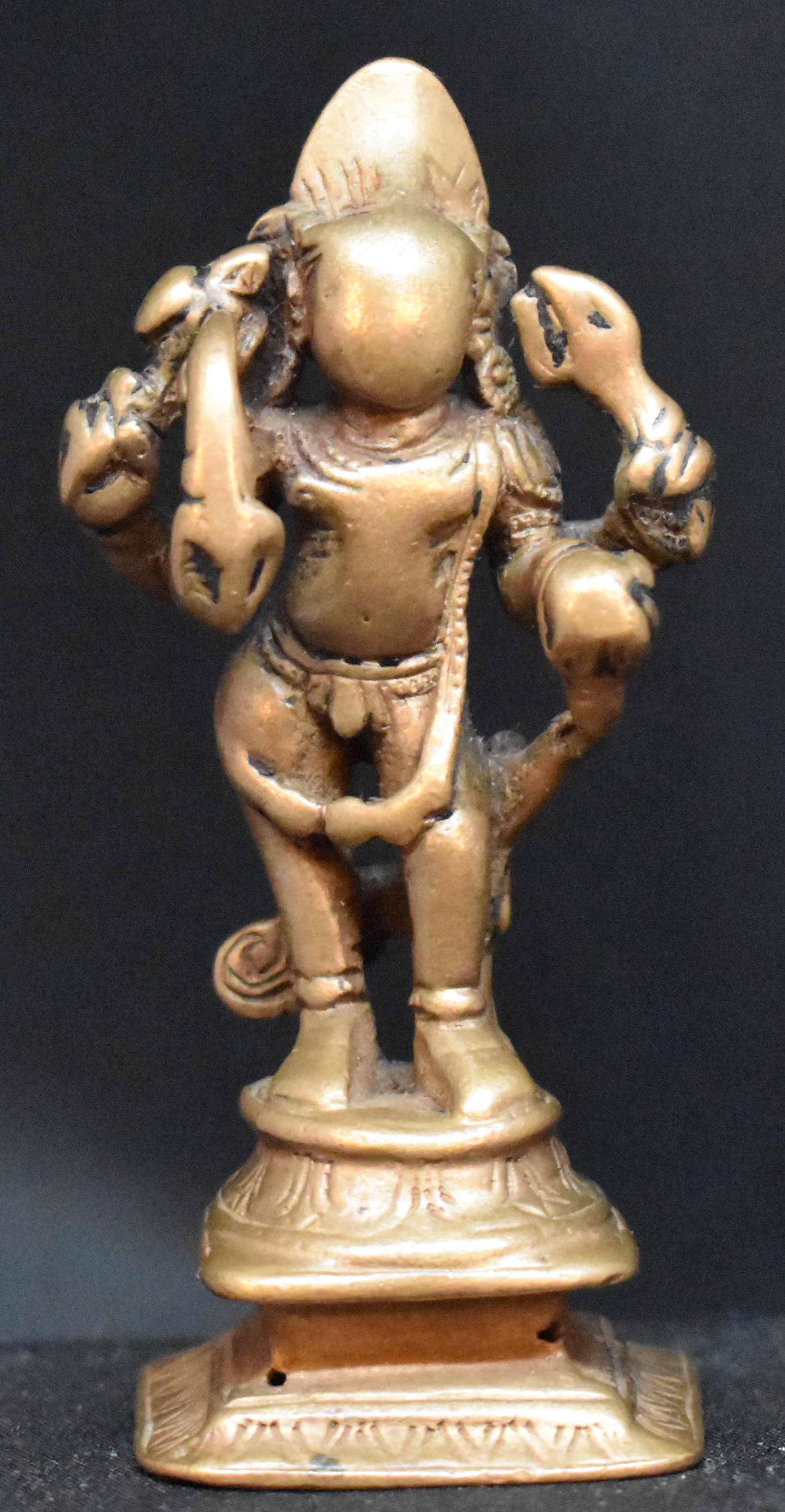
When I got this Bhairava, it was for study purposes and for comparison with another miniature Bhairava with me, shown below.
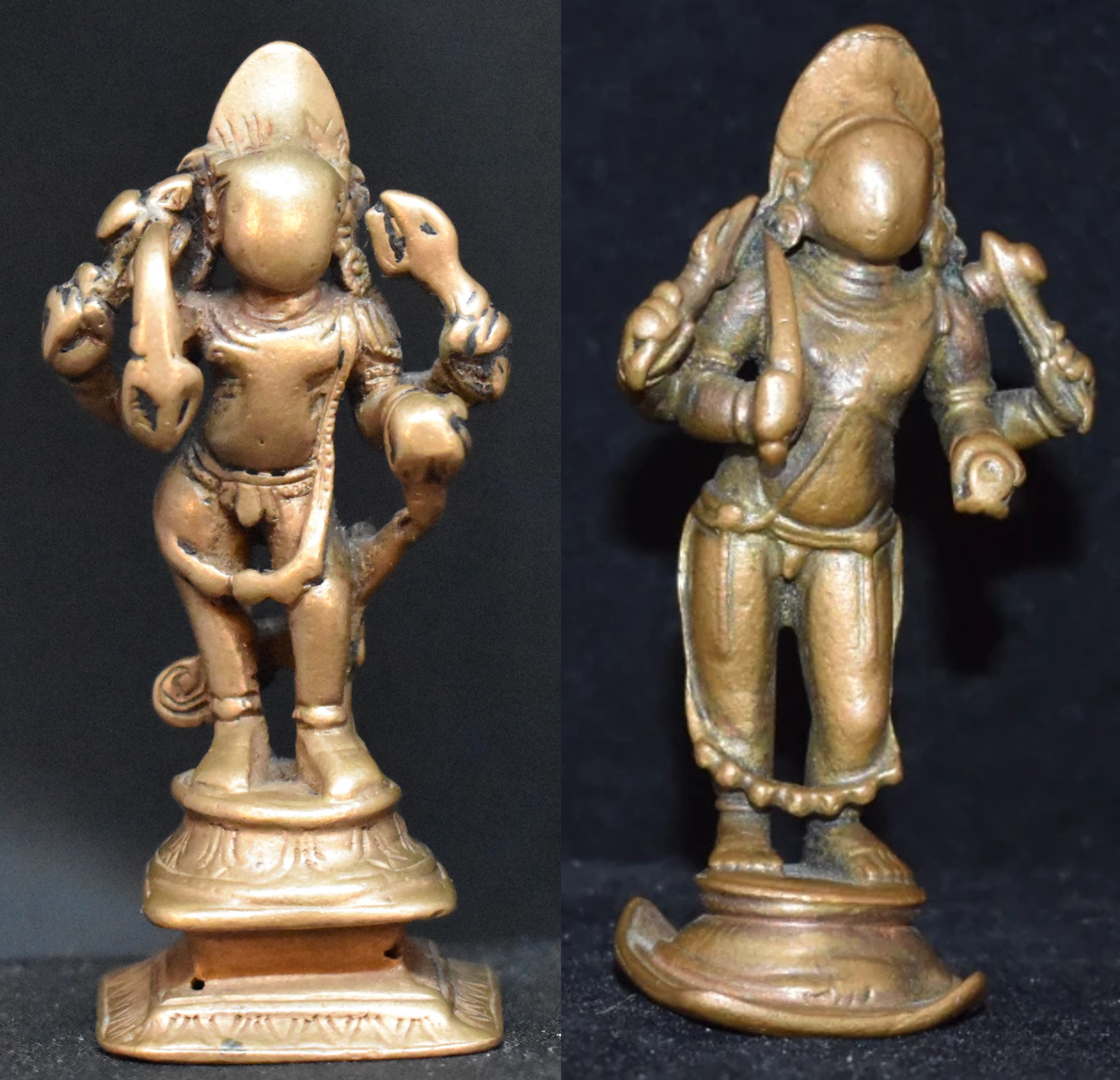
As I researched ‘the new Bhairava’, it became a topic of its own and that is what this blog is about.
Bhairava is identified by his attributes Sword, Drum, Trishul and Kapala along with a severed head in his hands (starting with his lower right hand and clockwise). The dog, his companion, reaching out to the severed head in Bhairava’s lower left hand reinforces the identification.
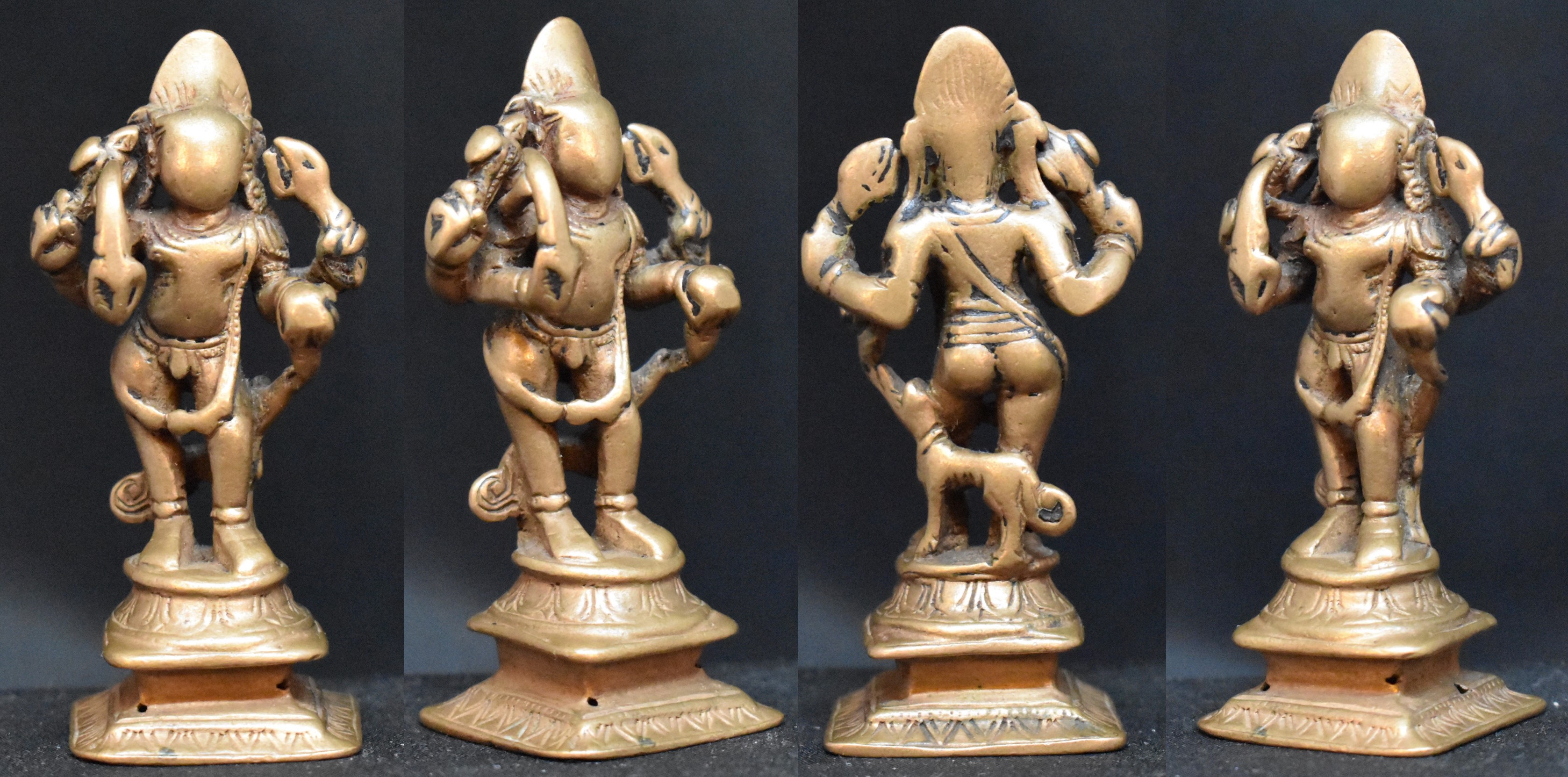
The sway of his body, his Jata arranged like a flame, the ritual wear and copper-rich alloy add to our enjoyment.
This Vigraha is 8 cm in height, and it is from Karnataka/Tamil Nadu cultural area.

The dog standing behind him and reaching out to catch the blood dripping from the severed head (It is Brahma’s fifth head) that is intriguing. Though you see Bhairava portrayed with dog in Tamil Nadu sculptures, this act of the dog is unique to Deccan sculptures.

The earliest one I have come across is in the British Museum. Reproduced here, to our left, for information. It is dated 950 CE. It is one of the most appealing bronzes I have come across.
The next example is with me and it is on our right. One more elegant bronze. This may be dated to the Chalukyan era. But a bit later than British Museum one.

There are several examples of Bhairava with this iconography attributed to the Hoysala period (10th-14th century CE). The Hoysala period is better known for its intricate sculptures. Here is one, on our left, from Chennakesava temple, Somnathpur dated to the 13th century CE.
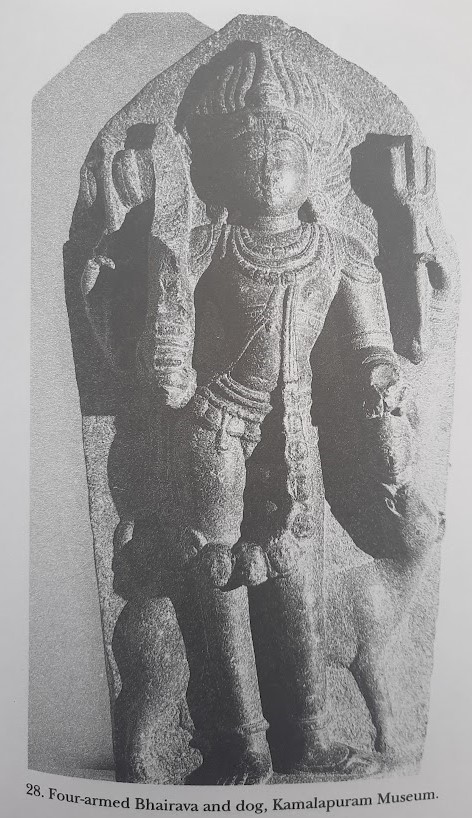
Following the Hoysalas, in terms of significant contribution to art, is the Vijayanagar empire (14th to 16th century CE). There are several examples at Hampi and the example, on our right, is from Kamalapuram museum, Hampi. Reproduced from the book Sculpture at Vijayanagara: Iconography and style by Anna Dallapiccola and Anila Verghese, plate 28.
The subject of this blog is from the post-Vijayanagar period (16th-17th century CE). It is remarkably close to the Kamalapuram stone Bhairava.
These examples show the preservation of this iconography over a period of seven centuries and through, at least, four dynasties.
Note: There is an eight-armed Bhairava with the dog reaching out to the dripping blood, in Madurai temple. It is attributed, incorrectly in my view, to the Chola period. All images of that bronze I came across are IP protected. A Google search ‘Bhairava Madurai bronze’ should get you the results. Parts of Tamil Nadu was under the Hoysala and Vijayanagar influence/rule. This sculpture in Madurai may have been commissioned at that time.
 Bronzes of India - A personal collection