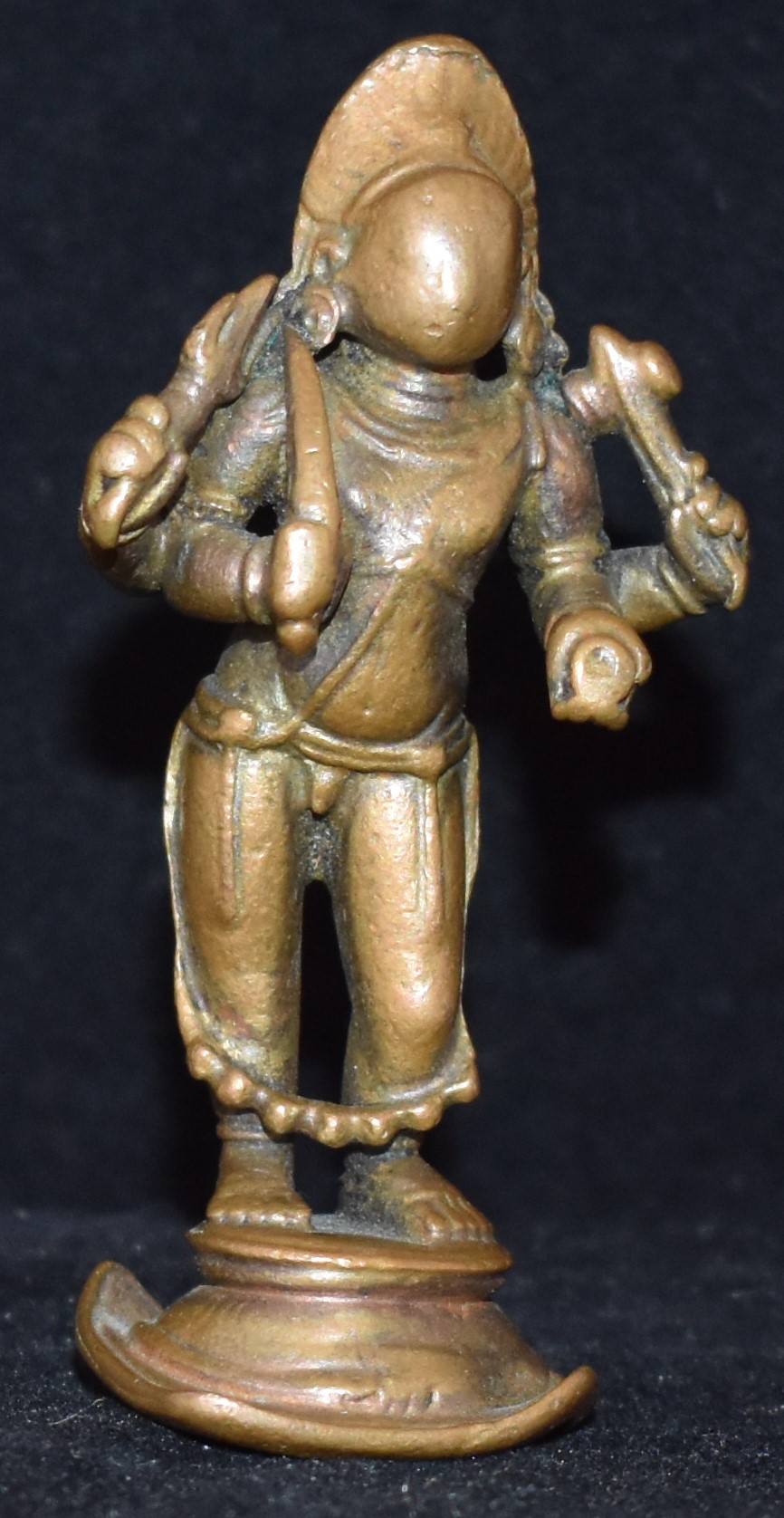
This miniature bronze, just about 6.5 cm, may have served as a personal icon in a home altar. He is holding a sword, Trishul, drum (Khadga) and a cup (may be a skull), starting from his lower right hand in the clockwise direction.

He is naked but for ornaments. The list of ornaments includes Kundalas, necklaces, Haras, chest band, Channivara, armlets, wristbands, a waistband with bells, Sirachakra, anklets and loose anklets. He is also sporting a full-length skull garland.
The attributes in his hands match in nature and in order with what H K Sastri in his book Indian Images of Gods and Goddesses (page 151) describes as Kala Bhairava’s features. So does the hair arrangement, like a halo, and the skull garland.
Bhairava is one of the manifestations of the Ugra (ferocious) aspects of Siva. Even death (Kala) fears this form of Bhairava and hence Kala Bhairava.
Bhairava is supposed to be holding Brahma’s severed head by the hair in his lower left hand. There are several stone sculptures and relief work showing this feature. I have yet to come across such a depiction in bronzes. In bronze, Bhairava holds a cup/skull instead.
Another feature that is different here is the absence of the dog, supposed to accompany Bhairava. Common in bronzes and almost always in stone sculptures. It is possible that the omission in this icon, meant for home worship, as dog is considered impure by orthodox Hindus.
The face is worn due to ritual use to notice his fangs. What is remarkable is the grace this bronze exhibits with the body in tribhanga (triple flex) despite the ugra (ferocious) nature of the deity.
Use of high copper content alloy and the fine nature of work indicates this may be from Tamil Nadu. It may not date before the 16th century.
 Bronzes of India - A personal collection