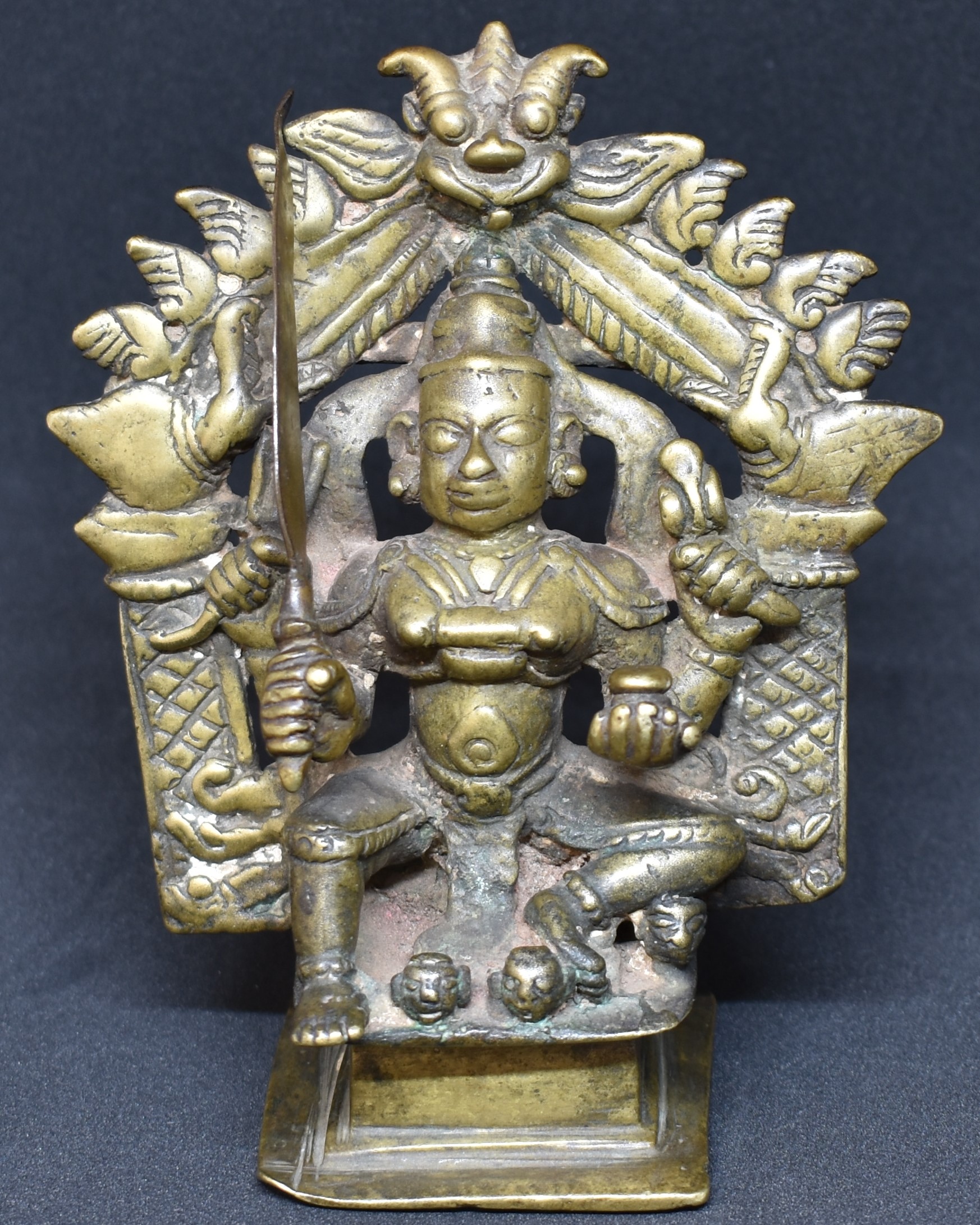
This is Bhairavi. Seated in a kind of lalitasana posture (This may be maharaja-lalitasana). This is a folk figure, and documented iconography may not apply.

Bhairavi’s attributes are a sword, a trident, a drum, and a skull cup (as usual, starting from lower right-hand clockwise). This is as per iconography. Bhairavi is supposed to wear a garland of skulls, like her husband Bhairava. The garland is absent. There are three skulls or heads, two in front of her and one under her left knee. She is not fierce, as the iconography states, but she is stern. Despite that difference, we are identifying her as Bhairavi. Why?
The back of the prabhavali has three rows of metal loops. A feature common among bronzes from North Karnataka and Maharashtra. The book titled Sculpture at Vijayanagara – Iconography and Style by Anna Dalliapiccola and Anila Verghese identifies the deity with the above attributes as Bhairavi (Page 65, plate 67 and plate 68 – see below). The Vijayanagara Empire included Karnataka, parts of the Telugu-speaking areas and parts of Maharashtra. That is good for me.
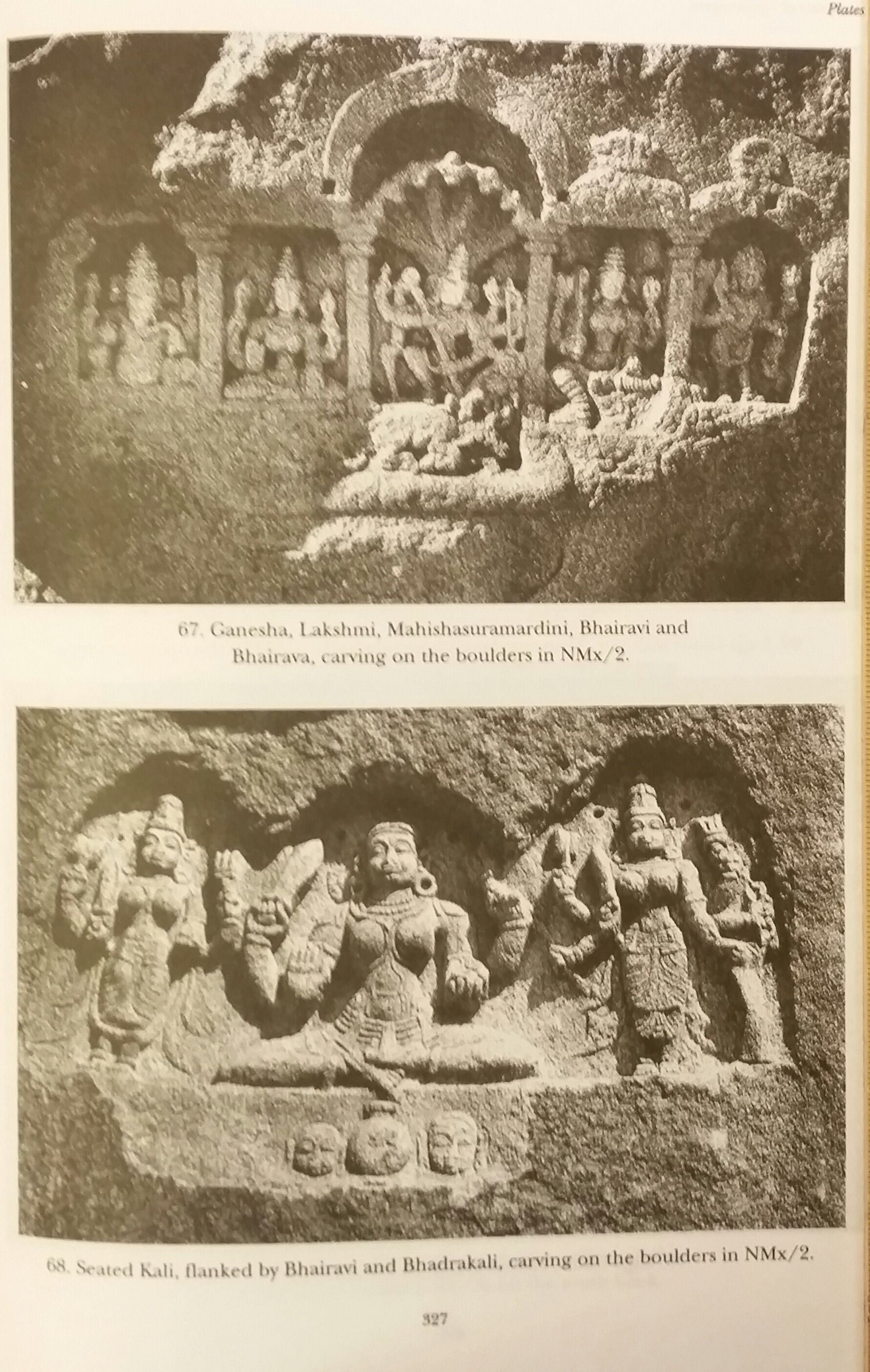
What is also interesting about this sculpture is the combination of folk and classical features. Prabhavali with Makara and Kiritamukha is a classical feature. The execution of the sculpture (features, assembly, six fingers in the lower right hand and exaggerated length of the sword) is folk-like. An unusual combination.
It is about 11.5 cm in height and shows signs of worship. No guess on the age, other than this may be from the nineteenth century or earlier.
 Bronzes of India - A personal collection
Hi Sridhar
I find it interesting that you identify this as Bhairavi. I have about ten sitting goddesses with similar iconography – damaru, trident, sword, bowl, some with skulls on the base. I usually identify them as Durga – I think I only have one with a chakra and conch. One or more of these has a lion, which I would associate with Durga rather than Bhairavi.
Recently, however I have bought a sitting goddess shrine which I think might be Bhairavi. It has a number of unusual details. The trident is replaced by a skull on a short pole. That is cradled in her upper left arm, with the forefinger of that hand touching her face (a very unusual gesture). She sits on a recumbent (defeated?) figure. Another tiny figures stands on the base. An even smaller animal (it is too worn to firmly identify but looks more like a dog than a lion) reachs up to her left knee. The dog and pole-skull made me think of Bhairavi.
The one-piece shrine is in the typical manner of Gujurat Hindu bronzes of about the sixteenth century, although a relatively heavy cast and base without cut-out shapes makes me wonder whether it might be a little later.
Best Wishes
Bennie
LikeLike
Hi David,
Good to hear from you.
Yes there is bit of tentativeness in the identification as Bhairavi. The iconography does not fit in with Mahavidya Bhairavi. As mentioned in the blog the I went with the book by Anna Dallapiccola and Anila Verghese. Now I have included the photo in the blog. As this bronze is from North Deccan, I went with Vijayanagara iconography.
Absence of Discuss and Conch shell (Shankha and Chakra) precludes (in my opinion) Durga.
Best regards…Sridhar
LikeLike