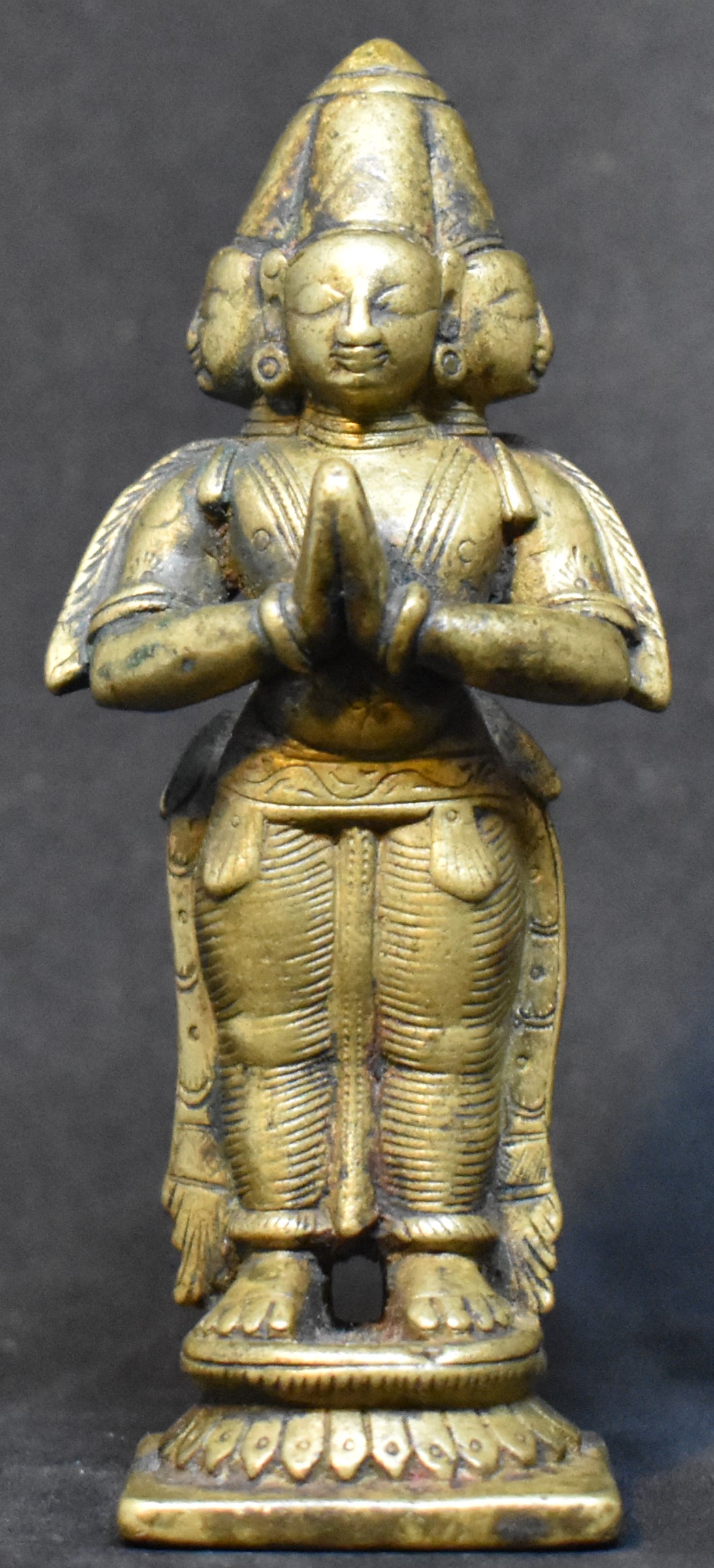
This is Brahma, as identified by his four heads. Brahma, in this example, has only two hands, and they are in Anjali Mudra or Namaskara Mudra.

Brahma’s history is remarkable. Brahma is supposed to have created everything, and later on, he was reduced to a subservient role of creating the Universe as Vishnu directed him. See Anatasayana on this blog.
To start with, he did not have a beard, and somewhere he acquired a beard on all four of his faces and then, as in this example, he lost the beard. Sometimes he is shown with a paunch, and in this example, he lost that as well.
Brahma had five heads, and Siva severed one of his heads. See Bhishantana Murti for the story. Despite his having four heads, he is normally shown with four hands or two hands.
Brahma’s consorts are Savitri and Saraswati. Even there he lost Sarasvati to Vishnu. See Pala Vishnu triad.
Though he is one of the Hindu Trinity (other two are Siva and Vishnu), Brahma’s role has always been secondary: Issuing from Vishnu’s navel to create the universe, Officiating Siva’s marriage (Kalyanasundara), Charioteer of Siva in Tripuranthakamurti and getting his status downgraded in Lingodbhava murti (sometimes seen as a swan and sometimes standing at the bottom in Anjali mudra).
This bronze is meant to slide into a slot in the Peetha. Other than guessing, this bronze is meant to be a part of a group, very little is known as to how and where. The protrusion at the back does not help either.
Based on the lotus petals at the base and the metal, I think this is from North Deccan. It is about 9.5 cm in height. There is significant wear resulting from worship. This may date to the nineteenth century or a bit earlier.

For this blog, the material came mostly from The Development of Hindu Iconography by J N Banerjea.
 Bronzes of India - A personal collection