 This is Mahaganapati (Maha meaning Supreme) and refers to the form of Ganapati with ten arms and accompanied by a consort. Mahaganapati is one of the rare forms of Ganapati and is highly sought aft…
Source: Mahaganapati
This is Mahaganapati (Maha meaning Supreme) and refers to the form of Ganapati with ten arms and accompanied by a consort. Mahaganapati is one of the rare forms of Ganapati and is highly sought aft…
Source: Mahaganapati
 This is Durga in the form of Mahishasuramardhini, the avenger of the demon Mahisha. The demon takes the form of a water-buffalo and terrorises human. Durga with the combined power of Gods co…
Source: Mahishasuramardhini – HP
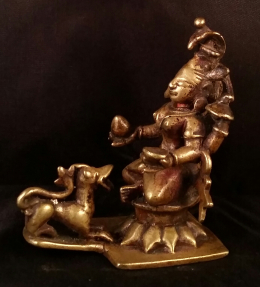
This is Mahalakshmi, modelled after the presiding deity of Kolhapur. In her hands, she is holding a fruit, a mace, a shield and a cup. (Starting from her lower right hand clockwise). She is carryin…
Source: Mahalakshmi
 Chakra (Wheel/Discuss) and Shankha (Conch Shell) are symbols of Vaishnavism. Vishnu is normally seen holding them in his hands. One such example on this site is Vishnu. Here the implements are moun…
Source: Shankha and Chakra
 Here the goddess is seated in Ardhapadmasana (Half lotus asana) and is holding lotus bud, goad, noose and a lotus bud in her hands (Starting from lower right hand clockwise). The goddess is sitting…
Source: Kamakshi
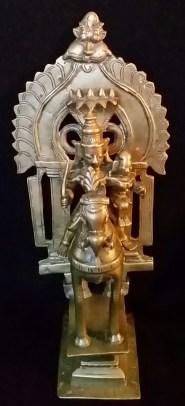 This is Khandobha and his consort Mahalsa riding a horse. This is one of the popular depictions of them. Khandobha is identified by his vahana, a horse, and by his attributes, a sword and a shield.…
Source: Khandobha (Folk)
 A simple village folk art from South Tamil Nadu, known after the major city Pudukottai of the region. Here you see two worshippers, the male figure with his hands in Anjali mudra and the woman hold…
Source: Worshippers – Pudukottai Bronzes
 Identified as Rama based on the Vaishnavite religious mark (Namam) on his forehead and the known iconography of Rama in preaching mode. This site has more examples of Rama in preaching/yoga positio…
Source: Rama in preaching mode
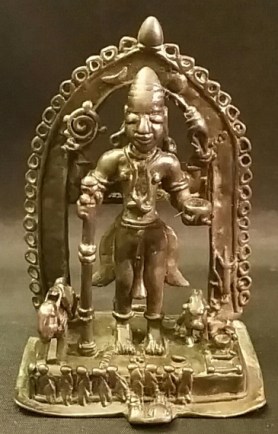 This is Govinda Bhairava, a syncretic form Vishnu (Govinda) and Shiva (Bhairava). His rear hands are holding Vishnu’s attributes Chakra and Shankha. Staff and begging bowl in the lowe…
Source: Govinda Bhairava (Tribal)
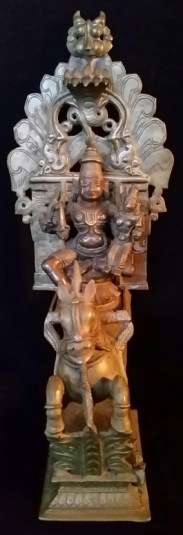 This is Khandobha with his consort Mahalsa. The identification is based on his vahana, a horse, being accompanied by a dog and his attributes. In his hands, Khandobha is holding Khadaga (a short sw…
Source: Khandobha (Classical style)
 This is Ayyanar (also spelt Aiyanar and Iyanar) with his consorts Puranai and Puskala (At least one author identifies the consorts by the names Madana and Varani.). Ayyanar is a Grama-devata (Vill…
Source: Ayyanar with consorts
One of the things I get asked is the books that I use or recommend. Tried to find the intersection of reasonable price, authenticity, simplicity, availability, rich in visual aids and breadth of …
Source: References
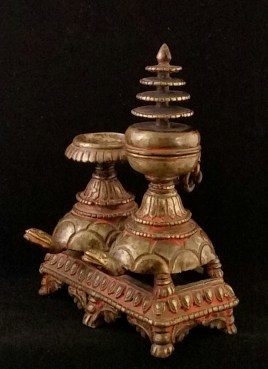 This is called Sinhamu in Nepal. Essentially they are powder/paste containers used in worship and/or rituals. The book Artistic heritage of Nepal, by the Handicraft Association of Nepal, mentions …
Source: Altar containers (Nepal)
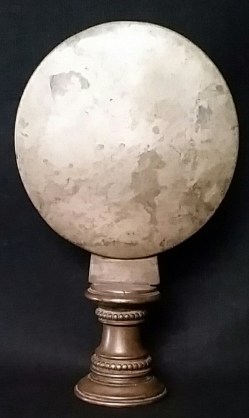 One of the simplest bronzes in my collection. A circular metal surface supported by a multi-leveled patterned cylindrical base. This is altar mirror from Nepal. This is referred to as Jwalanhayakan…
Source: Nepal altar mirror
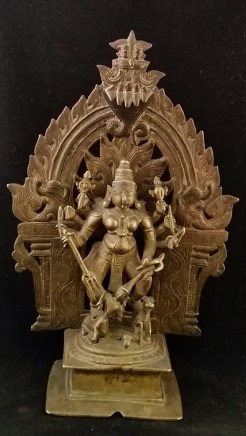 This is Mahishasuramardhini, the slayer (Mardhini) of the demon (asura) Mahisha, who has taken the form of a buffalo. Mardhini for short. You can see Mahisha being pulled out of the buffalo’…
Source: Mahishasuramardhini
 Bronzes of India - A personal collection