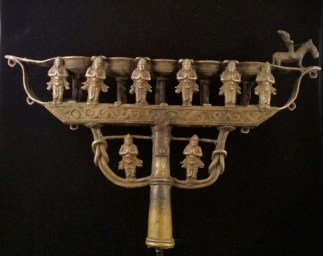
 This is an oil and wick lamp used in temple processions. The portion shown above is normally mounted on a long pole and carried in temple processions with the lamps lit. Boat lamp is the modern nam…
Source: Kerala Boat Lamp
This is an oil and wick lamp used in temple processions. The portion shown above is normally mounted on a long pole and carried in temple processions with the lamps lit. Boat lamp is the modern nam…
Source: Kerala Boat Lamp
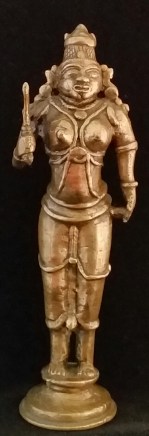 This folk bronze is identified as Karuppuswamy, a village guardian deity from Tamil Nadu, in South India. Karuppuswamy in Tamil means ‘black god’. The identification is based on similar…
Source: Karuppuswamy
 This is Visvakesana, a Vaishnavite figure. He is Vishnu’s army chief, keeper of Vishnu’s treasury, an obstacle remover and the guardian of gates to Vishnu’s abode, Vaikuntha. As a…
Source: Visvakesana
 Dhanvantri is the patron god of Indian Medicine. There are two versions of events leading to his birth as a Prince to the King of Varanasi. As per one, Dhanvantri came out of the churning of the oc…
Source: Dhanvantri
 One more Vithoba, the reigning deity of Maharashtra. His others names include Vittala and Panduranga. The worship of Vithoba is centred around Pandharpur. For more details of Pandharpur deity see P…
Source: Vithoba
 This is Sun god, Surya, His iconographical features include lotus buds in his hands and chariot driven by seven horses. The single wheel chariot (See the side view) is another characteristic of Sur…
Source: Surya on a chariot
 This is Yoga Dakshninamurti. There are fewer doubts about attributing that name to this form of Shiva. Holding battle axe in his upper right hand, with his right leg hanging down and resting on Apa…
Source: Yoga Dakshinamurti
 This is Ambika, Yakshi of the 22nd Jain Tirthankara, Neminath. The four-armed Ambika is identified by the child on her left lap, her sitting under a tree (mango tree), her holding a bunch of mango…
Source: Ambika (Jain)
 This is Ambika, Yakshi of the 22nd Jain Tirthankara, Neminath. The four-armed Ambika is identified by the child on her left lap, her sitting under a tree (mango tree), her holding a bunch of mango…
Source: Ambika (Jain)
 This is Radha, a consort of Krishna. it is common for them to be separated as normally they are not mounted on a common base. This bronze is possibly from Bengal or Orissa. The bronze is only about…
Source: Radha
 This is Yoga Dakshinamurti, a form of Siva. The attribution to Siva is based on the battle axe and antelope in his rear right and left hands respectively. The Yogapatta running around him and the w…
Source: Yoga Dakshinamurti
 This is Sambandar, a Tamil Saivite saint. One of the four key Nayanmars of Tamil Saivism. He is historical figure and said to have lived in the seventh century. Typical and accepted iconography. Ri…
Source: Sambandar
 Here Lakshmi Narasimha is seated in Yogasana with Yogapatta, thick band holding his legs. This is sometimes known as Utkutika asana. Narasimha is one of the avatars of Vishnu. Lakshmi is sitting …
Source: Yoga Lakshmi Narasimha
 This is melong, altar mirror from Tibet/Nepal. Melong is Tibetan term for looking glass or mirror. Melong is seen as a symbol reflecting things as they are, kind of reality check. This mirror is ab…
Source: Melong – Altar Mirror
 This is probably the most common household lamp for worship in South India and it is known as Gajalakshmi lamp due to the backdrop. Gajalakshmi refers to Lakshmi’s form where she is fl…
Source: Gajalakshmi Lamp
 Bronzes of India - A personal collection