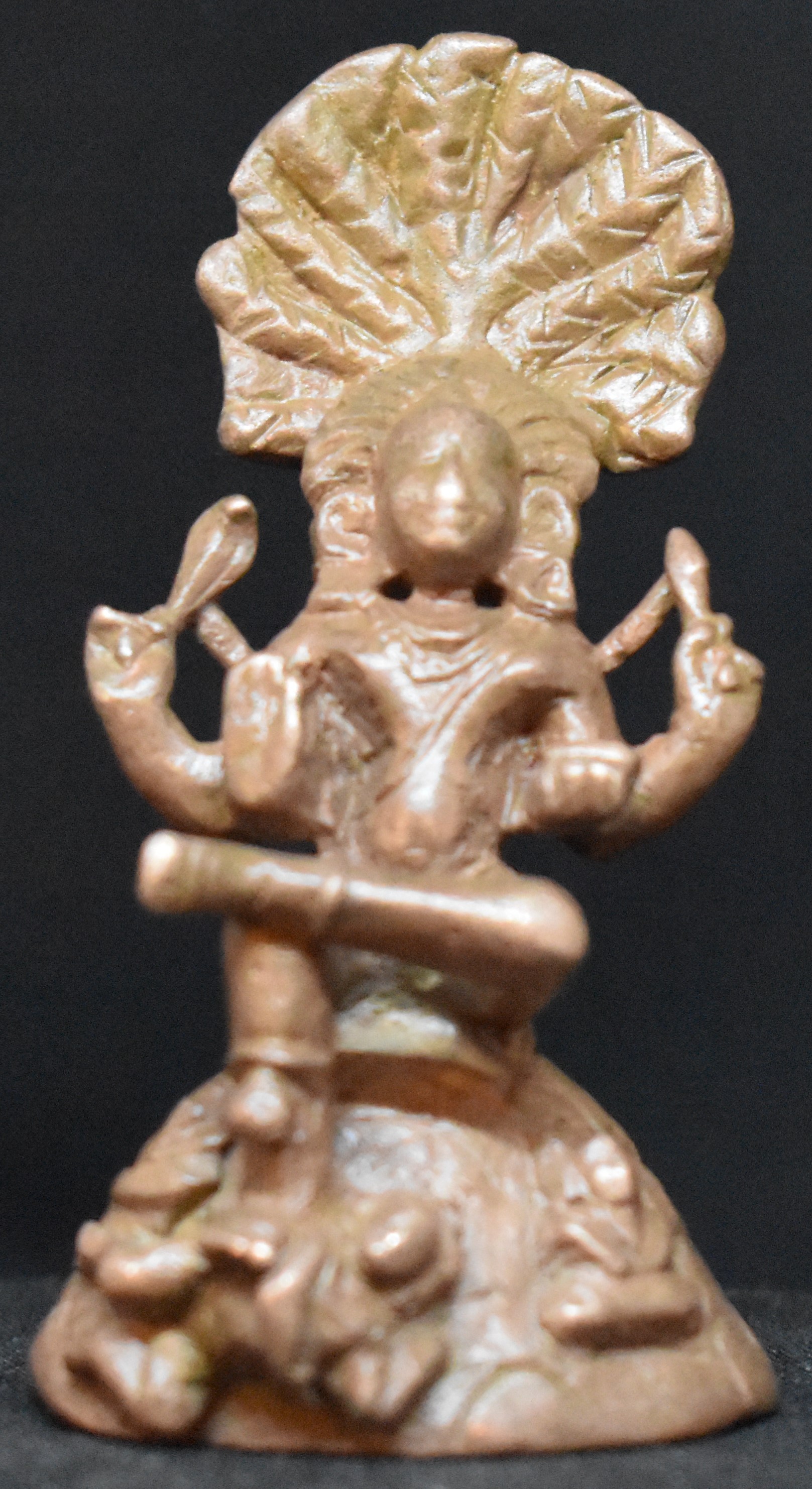
This is Siva as Dakshinamurthy, the Supreme teacher.
One of the meanings of Dakshina is South and normally Dakshinamurthy will be housed as a Kosta Vigraha, in a niche, on the South facing outer wall of the Garbhagriha.
There are other interpretations of the word ‘Dakshina’.
As per the Shaiva philosophy, the knowledge comes from below which is South and hence the name to the Supreme teacher.
Dr Pratapaditya Pal points out originally ‘Dakshina’ meant grace. Hence the name to the one who imparts knowledge and wisdom in his graceful form.
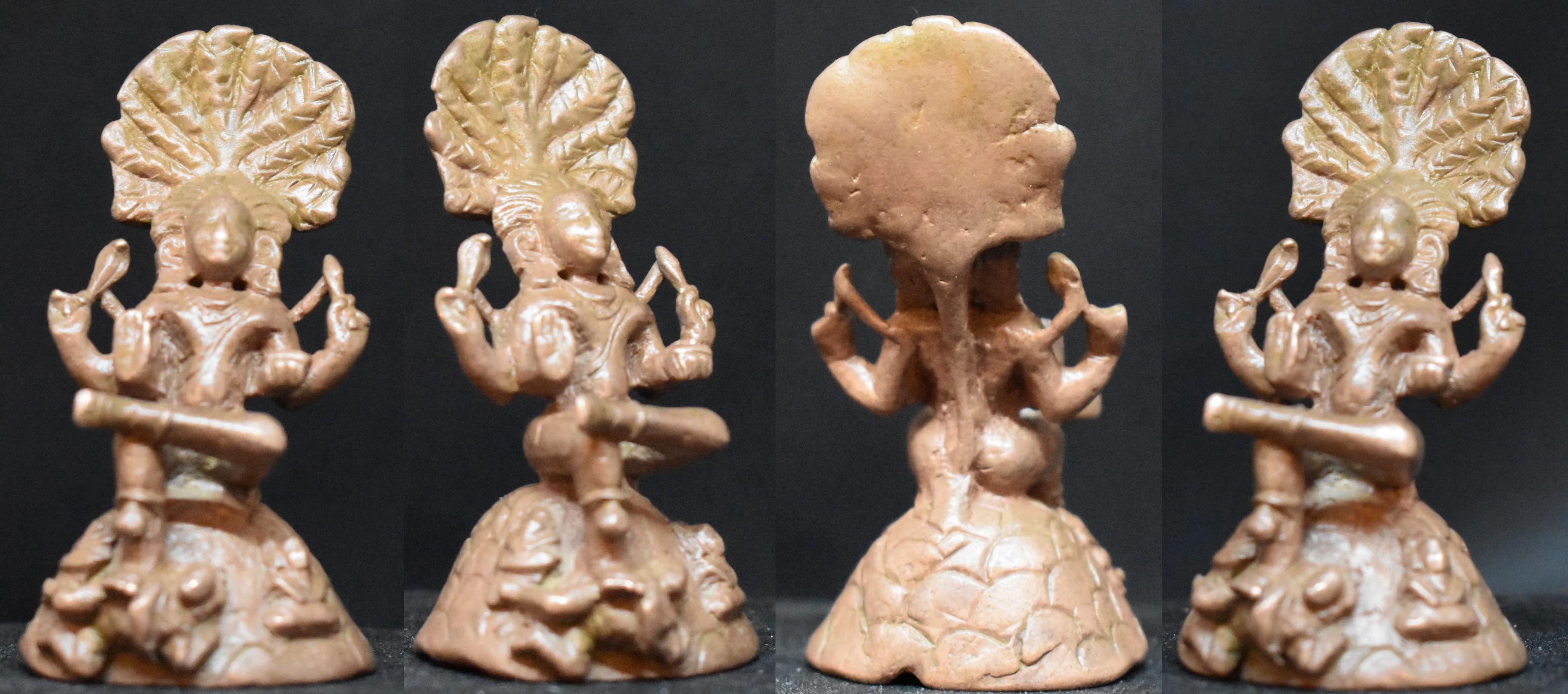
Here Dakshinamurthy is sitting on a hillock, signifying Himalayas, under a Banyan tree in Virasana pose. His right foot is resting on Apasmara. There are two ascetics on either side of his pendant leg and are listening to Shiva’s discourse.
His lower right hand is in Cin mudra, a sign of espousing wisdom. Other hands are holding a cobra, a battle axe and a book. Clockwise starting from the upper right hand.
Out of curiosity I tabulated the attributes of Dakshinamurthy (Vyakhana) as published in some well-known books.
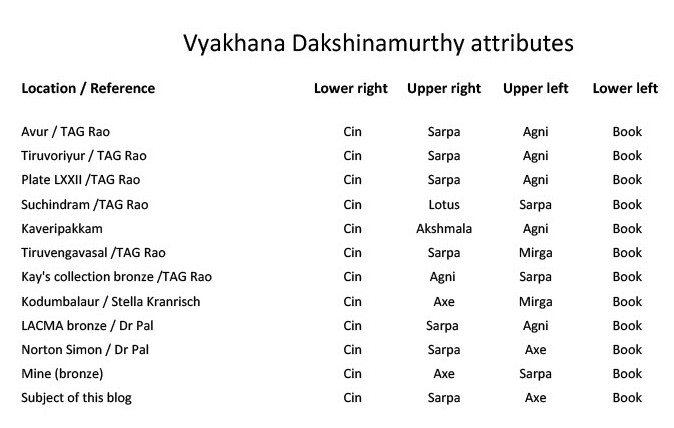
The above compilation shows that in all examples of Vyakhana Dakshinamurthy the lower hands are in Cin mudra and holding Pustaka. The upper hands attributes are that of Siva but lacks the same consistency as the lower hand attributes.
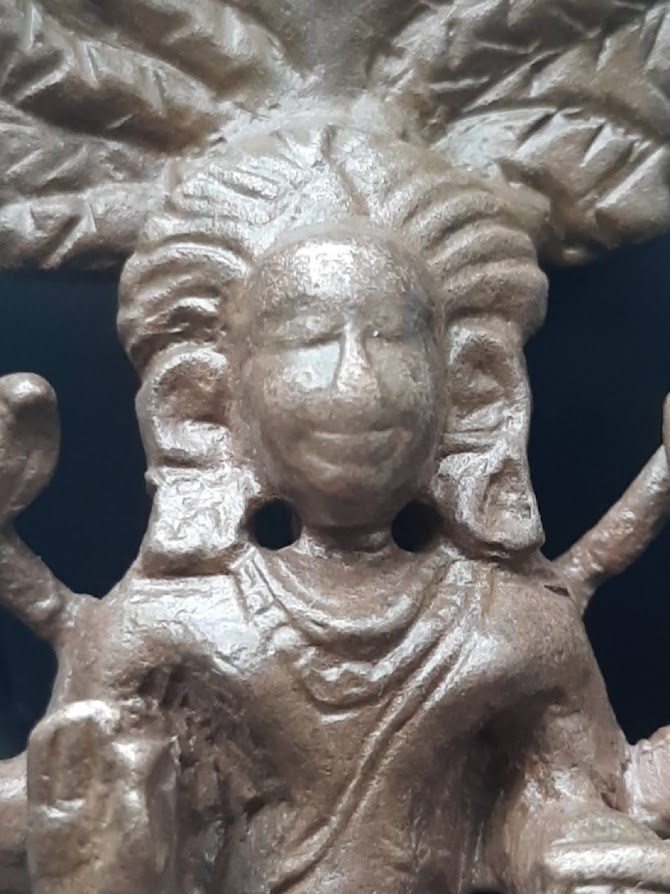
This Vigraha is about 6.5 cm high. Does he not have something to tell despite the miniature form? If you want an example of attention to detail here is one. See Shiva is shown with earrings of different shape, rectangular vs tear drop. Sakthi residing in Shiva is normally shown by him wearing earrings of two distinctive designs.
The Vigraha is from Karnataka or Tamil Nadu border area. This may be dated to the nineteenth century.
 Bronzes of India - A personal collection