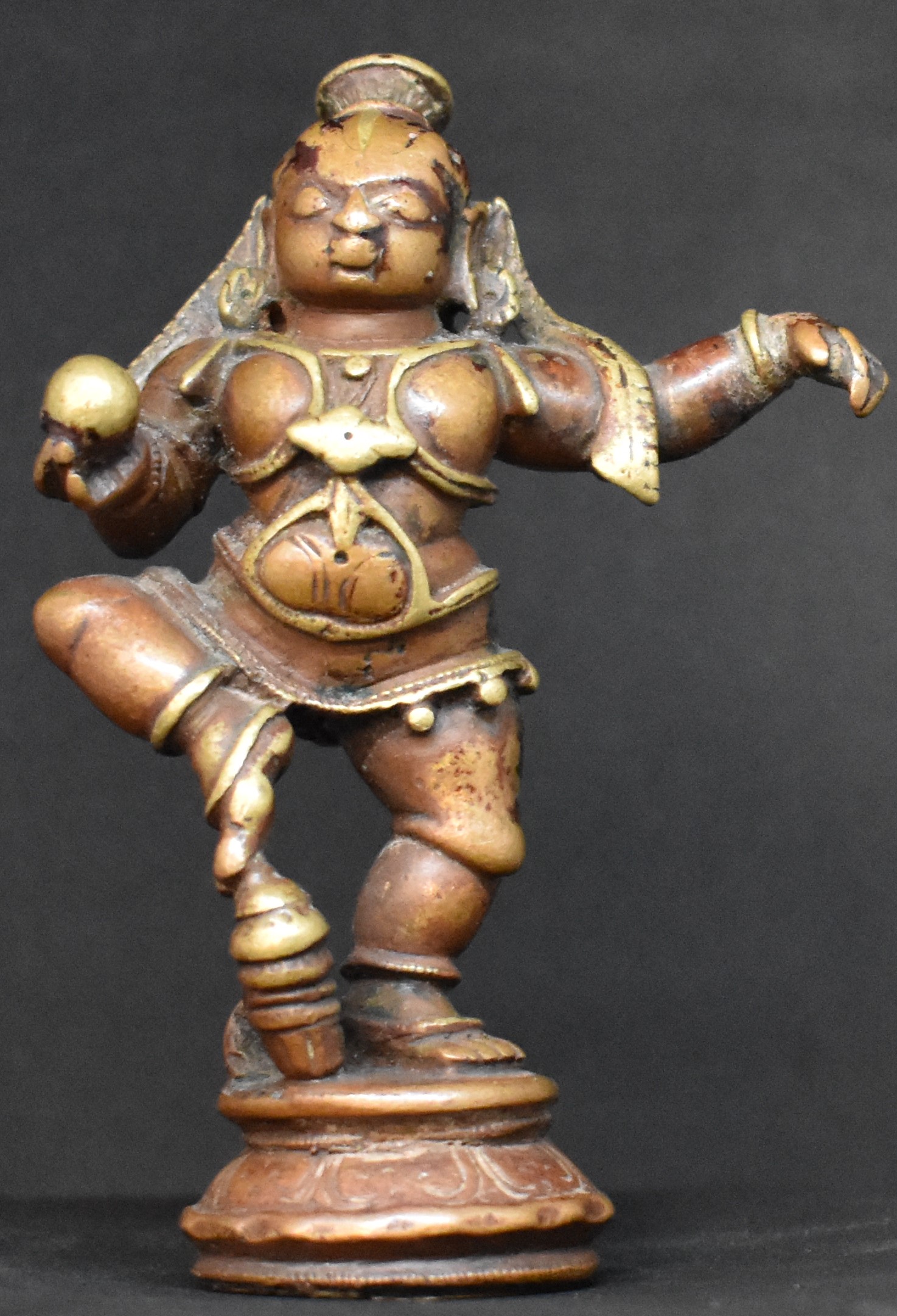
This is Krishna, identified by the ball of butter in his right hand and the pinched hair-do. He is in a dancing pose, with his right leg supported by a lotus. This form of Krishna is quite common in household shrines. This website has several examples.

But this dancing Krishna is special as he is made of two metals, using the Ganga-Jamuna (GJ) technique. It is normally brass ‘laid’ on a copper base. This technique was practised mainly in North Karnataka. Some GJ bronzes have been attributed to Tamil Nadu, specifically to the Tanjore-Madurai region. Most of these GJ bronzes date to the eighteenth century.
As is common, Krishna, depicted as a child, is naked. That is, but for his ornaments. The ornaments include earrings, neck chains/necklaces, arm and wristbands, waist chains with bells (see the photo of his back), anklets and foot chains.
This bronze shows considerable ritual wear, and it goes with the estimated age, dating to the eighteenth century.
The photos show a lot of patches (for example, see the forehead and the left forearm – photo of the back), and it is the way the bronze is. At some stage, it must have been coated with some ‘paint’. It is removable, but I decided to leave it as I got it. At least for now.
This bronze is about 9.5 cm in height.
 Bronzes of India - A personal collection