
This is a Dwarapala, a door guardian. It is the posture that catches attention. Left leg crossed over to the right and with his right hand on the hip, a relaxed stance for the guardian of a temple.
As Guardians they are normally present on either side of the entry way. Their attributes reflect that of the deity in the sanctum. Given that here he is holding Chakra, Shankha and Mace, this Dwarapala belongs to the Vaishnavite sect.

Normally the hand gestures are either Abhaya (protection) mudra, Tarjani mudra (warning) or Vismaya (expressing wonder of the deity in the Sanctum). Here the pose is welcoming and relaxed unlike that of a guardian and with a show of assurance with his hand on the hip. An unusual posture and that got me to search for a similar Dwarapala. Found one, a relief carving on a pillar of the entry Mantap of Hazare Rama temple. Hampi. The photo below is from the book Studies in Tuluva History and Culture By Dr Gururaja Bhatt.
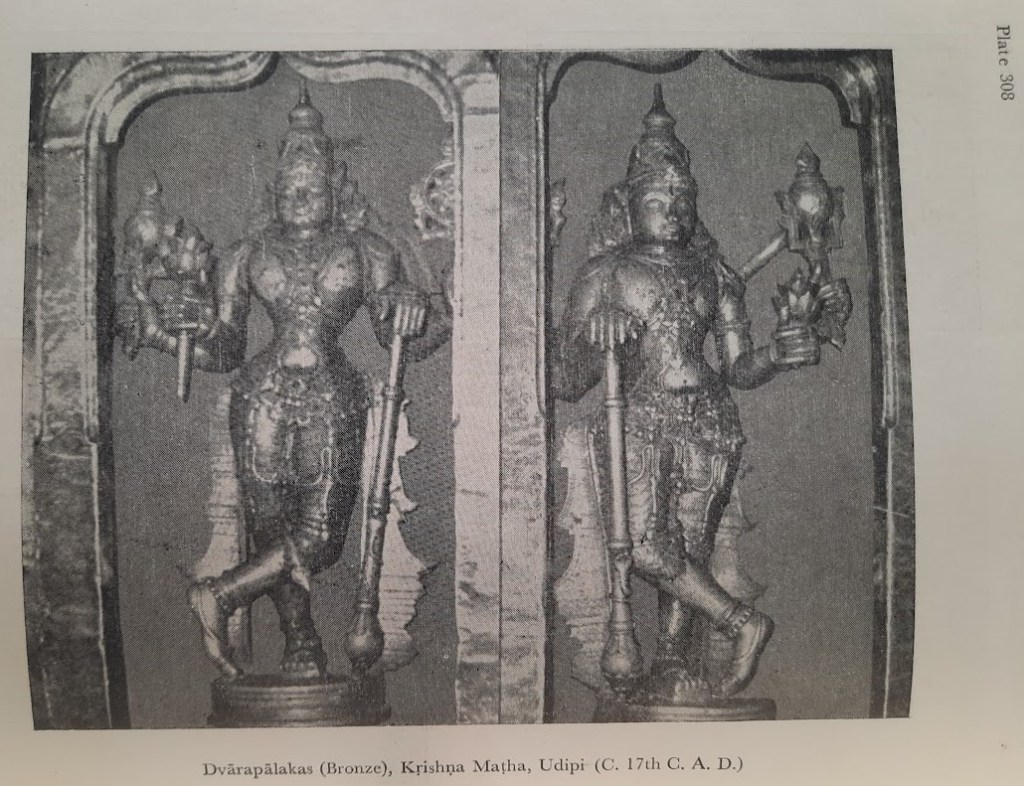
That ties with my assessment as to where this Vigraha is from, North Karnataka. And, of course, this is post-Vijayanagar period and may be from the seventeenth century. Quite worn from ritual use.
Making an assumption the deity would have been larger than the Dwarapala, it is quite likely this Vigraha came from a temple.
The Dwarapala comes with matched base and Prabhavali. I do not believe they started their lives together. As their colour and size match, I am keeping them as I got them.
The Vigraha is about 15 cm tall and with Prabhavali the height is 23 cm.
One other interesting thing is his wearing Paduka, though it is a Hindu practice to remove footwear before entering a temple. However I have come across several deities wearing footwear. That is one of my research topics.
 Bronzes of India - A personal collection