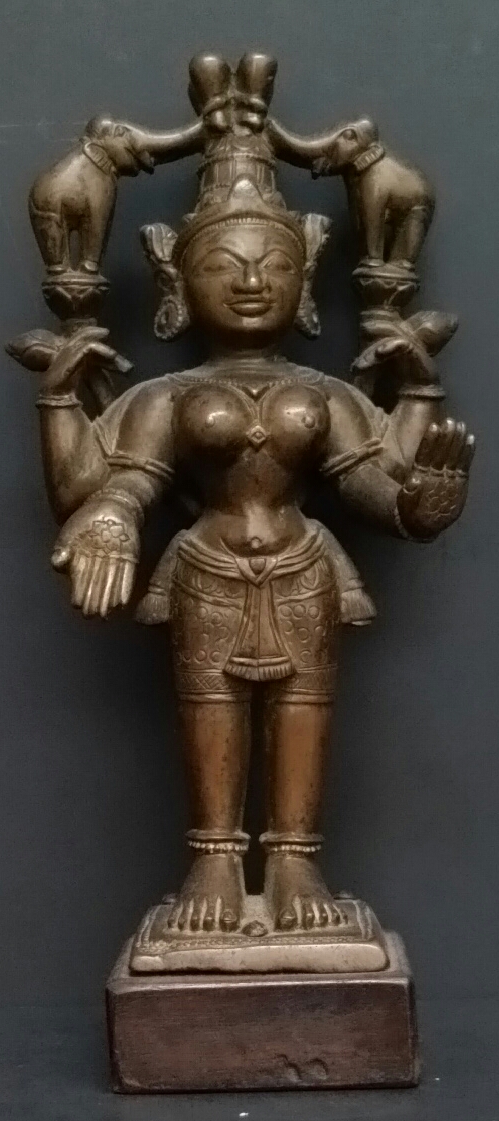
Standing Gajalakshmi (Goddess of wealth, Lakshmi, with elephants) is one of the most enduring motifs in Hinduism. The Indian Museum, Calcutta, has in its collection a medallion showing two elephants pouring water over Lakshmi, dating from the 1st century BC. Examples date back to the 3rd century BC.
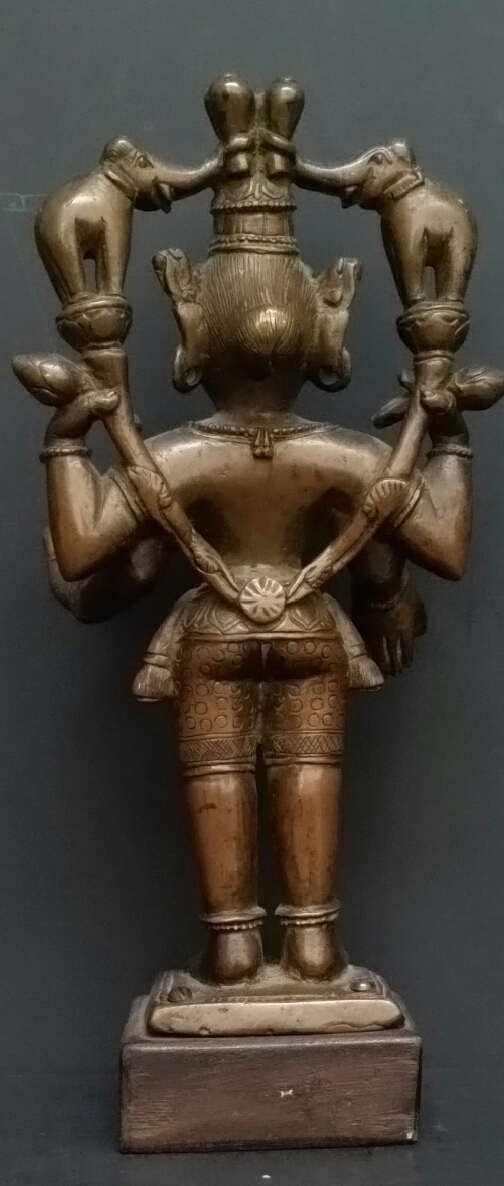
Here, Lakshmi is standing in samabhanga pose (with the whole body straight). This four-armed Gajalakshmi with primary hands in varada and abhaya mudra, her upper hands holding lotuses that support two pairs of conjoined elephants emptying pots of water over her head. The conjoined elephants can be discerned from the close-up view, at the bottom of this blog, which shows four upturned pots. The elephants represent the four directions.
The elephants are said to have two related meanings.
First, they are equated to clouds by poets and shower the earth with rain wherever they go and make the land fertile. The flanking, showering elephants emphasise Lakshmi’s association with the fertility of crops. The grains are regarded as a form of Lakshmi (Dhanya-Lakshmi).
Second, elephants suggest royal authority. Here, their presence performing abhisekha may be interpreted to bestow the qualities of fertility and royal authority on Lakshmi, herself the source of these very qualities.
This bronze is from Orissa. The feature of elephants being supported by the Goddess as they stand on the lotuses held in her upper hand is not seen in Gajalakshmi images from other regions. Normally, the elephants are on free-standing lotuses or part of a surround (torana). Interestingly, the Kajuraho museum houses a free-standing Gajalakshmi stone sculpture where the lotuses held by her are supporting elephants. (Museum ac no 817). Kajuraho dates to the 11th century. (Ref Indian Iconography A.L. Srivastava, 2011)
This bronze is about 17.5 cm in height and may date to the 19th century or earlier. The wood base is a later addition.

 Bronzes of India - A personal collection