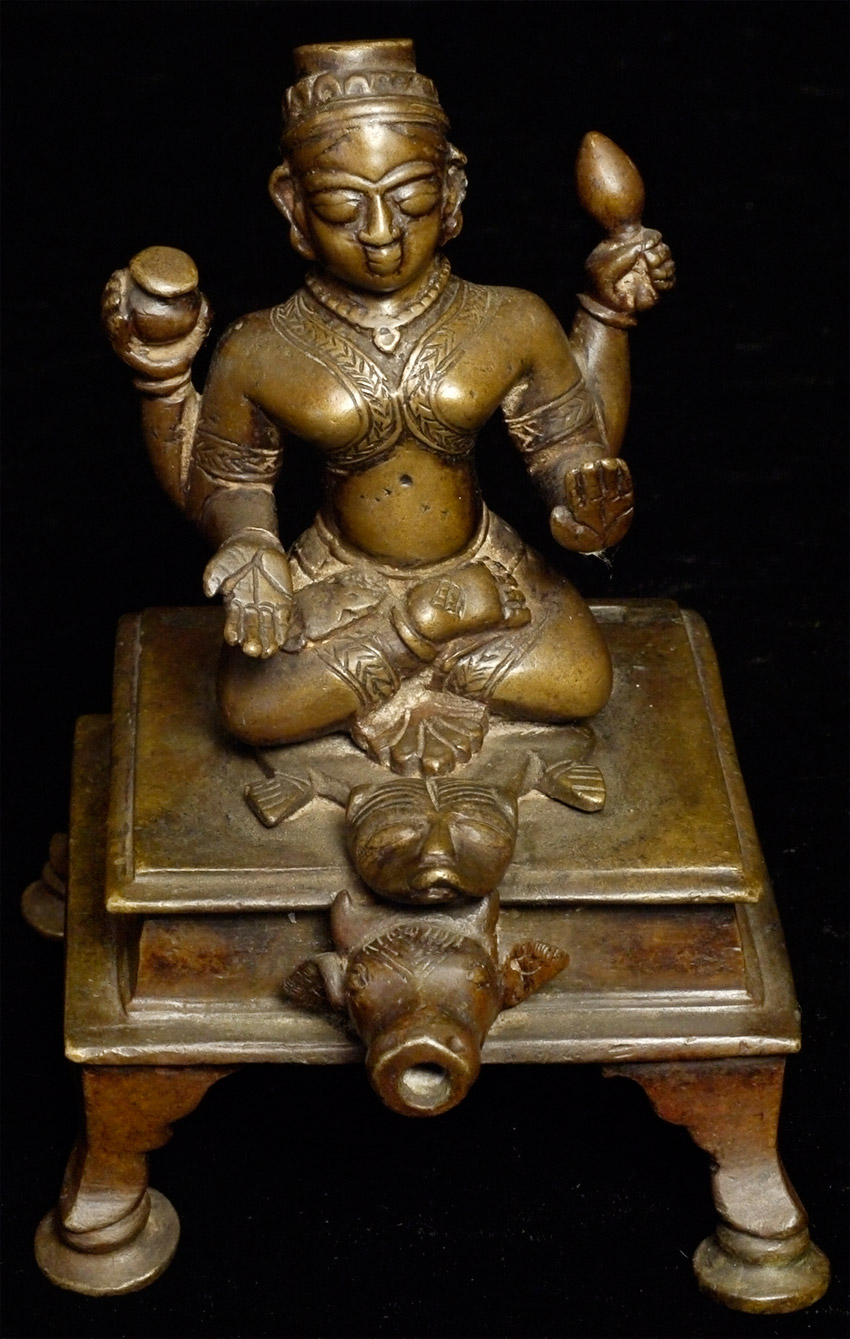
This is Ganga, personified river Ganges, sitting on her vahana, Makara (sea monster). The pedestal has a bull’s head at the front.
The Ganges is the holiest of holy rivers in Hindu belief. Hindus bathe in the Ganges to absolve themselves of their sins and, more importantly, liberate themselves from the cycle of life and death. Let me get back to iconography.
In her upper hands, she is carrying a pot, which represents abundant life, and a lotus, a sign of purity. Her lower hands are in Varada and Abhaya (giving and protection) mudras.
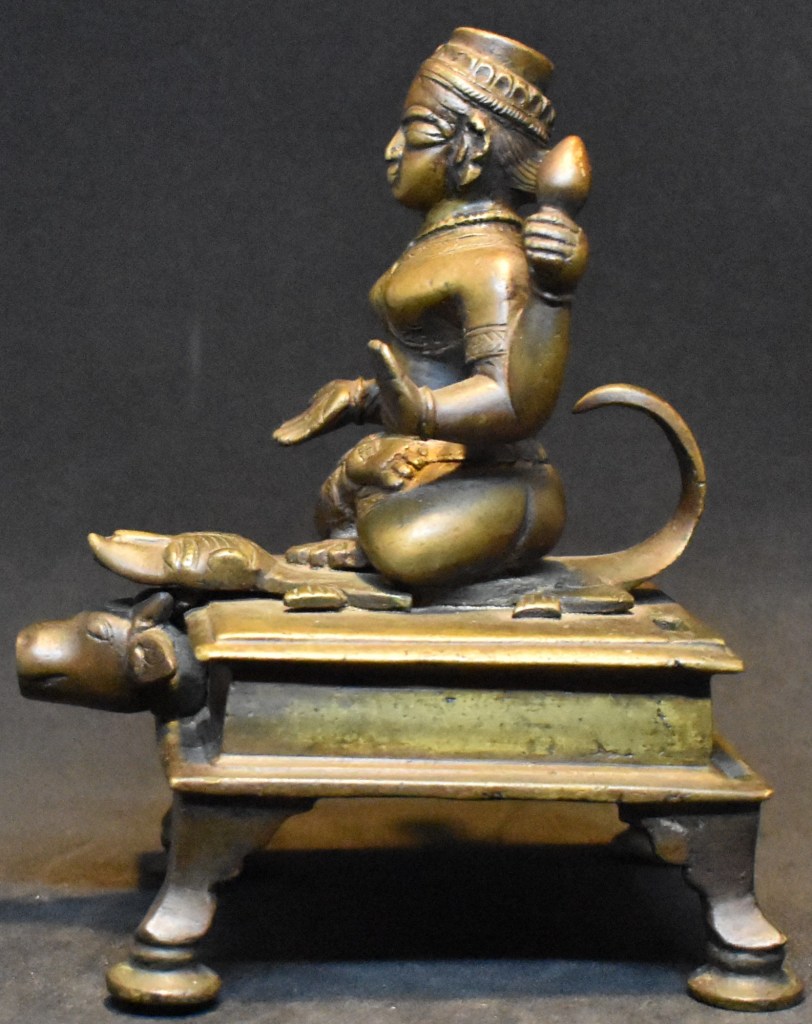
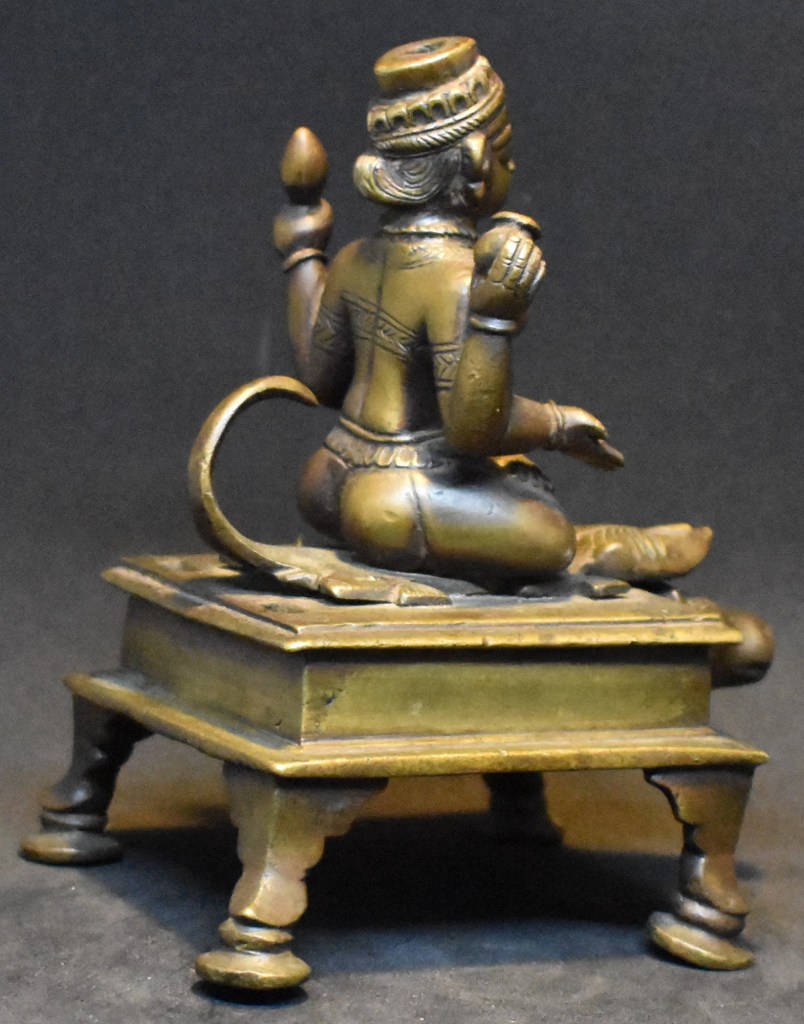
She is sitting on makara, a hybrid creature having the body of a crocodile and the tail of a fish. The makara is also the vehicle of the Vedic god of waters, Varuna, thus establishing Ganga’s Vedic roots.
It is not unusual to encounter images of Ganga and Yamuna (a tributary of Ganga) flanking the doorway of a Hindu temple. Entering a temple through the jamb decorated with sculptures of these goddesses is believed to cleanse the devotees.
This bronze is about 12.7 cm tall. I have no clue where in India this bronze is from. Maybe from Bengal.
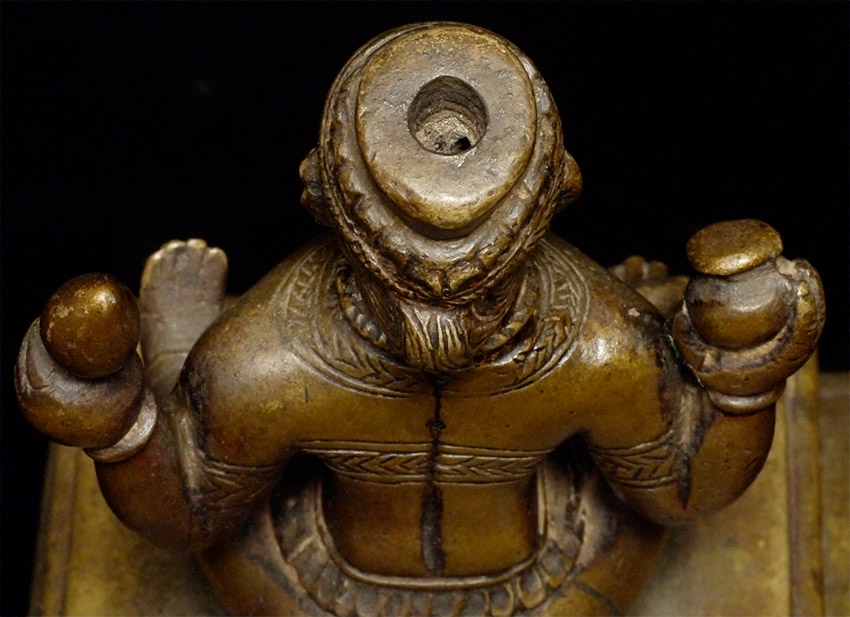
One interesting aspect of this bronze is that liquid poured through the hole in the head (see the photo at the bottom) comes out from the bull’s mouth. Ganga is worshipped on her own, but this icon may have been used in the worship of other deities, most probably Siva.
One of the readers pointed out that the top opening has a screw fitting. The bull’s mouth seems to be designed for a stopper. And this bronze may have been used to carry or hold Ganga water. It is not unusual to keep Ganga water in the home altar.
 Bronzes of India - A personal collection