
This goblet is about 14 cm tall and features Mahadeva and Nataraja (on the other side).
It is an assembled piece, involving at least four parts. The two halves of the goblet, the stem including the bottom of the goblet and the base. You can see the welding joints as whoever made it did not take the trouble to hide the joints.
Silver dinning table accessories featuring Hindu Deities were popular among the Britishers in India during the late nineteenth century to the early twentieth century. They were known as ‘Swami (God) silver’.
But why the depiction of Hindu deities on dinnerware? May be to bless the food and protect diners from ‘Delhi belly’.
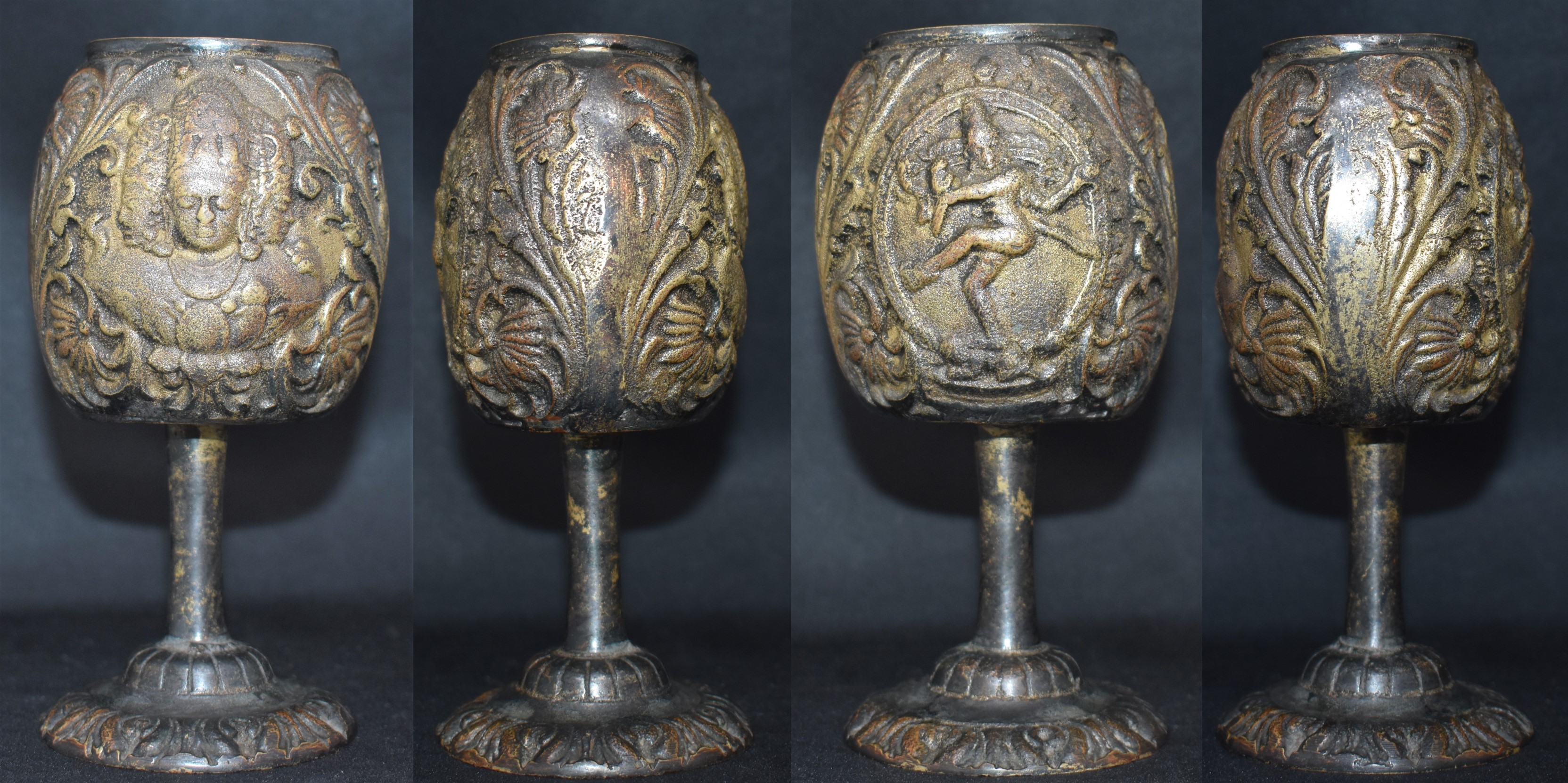
I can not imagine a practicing Hindu buying and using such goblets for serving drinks. And that is what prompted me to buy and preserve it as an example of what they did with my deities. This blog site has an example of deities being depicted as chess pieces.
When I was discussing with one of the collector friends, he mentioned that he has seen one such goblet before. It was presented as a memento in the 1970s in some function in Mumbai. May be a colonial hangover.
A quick search on the Internet did not show any bronze goblets, featuring ‘Swamis’, for sale. That perhaps shows the changing attitude towards the depiction of deities on ‘everyday’ items.
Another thing that caught my attention is the depiction of Mahadeva. I compared it with Mahadeva of the Elephanta caves. It is obvious as to where the inspiration came from. Elephanta photo courtesy smarthistory.org.

The alloy is more like bell metal, copper alloy with higher tin content when compared to bronze. The goblet, when struck the goblet makes a pleasing sound.
Well, this is not an antique nor a well made Vigraha nor a great example of craftsmanship. Why did I add it to my blog site? It is a cultural artifact, has its history and a part document of our changing (?) attitudes towards the deities.
 Bronzes of India - A personal collection