
When I bought this a few years ago, it was with the impression that the bronze represents Krishna as a baby, his foster mother Yasodha and his foster-father Nanda. Yasodha and Nanda are holding a lotus each in their hands, an attempt to deify them, as this bronze was made for worship. So far, I have not come across similar bronzes or seen any literature on this type of bronze.

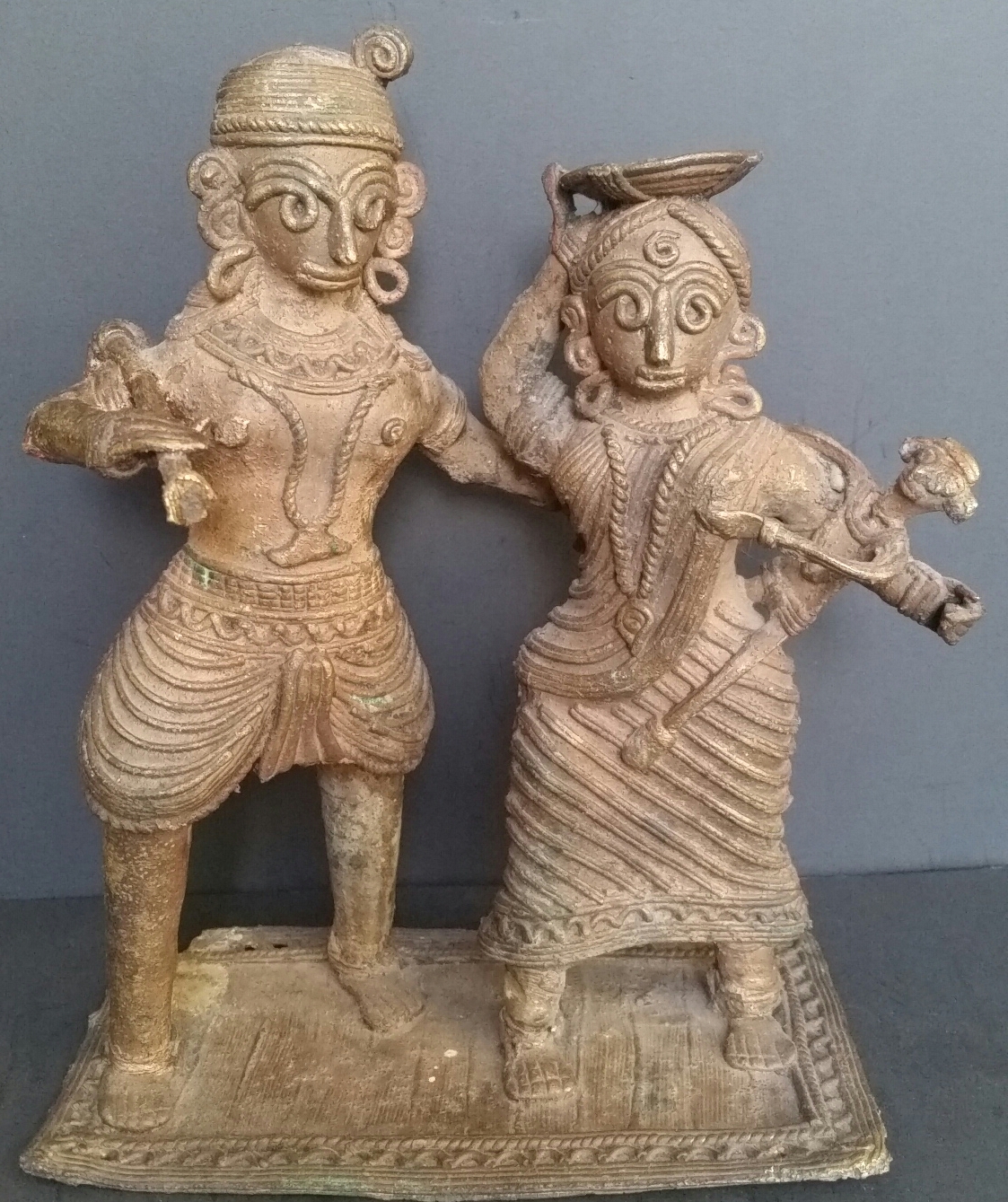
The only similar image I have seen is a tribal bronze, shown at the bottom of this blog, also in my collection. In that bronze, the posture and the attributes make it clear that the main figures are from the farming community. There is no attempt to deify them. However, given Indian tradition, it will not stop believers from worshipping that bronze as well.
Comparable images exist in Buddhism and in Jainism. Both references are from the LA County Museum of Art. The first one, relating to Buddhism, shows Panckika and Hariti and is from the Gandhara region. The second one, relating to Jainism, represents the parents of a Jina and is from Uttar Pradesh. Despite the differences in the medium and age, the similarity is to be noted.
The hair arrangement, a pinched bun, of the child is typical of Krishna. Hence, the identification as Krishna, Yasodha and Nanda.
The peethas/pedestals, Padmapeetha and Bhadrapeetha, of this icon are common in bronzes from South India. The hair arrangement of Nanda and Yasodha is typical of South India. The work is folkish in nature.
The bronze is about 6.5 cm in height and 8 cm in length. There is a considerable bronze loss without corresponding wear. There is some patina. In the absence of comparable bronzes and with inconsistent tell-tale signs, it is difficult to estimate the age. Still remains a delight.
 Bronzes of India - A personal collection