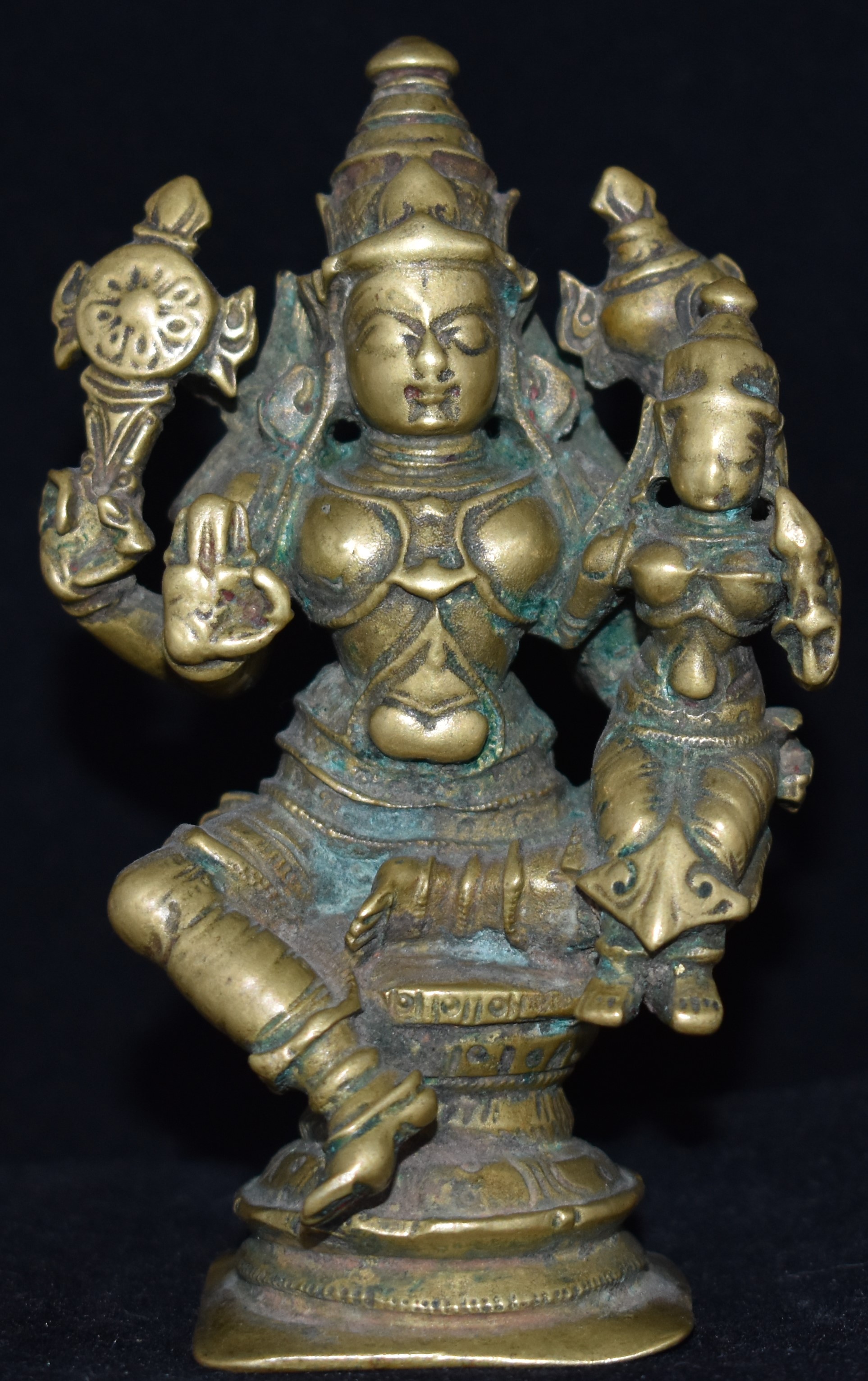
Images such as the one above, Vishnu with Lakshmi seated on his left lap, Lakshminarayana, are frequently seen. Lakshmi is the inseparable energy of Vishnu. Vishnu has a mark in his chest, Srivatsa, indicating Lakshmi’s residence in him. This icon does have that mark on the right chest, and it is not visible here. Even when Vishnu is alone, he is not.
Vishnu is seated in Lalitasana, at ease with his right leg hanging down, with Lakshmi seated on his left thigh. Vishnu is holding his attributes discuss and conch (Chakra and Shankha) in his upper hands. The lower right hand is the gesture of protection, and his left hand is holding Lakshmi. In her left hand, Lakshmi is holding a lotus. Lakshmi herself is known as the lotus (Padma). Lakshmi’s right hand is holding Vishnu.
Normally, Vishnu is shown with two consorts, Lakshmi/Sri and Bhu (in South India) or Saraswati (in Bengal/Bihar). When he is shown with one consort, it is always, at least in South India, Lakshmi, as in the image above. When Vishnu is shown with two consorts, Lakshmi is always on Vishnu’s right, in the preferred position.
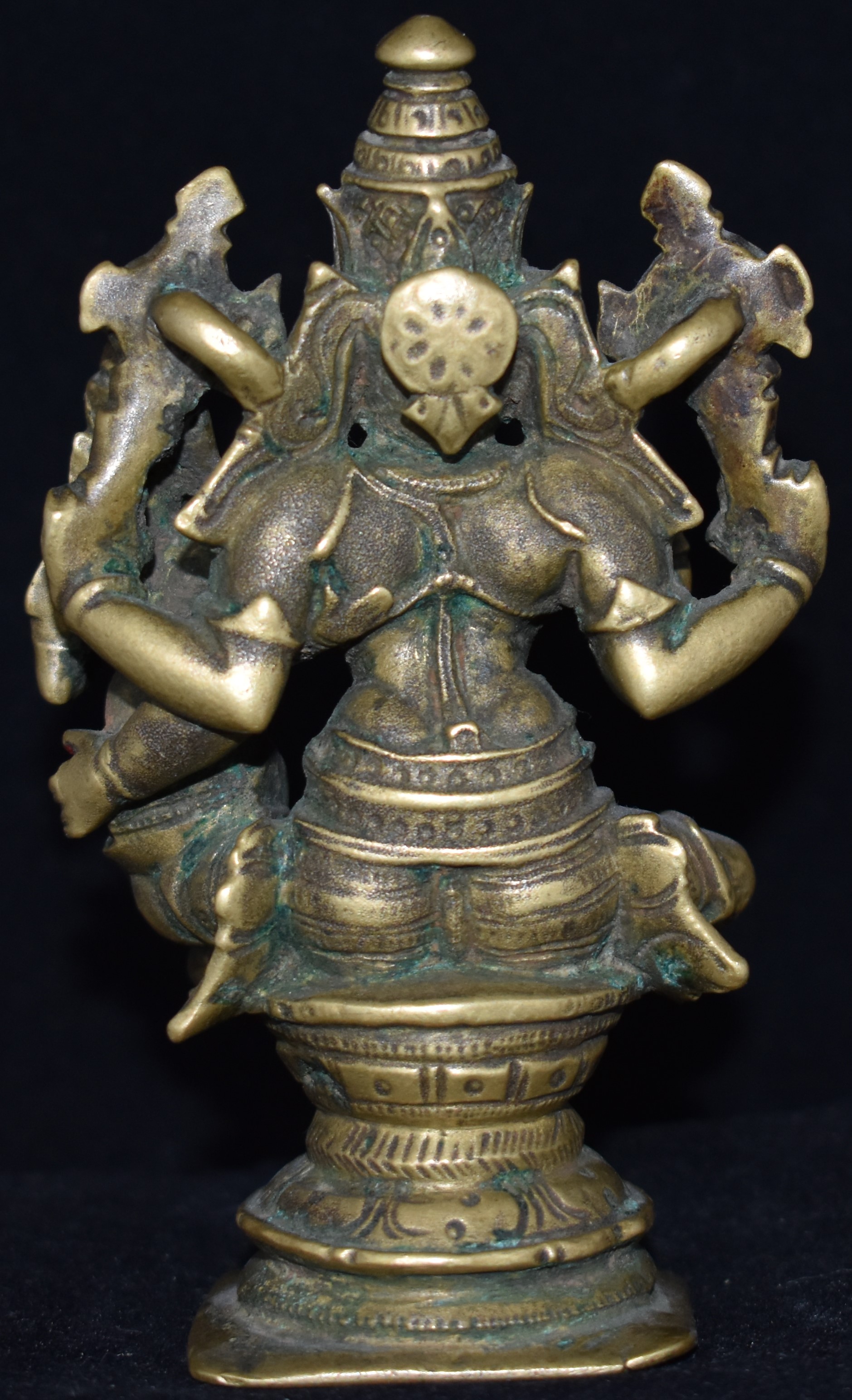
This icon is probably from Karnataka, as suggested by the use of brass and retention of spurning, visible from the back. One of the unusual aspects is Lakshmi’s saree (lower garment), the way the lower part spreads out in front. One such example, spread out lower garment (Umamaheshwara from North Kanara, dating to the 14th century)) is published in Dr Gururaja Bhatt’s book Studies in Tuluva History and Culture (Plate 92, fig a).
This icon is about 11 cm in height. Icons of this size are normally used for worship at home.
There is noticeable ritual wear. The above book by Dr Gururaja Bhatt has a similar example (Plate 196, Fig d) and it is dated 15th century. Due to the significant ritual wear in the above example, I would date it to 16-17th century.
 Bronzes of India - A personal collection