 The central figure is Manasa, the snake Goddess. This piece is a part of a ritual ewer. Manasa is the Goddess who guaranteed her
 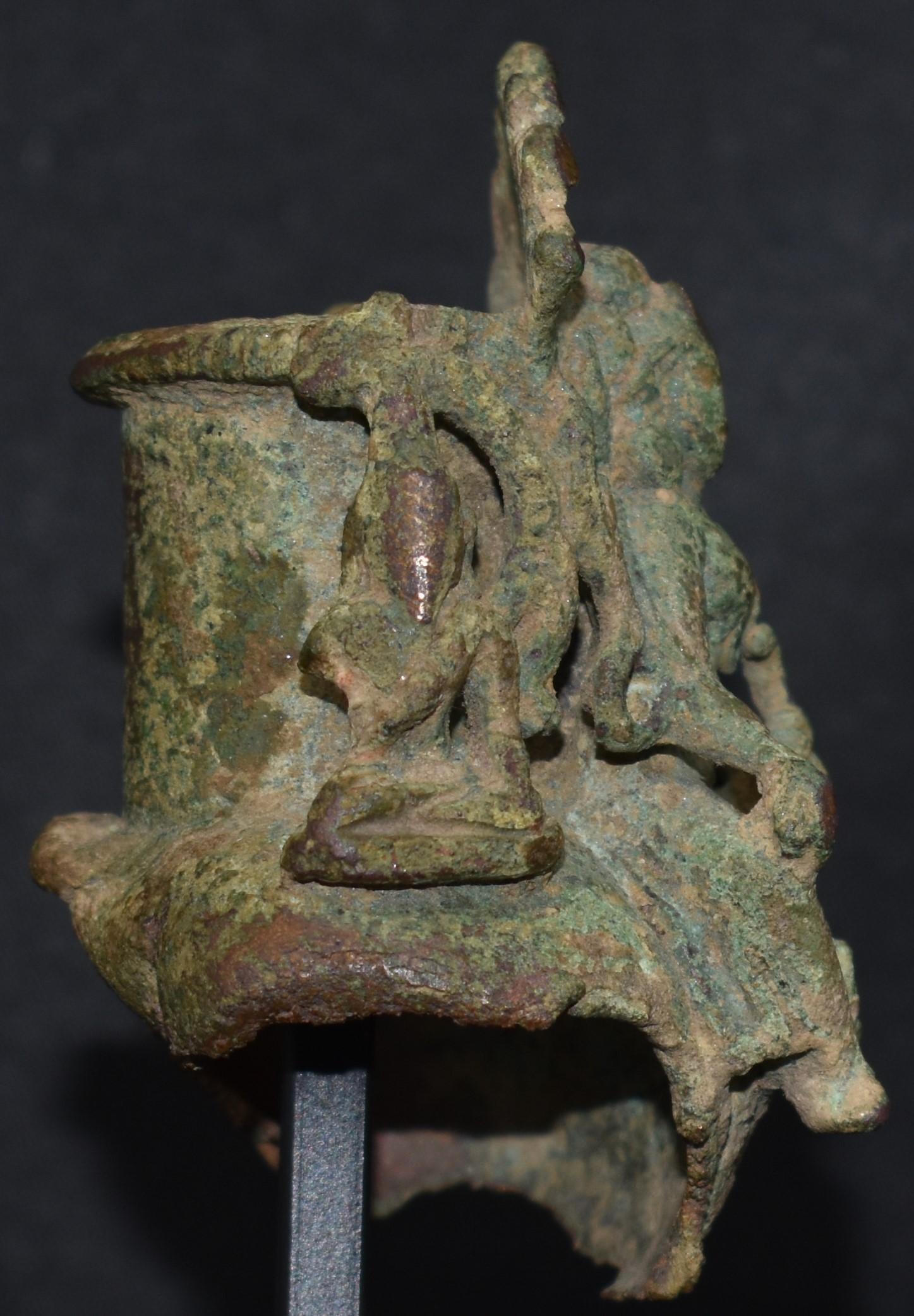 devotees ‘health and prosperity, sons and grandsons and immunity from snake-bites.
Manasa is framed by a seven-hooded snake, emphasising her position in the snake-worshipping cult. Manasa is holding a snake in her left hand, and her right hand holds a round object, possibly a fruit. Her right leg is pendent, and she is sitting on the spout of the ewer. On Manasa’s right is the branch of the Snuhi tree.
 On her right is her consort Jaratkaru (lit: one who dried up a fine figure), emaciated and bearded ascetic with a yogapatta around his legs. Jaratkaru’s right arm is missing.
On Manasa’s left is her son, Astika and he is sitting in Rajalalithasana.
But for the spout, mouth and a little bit of the body, the rest of the ewer is now lost. For a picture of a complete Manasa ewer, refer to the one in the Met Museum. One of the pictures from their site is reproduced here.
Manasa is, possibly, a late entrant to the Hindu Pantheon, and her worship in Bengal has been traced to the 10th century of common era.
This vigraha, despite having been buried for a very long time, has retained its features. It is about 7 cm in height as it is. The full ewer will be about 16 cm in height. Amazing details for its size. This vigraha may be dated to the 10th-11th century. 
References:
Nalini Bhattasali 2008 (Reprint) Iconography of Buddhist and Brahmanical sculptures in the Dacca Museum
Enamul Haque 1992 Bengal Sculptures Hindu Iconography up to C 1250 AD
Martin Lerner & Steven Kossak 1991 The Lotus Transcendent Indian and Southeast Asian Art from the Samuel Eilenburg Collection
 Bronzes of India - A personal collection