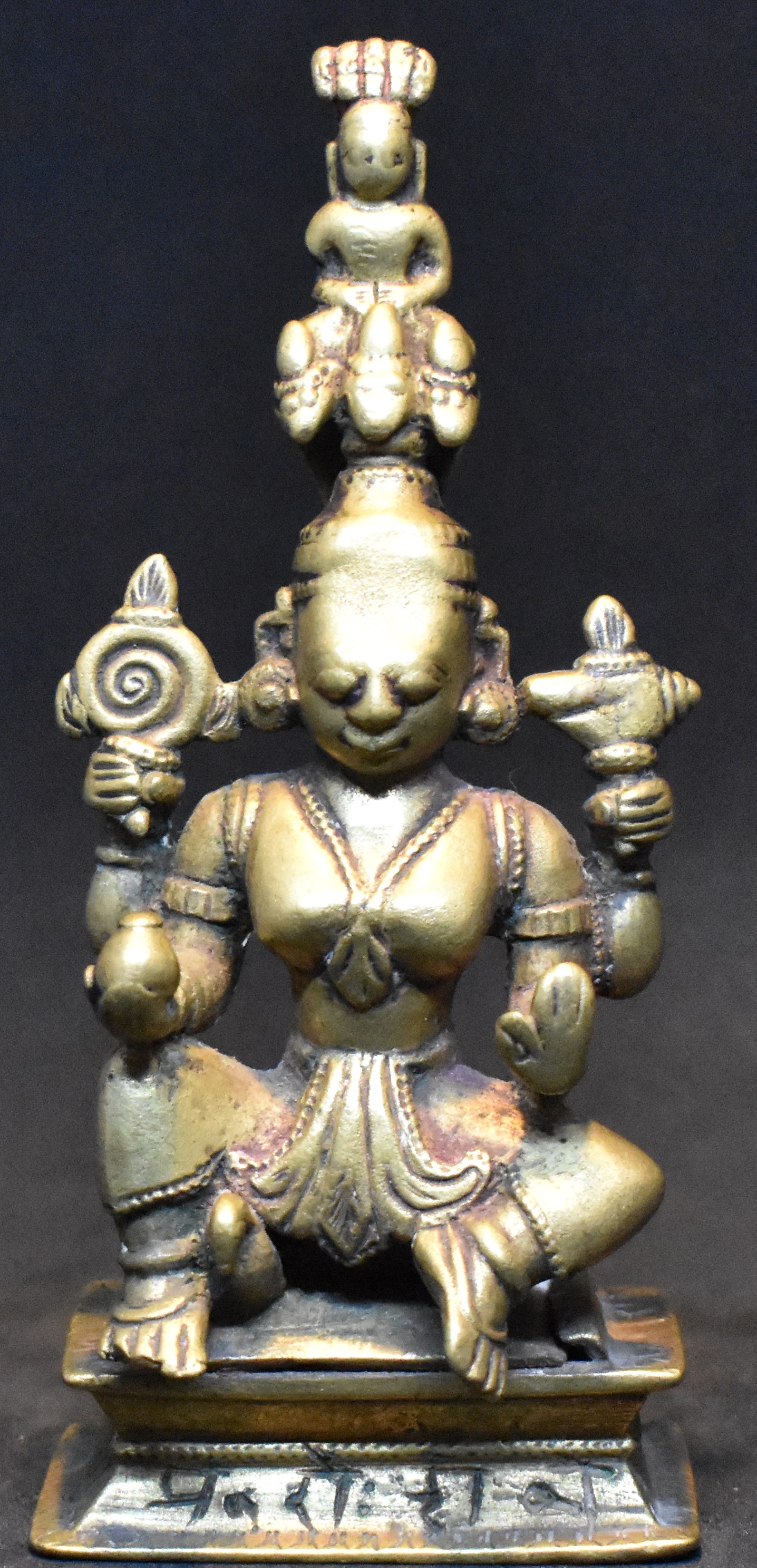
This is a Jain image of Padmavati, and she is one of the most worshipped Jaina goddesses. Here, Padmavati is shown with four hands. She is holding a container or fruit, a wheel/noose and a goad in her hands, clockwise starting from her lower right hand. Her lower left hand is in Abhaya mudra. Padmavati is identified by a canopy of a hooded snake upon her crown.

Padmavati is the Sasanadevata, female messenger of Thirthankara, of Parsvanatha, the twenty-third Tirthankara of the Jains. Sasana Devatas normally have their Thirthankara shown along with them, as it is the case here. Note the small Jain image sitting on the hood of a three-hooded snake. Parsvanatha is also identified by his association with a snake, and in this example, a five-hooded snake is providing the canopy.
The main image is fixed back-to-front on the pedestal. There are inscriptions on all four sides, one of the typical characteristics of Jain sculptures.
This bronze is about 12.5 cm in height and is quite worn from rituals of worship. This may be from Gujarat, Western India and the inscriptions (including some Gujarati numerals, see the photo of the back) should help in deciding the age. As Jains follow more than one era, deciding the age is one for the experts.
Manasa, the snake goddess, is considered to be Padmavati’s counterpart in the Hindu religion. Manasa is also known as Padmavati.
Just to make it more interesting, Padmavati is the name of Lakshmi, seated in lotus posture as she emerged from the ocean, when it was churned by the gods and demons for the sake of ambrosia.
This is one of the very few Jain bronzes I have, and my awareness of Jain bronzes is very low. For this blog, I depended heavily on Pratima Kosha by S K Ramachandra Rao.


 Bronzes of India - A personal collection