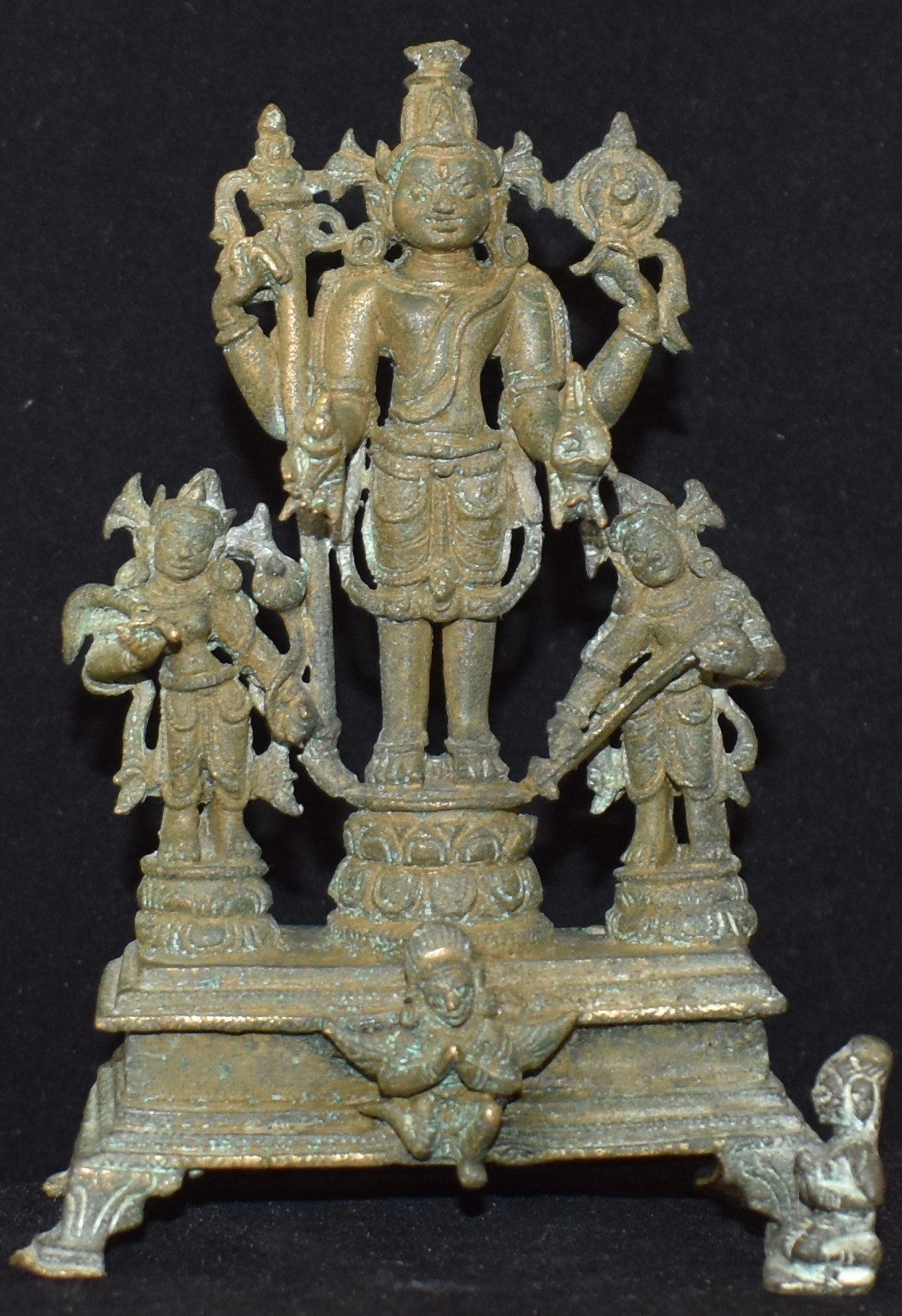
The above is a typical representation of Vishnu and his consorts in Bengal (including current Bangladesh) and Bihar areas during the Pala regime. The Pala kingdom ruled that region between the tenth and twelfth centuries. Several bronzes and stone sculptures of this form exist.
Here, Vishnu is holding a lotus, mace, discus, and conch in his hands. Starting from the lower right-hand in a clockwise direction. This form of Vishnu, based on the order in which he is holding the attributes, is called Trivikrama. This classification is as per Agni Purana. (Pratapaditya pal, Indian sculptures Volume II) . This name is not to be confused with one of the avatars of Vishnu, Vamana or Trivikrama. This composition is one of the most common forms in Bengal during the Pala period.
Vishnu is standing on a double inverted lotus. Vishnu is flanked by his consorts. Lakshmi is on his right, holding Chamara and a lotus. Saraswati, on his left hand, is holding a lute. Lakshmi and Saraswati are also standing on a double inverted lotus.
Vishnu is standing in Samapada (no bending). A typical position for Vishnu, virtually a Pan-Indian feature. Postures of his avatars are a different story. Lakshmi and Saraswati are standing in the Tribanga pose.
Below the lotus base, attached to the rectangular base, is Garuda, Vishnu’s vahana, with his hands in Anjali mudra. At the bottom edge of the base is a human figure with hands in Anjali mudra. Presumably, the donor is in perpetual prayer.
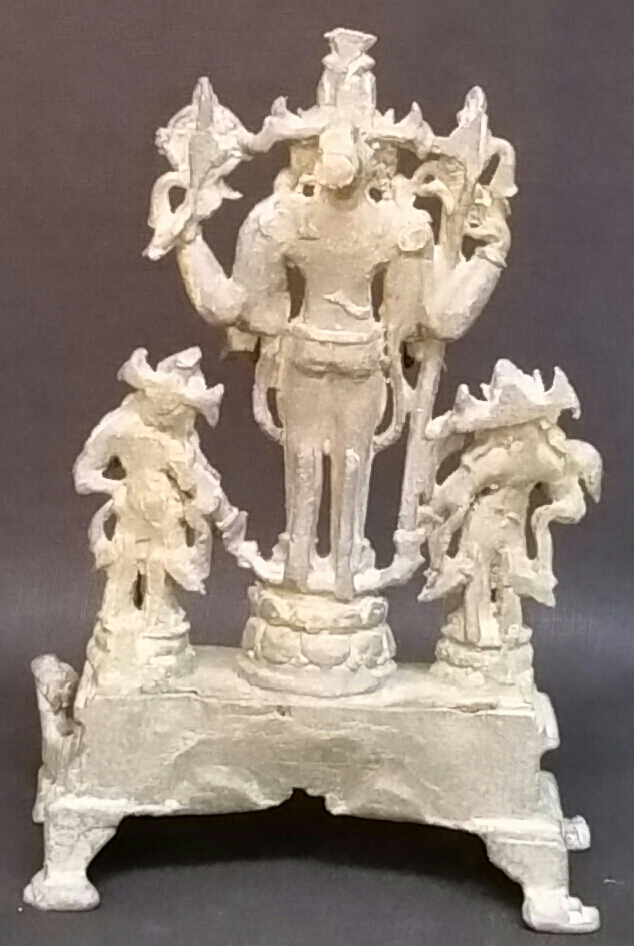
Unlike most of the bronzes from South India, here the bronze is assembled and not cast as a single piece. The back view shows that. Another difference is that the back is not worked on, as normally devotees do not see the back.
This bronze has lost the prabhavali. Its height is 11.5 cm. This may date to the 11th century.
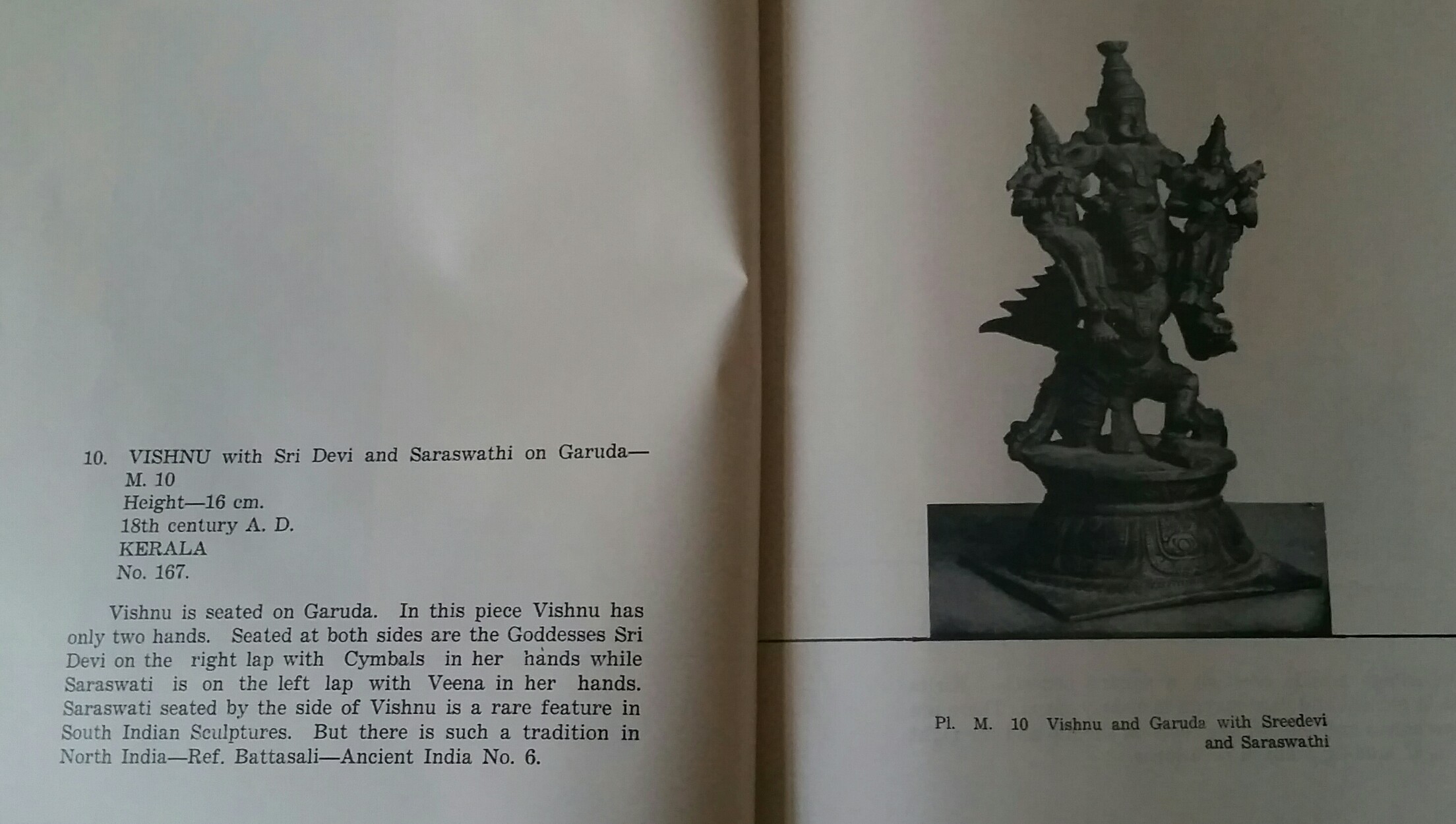
18 Aug 2018: Have come across a reference to one example of Vishnu with Sri Devi and Saraswati. The photo below is from the book ‘Catalogue of selected bronzes, wood carvings and stone sculptures – Art Museum Trivandrum’.
 Bronzes of India - A personal collection