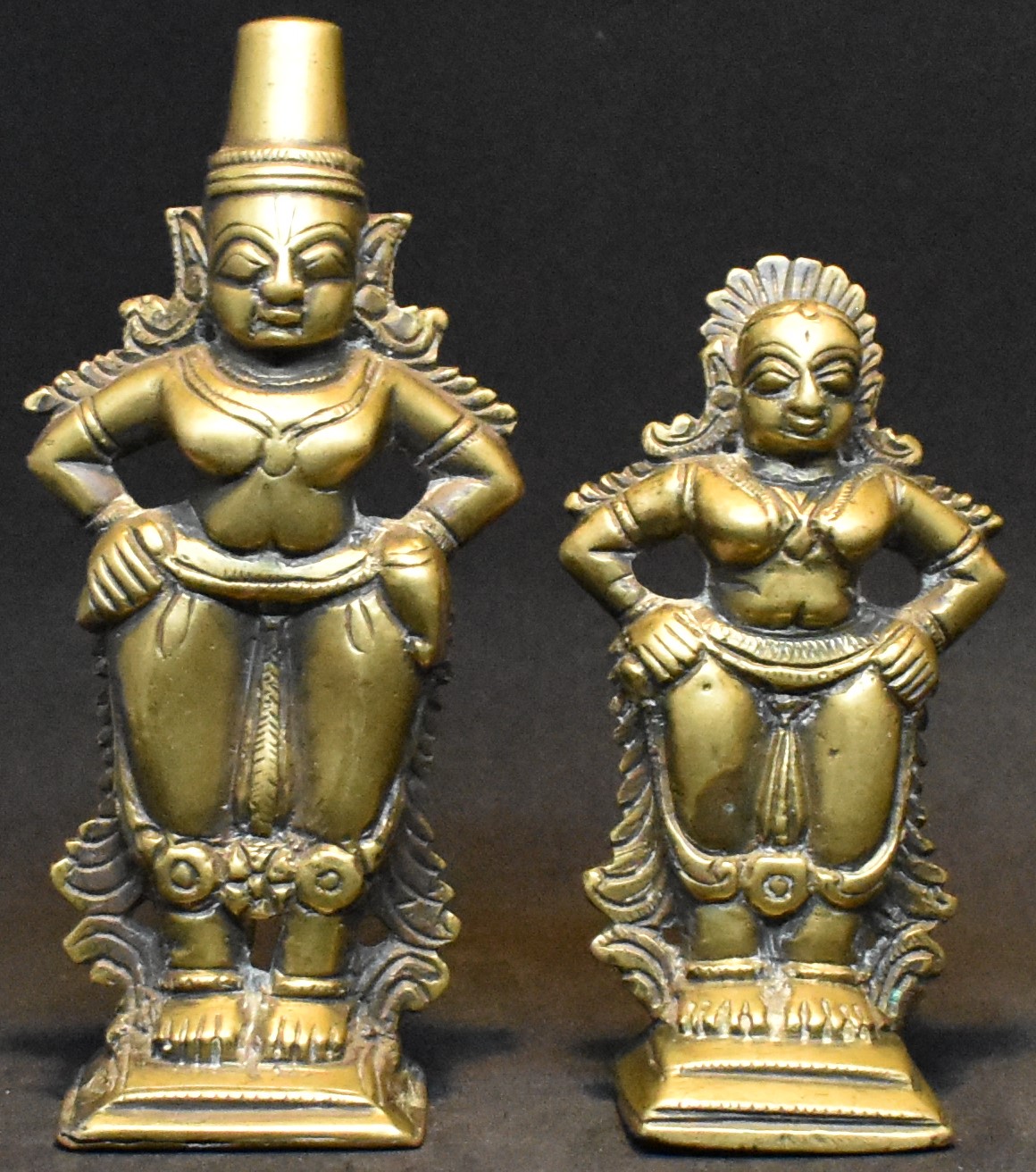
This is Panduranga and Rukmini from Pandharpur. Panduranga is a minor incarnation of Krishna, and his worship is centred around Pandharpur. He is also known as Vitthala or Vithoba.
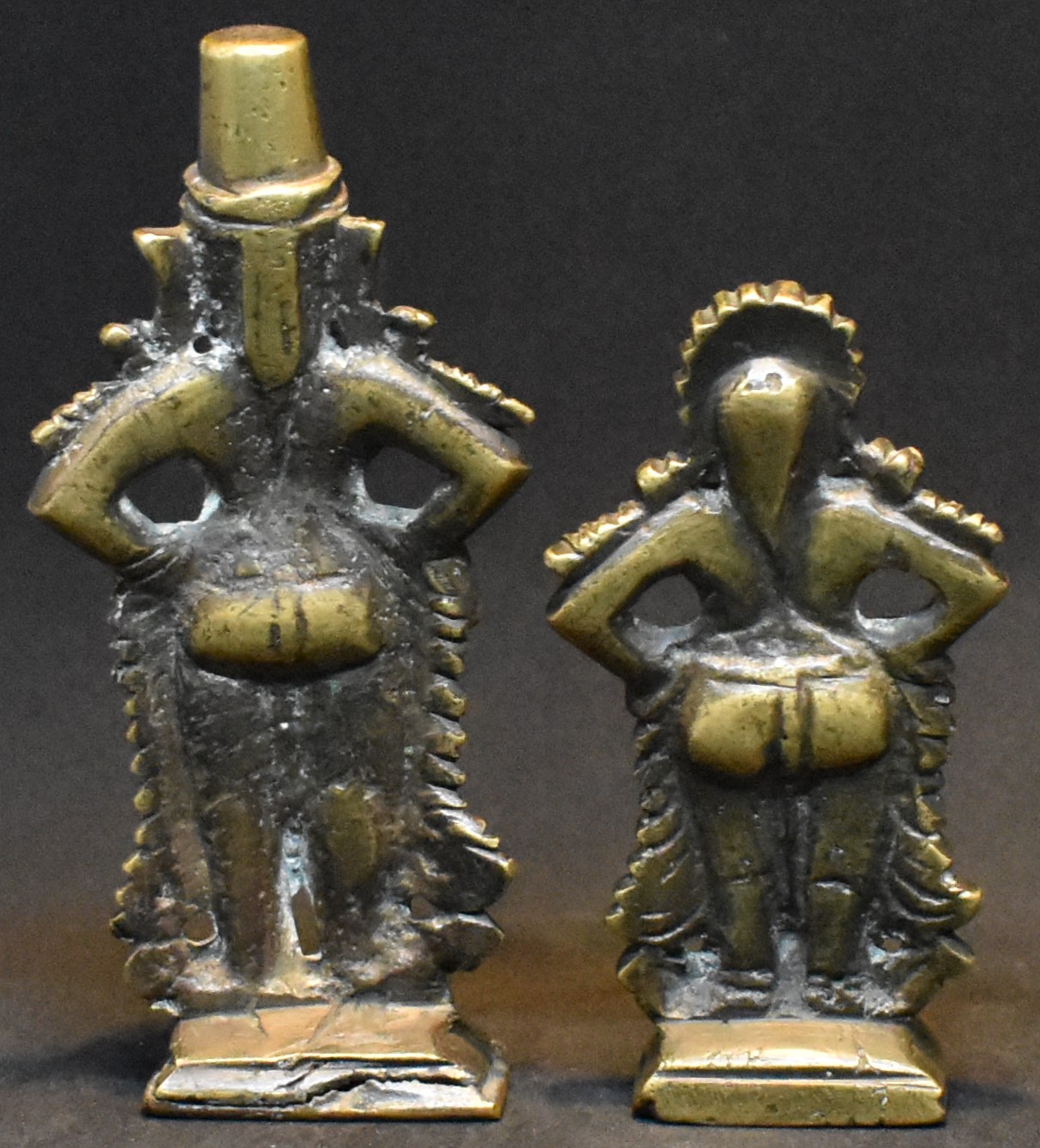
The myth has it that Krishna went to meet Pundalik in Pandharpur to acknowledge Pundalik’s devotion to his parents. Pundalik was busy taking care of his parents and gave Krishna a brick to stand on as an asana (seat) till Pundalik is freed up. When Krishna asked his as to boon Pundalik wanted, Pundalik asked for the eternal presence of God at the spot. And that was aeons ago.
Panduranga is two-armed, with the left hand holding a conch (shankha) and the right hand holding a lotus stem. He is wearing large Makarakundala in his ears and a flat-topped crown. He is also wearing a long garland, Vanamala, typically worn by Vishnu.
Rukmini, Panduranga’s consort, is also standing with her hands on hips and is dressed like a Marathi lady.
The temple in Pandharpur has separate shrines for other consorts, Radha and Satyabhama.
Panduranga/Vitthala is the reigning deity of Maharashtra, similar to the position Durga holds in Bengal. Vitthala’s Bhakti cult (devotion as opposed to ritual) has few parallels.
According to Temples and Legends of Maharashtra by M S Mate, the presence of the deity in Pandharpur was never continuous. He has been removed a few times. Once by Vijayanagar ruler Krishnadeva Raya, of the Vijayanagar dynasty, to be installed in the Vittala temple, once to protect it from invaders, and twice it was stolen and held in ransom by private individuals (recorded incidents).
Unlike Vithoba bronzes (to be published soon), Panduranga/Rukmini bronzes retain the folk qualities.
These bronzes are about 11 cm and 8.5 cm in height. Unlike typical bronzes from this region, Deccan and further south, the back is not worked on. They are made for personal worship. They may date to the early twentieth century.
 Bronzes of India - A personal collection