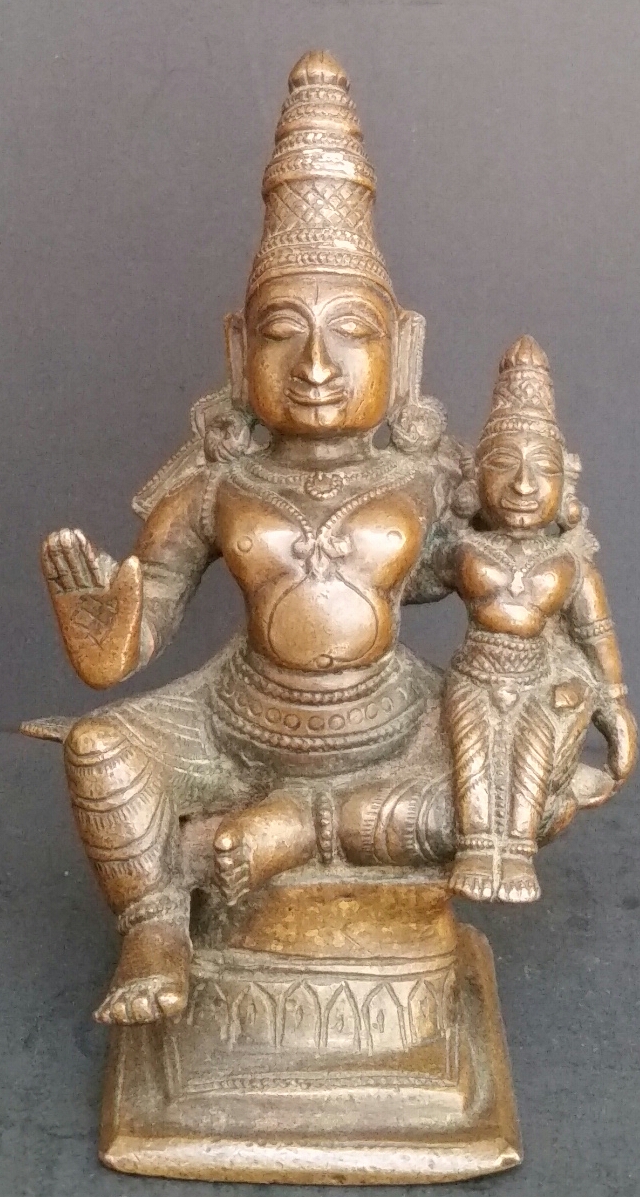
This bronze is Rama with his consort Sita. His right hand is in abhaya mudra (protection).

Rama’s forehead shows a vertical religious mark, specific to Vaishnavites. As Rama is an incarnation of Vishnu, his wearing the Vaishnavite symbol on his forehead is to be expected. In this incarnation, Rama was born as a human being without the awareness of his divine origin. Hence, the absence of additional arms and the attributes that characterise Vishnu. Sirachakra, see the image of the back, is possibly the only indication of divine nature.
Rama is seated in lalitasana, and Sita is sitting with both her legs pendant. The ornamentation, as usual, is profuse. and fit enough for a king.
The tall crown and facial features, especially Sita, are typical of bronzes from Telugu speaking region. Compared to neighbouring regions, Karnataka, Maharashtra and Tamil Nadu, bronzes from the Andhra/Telugu-speaking region are rarer.
Patina is deep. There are signs of worship, but the wear is not significant.
The shape of Rama’s lower back is quite unusual.
This bronze is 9.5 cm in height, and it may be 19th-century or later.
 Bronzes of India - A personal collection