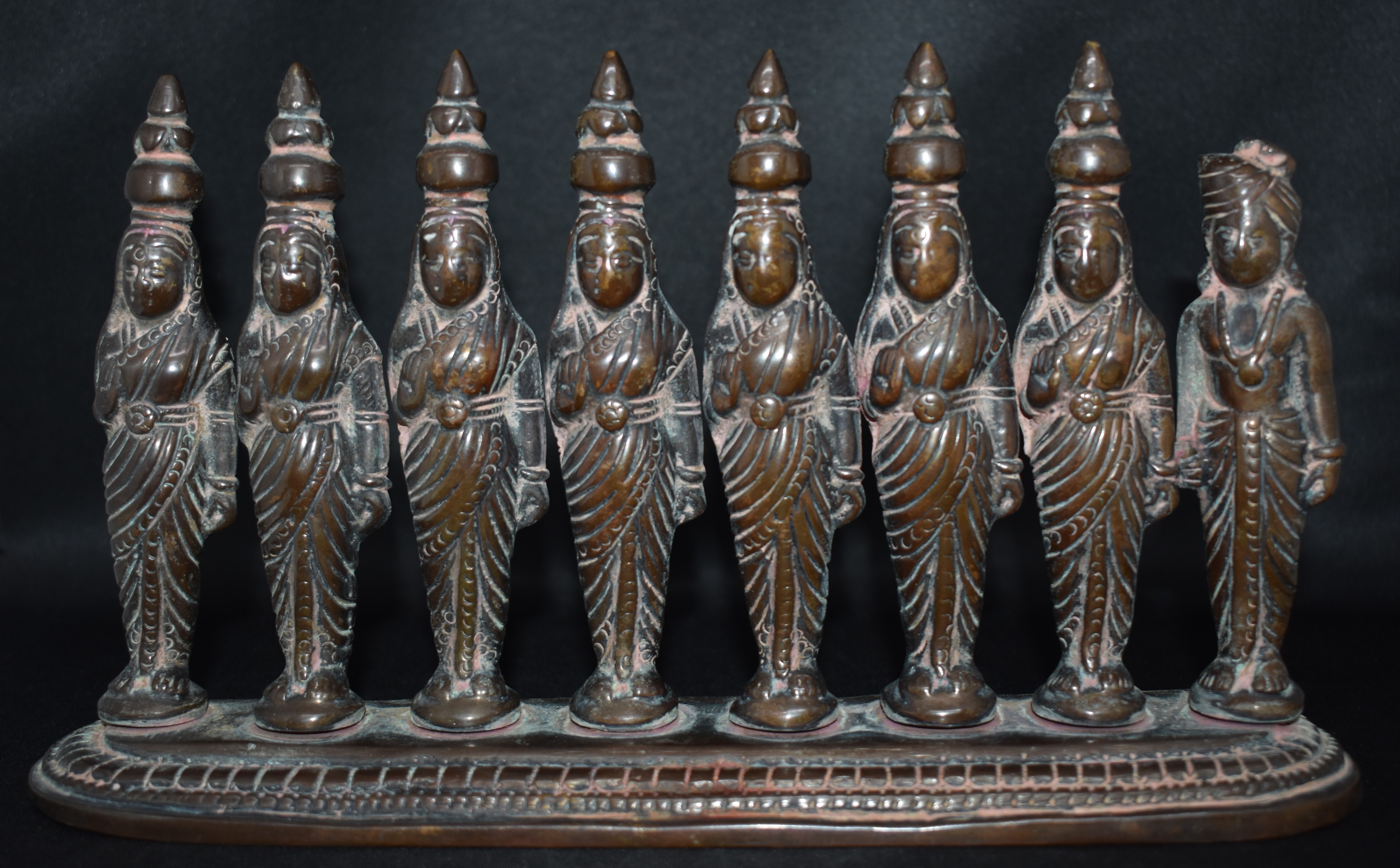
15 Dec 2024: Quite a few readers got back to say this is a depiction of the Seven River Goddesses and their brother. Worship of the seven river Goddesses is prevalent in Maharashtra and the Konkan region. I will update this blog after some research.
Original blog: This group of seven Goddesses is Saptamatrika (Seven Mothers). The eighth figure is Bhairava. The concept of worshipping a group of goddesses dates back to the Mahabharata period. This concept probably evolved from village goddess cults central to folk and tribal tradition.
The Mahabharata refers to the Matrika as dangerous and associates them with non-Brahminic deities. In the medieval period, they got their male counterparts and assumed a more protective nature. In between, they were associated with Durga and were part of Durga’s retinue in defeating demons.
The number of goddesses also changed over a period four, seven, eight and sixteen being the common numbers. Somewhere, if only time can tell the story, the number was standardised to seven and they are now known as Saptamatrikas (seven mothers).
Their names also changed over space. For example, they are referred to as Sapta Kanniga (Seven Maidens) in Tamil Nadu, Sat Bahini (Seven Sisters) in Madhya Pradesh, Sata Asara ((Seven Water Nymphs) in Maharashtra and SaptaMatrikas (Seven Mothers) Pan-India.
The most commonly accepted names of the Saptamatrikas and their male counterpart (in brackets) are Brahmani (Brahma), Maheshwari (Siva), Kaumari (Kartikeya), Vaishnavi (Vishnu), Varahi (Varaha), Narasimha (Narasimha) and Aindri/Indrani (Indra).
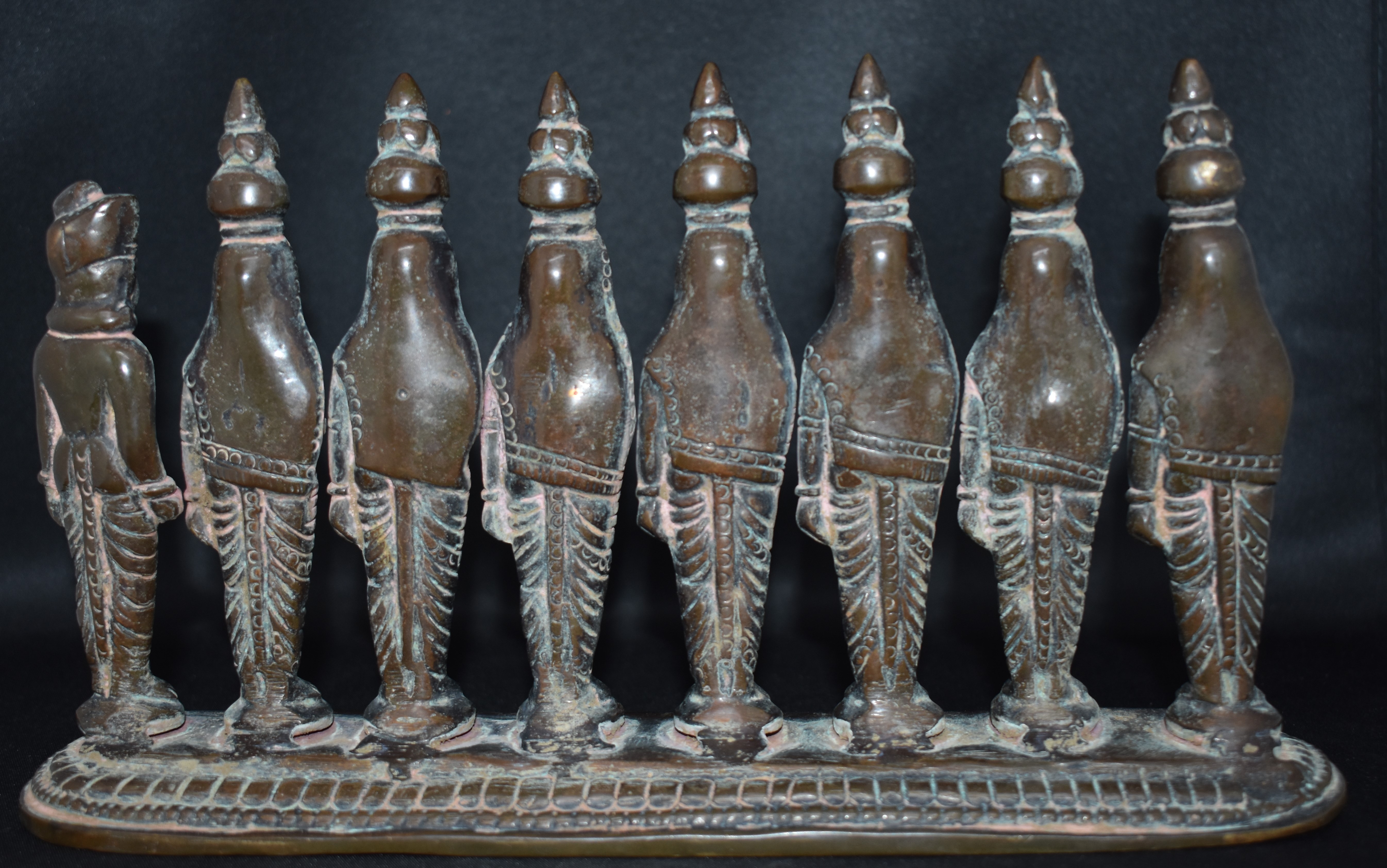
Mahabharata, Natya Sastra, Devi Mahatmya, Devi Bhagrata Purana, Matsya Purana, Varaha Purana, Vishnu Dharmottara have references to Matrika’s. Despite carrying ‘mother’ in their names, they continue to be associated with vices or inauspicious emotions according to Varaha Purana.
This bronze is from the twentieth century. It is from Central India/Maharashtra. It is about 14.5 cm in height and 24 cm in length. All the pieces are individually cast and attached to the base. The male figure on our right side is likely to represent Bhairava. Sometimes the Matrika’s are shown with Ganesha. This bronze shows signs of worship.
 Bronzes of India - A personal collection