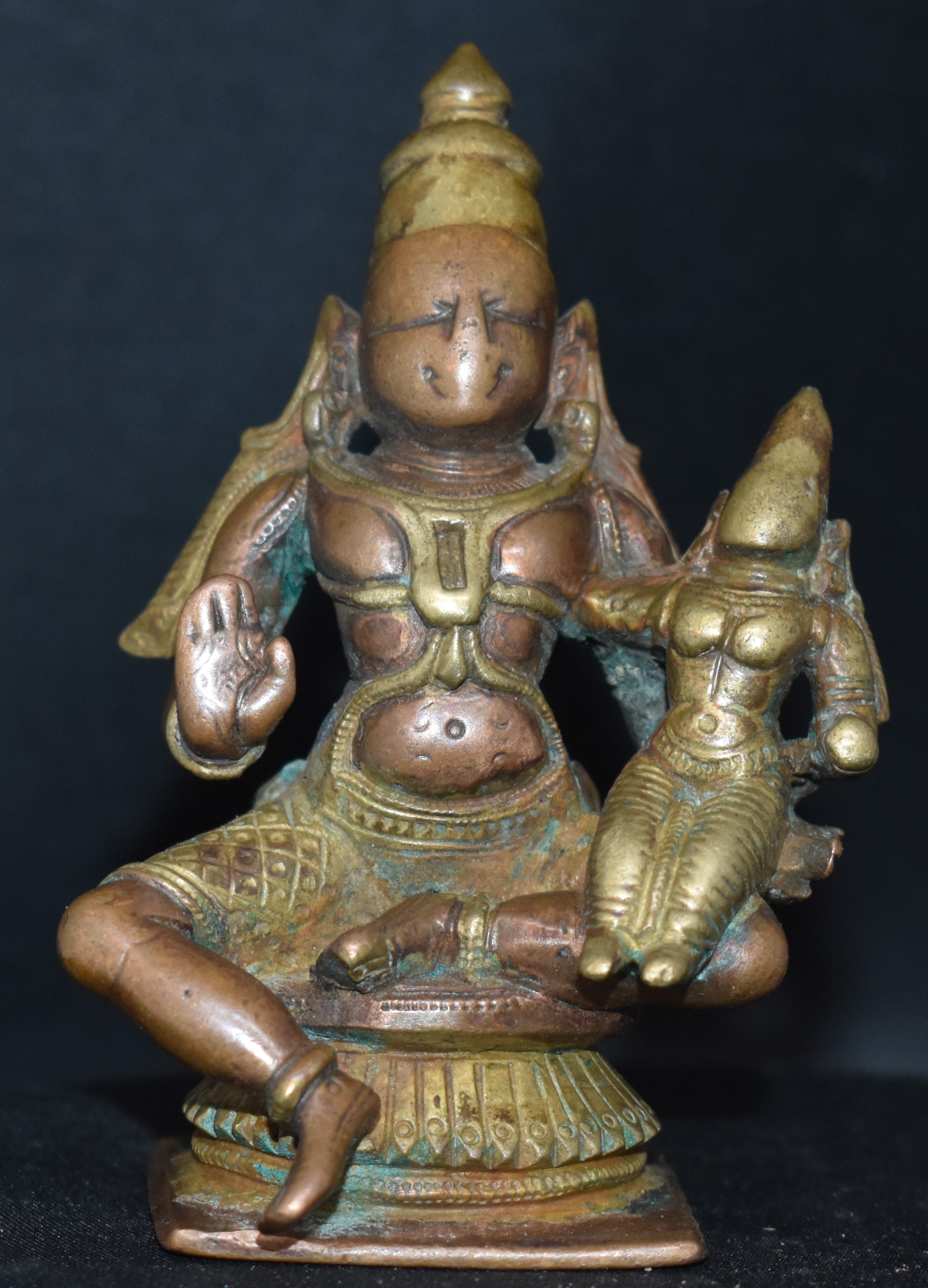
This is Rama and Sita. The identification is by elimination. Most Hindu male gods are portrayed with four arms and only Rama is often shown with two hands.
For more details on this iconography please refer to Rama Sita on this site.
This bronze is made using the Ganga Jamuna technique. North Karnataka is possibly the only region where that technique was practised at that time (18th -19th century)

The base suggests this would have been made to slide into a pedestal and it is possible this was a part of Ram Durbar set. For an example of such a set refer to the V&A museum. That set is listed under Vishnu and Lakshmi (?).
Going by the wear, Sita’s face, lower garment and the crowns, this may date to the eighteenth century. Most of Ganga Jamuna bronzes date to the eighteenth/nineteenth century.
The bronze is solid cast and quite heavy. It is about 8 cm in height and comes from Northern Karnataka /Southern Maharashtra.
Note: The damage to Sita’s hand is noted. The need to preserve the Ganga Jamuna examples weighs in favour of buying such vigrahas.
 Bronzes of India - A personal collection