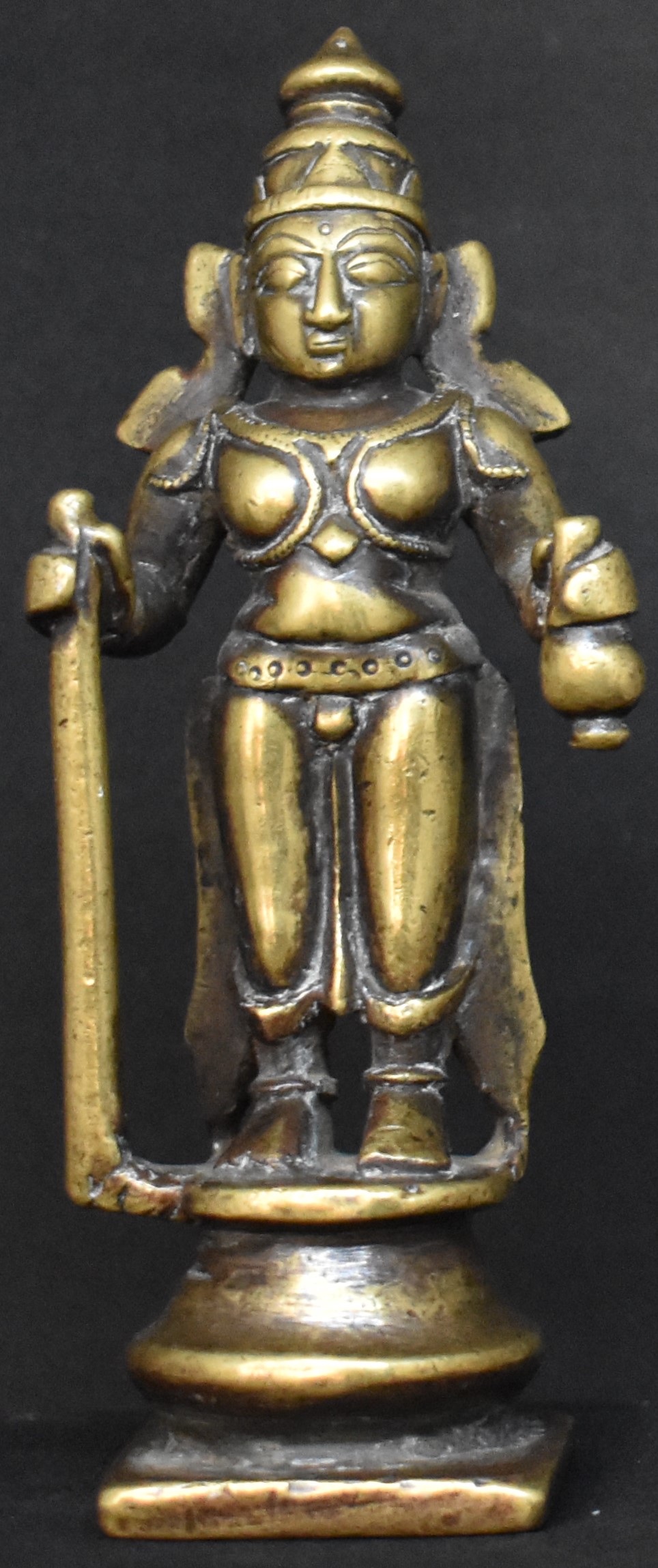
Holding a staff in his right hand and a water carrier (Kamandala) in his left hand, Siva is shown as an ascetic.
The usual attributes of Siva (Trishul, Mirga, Drum) are not present in this bronze. It is the weight of several others who identified this form as Siva that leads me down the path.
Antiquities of Himachal Pradesh by M Postel, A Neven and K Mankodi has several examples of two-armed Siva (Page 118/fig 151, Page 121/Fig 161 and 162). Similar figures are published in the Hindu Pantheon by Edward Moor. All the figures referenced above books show Siva in tribal/Folk forms. This bronze, in this blog, has classical features.
C Sivaramamurti, in his The Art of India, page 74, mentions that the Vedic form of Siva, Rudra, is portrayed with only two arms.
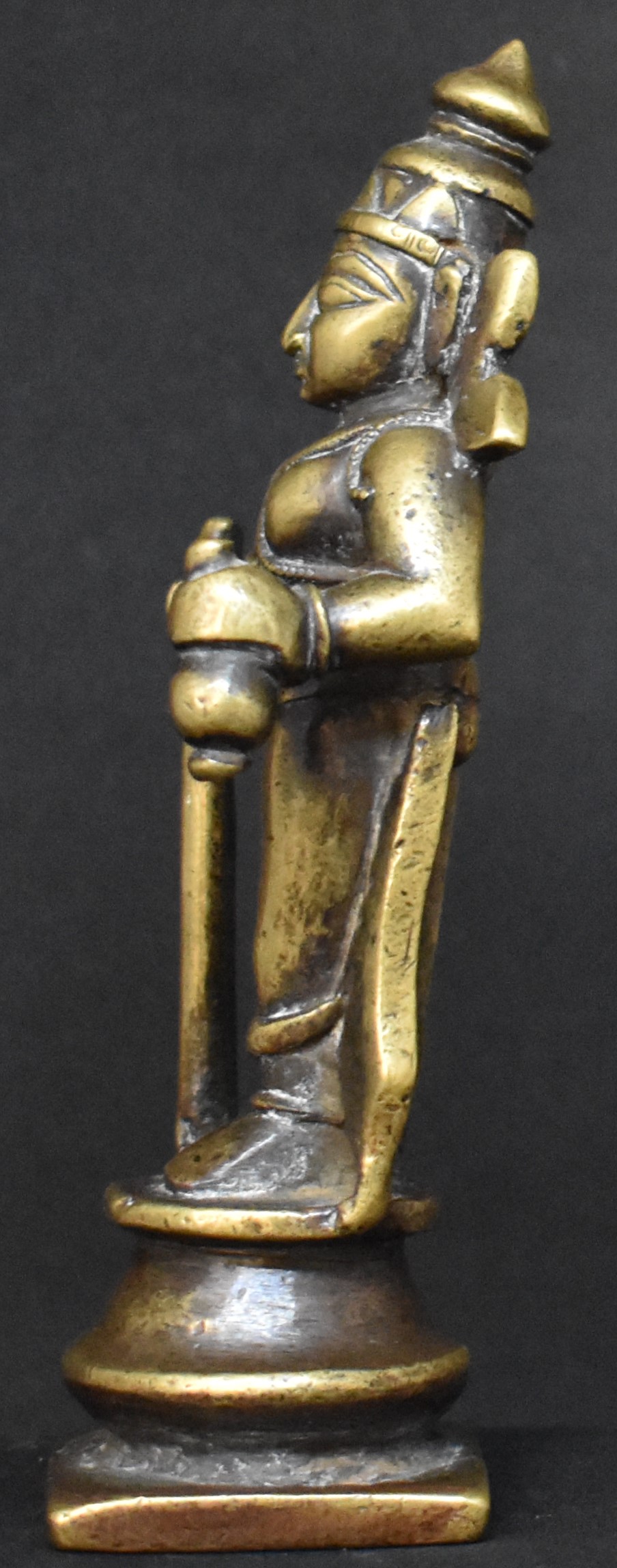
This bronze is quite heavy, and the casting is thick. See the side view. For an ascetic, Siva’s ornamentation is profuse, and ornaments include a crown, earrings, necklaces, chest braces, shoulder hara, bracelets, waistband and anklets. He is wearing a full-length lower garment.
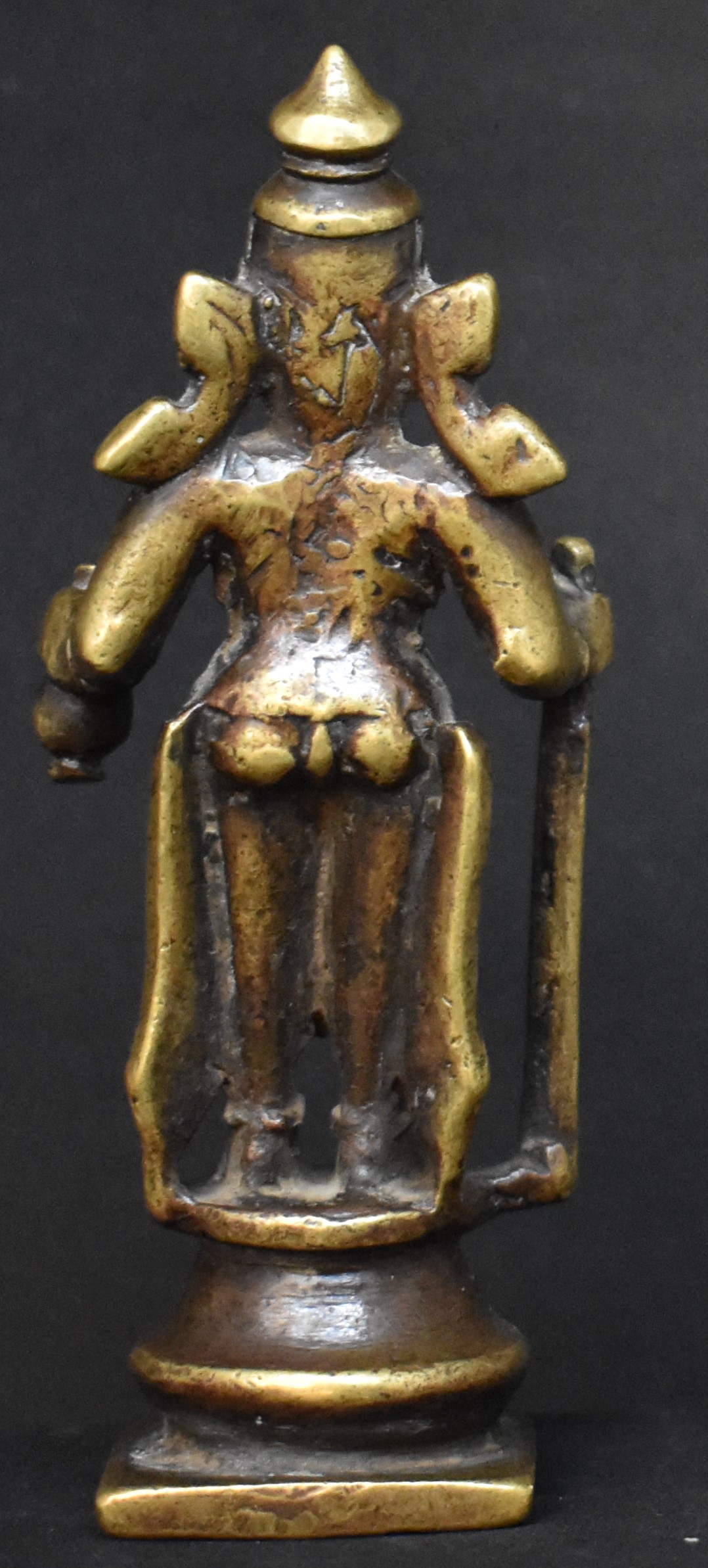
One strange thing about this bronze is that it looks almost as if the making of this bronze stopped halfway. Notice the absence of incision/engraving in the ear pendants, the lower garment’s side flares. The fingers and toes are not delineated. The bronze’s back is not worked on.
This bronze is about 11.5 cm in height. It shows wear and signs of use. This may not be earlier than the nineteenth century and may even be from the early twentieth century. It is almost certainly from Northern Deccan (North Karnataka/South Maharashtra)
25 Sept 2021: Swanad informed that this is not Siva; how can an ascetic Siva be crowned? This, according to him, is Mul Purusha. They are from South Maharashtra/North Karnataka. They depict the first person of a clan. The concept is not that different to Gotra.
 Bronzes of India - A personal collection