
Uma or Parvati, while accompanying Nataraja, is called Sivakami. Nataraja and Sivakami are normally on separate pedestals. It is not surprising, given Nataraja’s form.
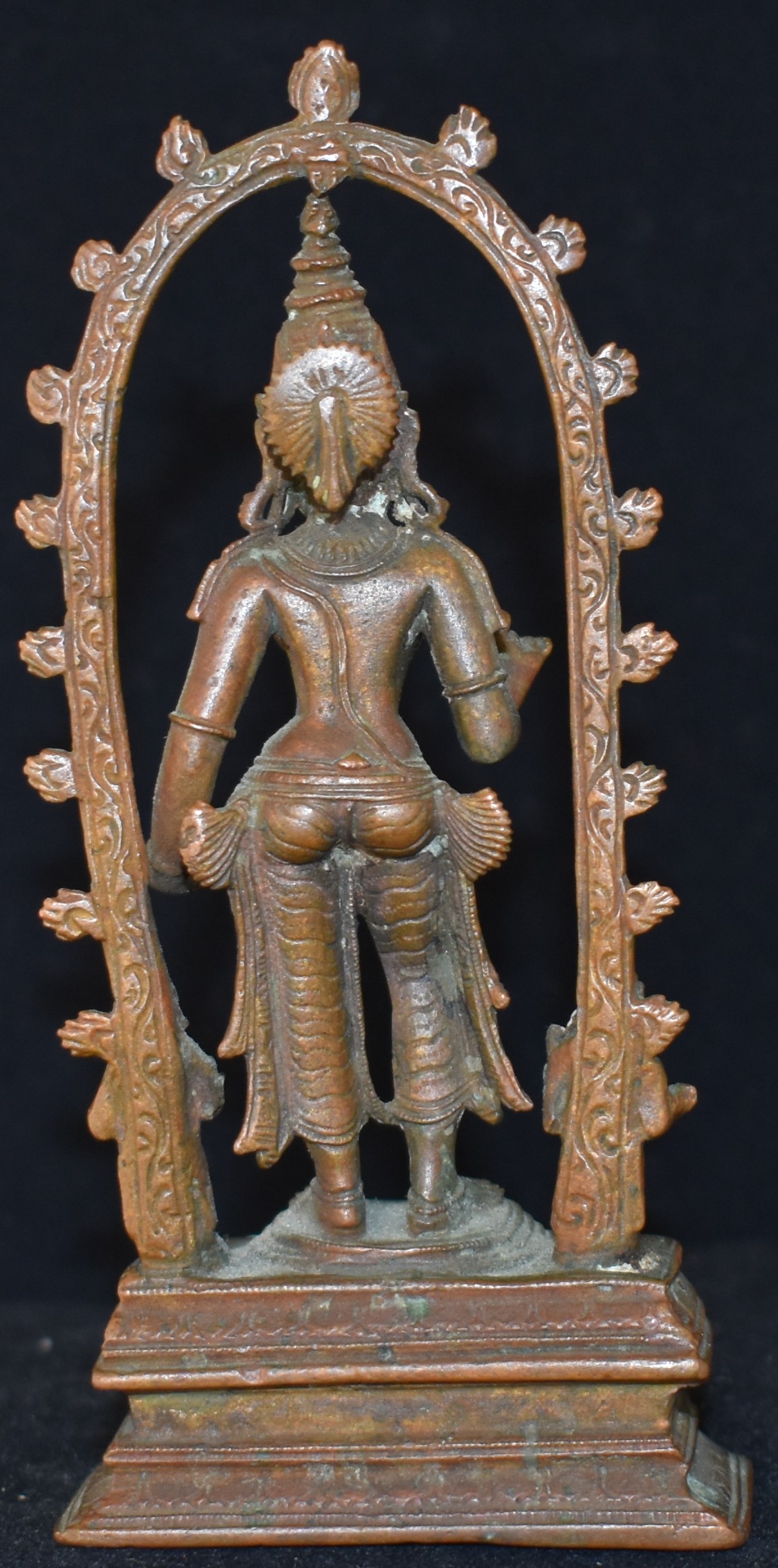
Here, Sivakami is framed by a prabhavali with flames, similar to what you see in Nataraja’s sculptures, and she is accompanied by two attendants. Graceful as she is, her standing in Tribanga (three bends) adds to the grace.
This statue must have meant a lot. See the delineation of Sivakami’ s fingers, her form including a slender waist, the design of ear ornaments, detailing on the pedestal and the multi-level pedestal.
Normally, South Indian bronzes have the back worked on, despite the fact that the back is normally not seen. In this bronze, the back of the prabhavali and the flames are also detailed. Class work.
Vidya Dehejia’ s book on The Sensuous and the Sacred has, on page 85, Figure 4, a photograph of a goddess with two attendants. That bronze is from the Thiruvenkadu temple. However, the goddess is not identified in that book.
The incision of lotus on the pedestal, high copper content and the subject itself point to Tamil Nadu as the origin. There is some wear due to handling, and this may date prior to the nineteenth century.
The bronze is about 12 cm in height.
 Bronzes of India - A personal collection