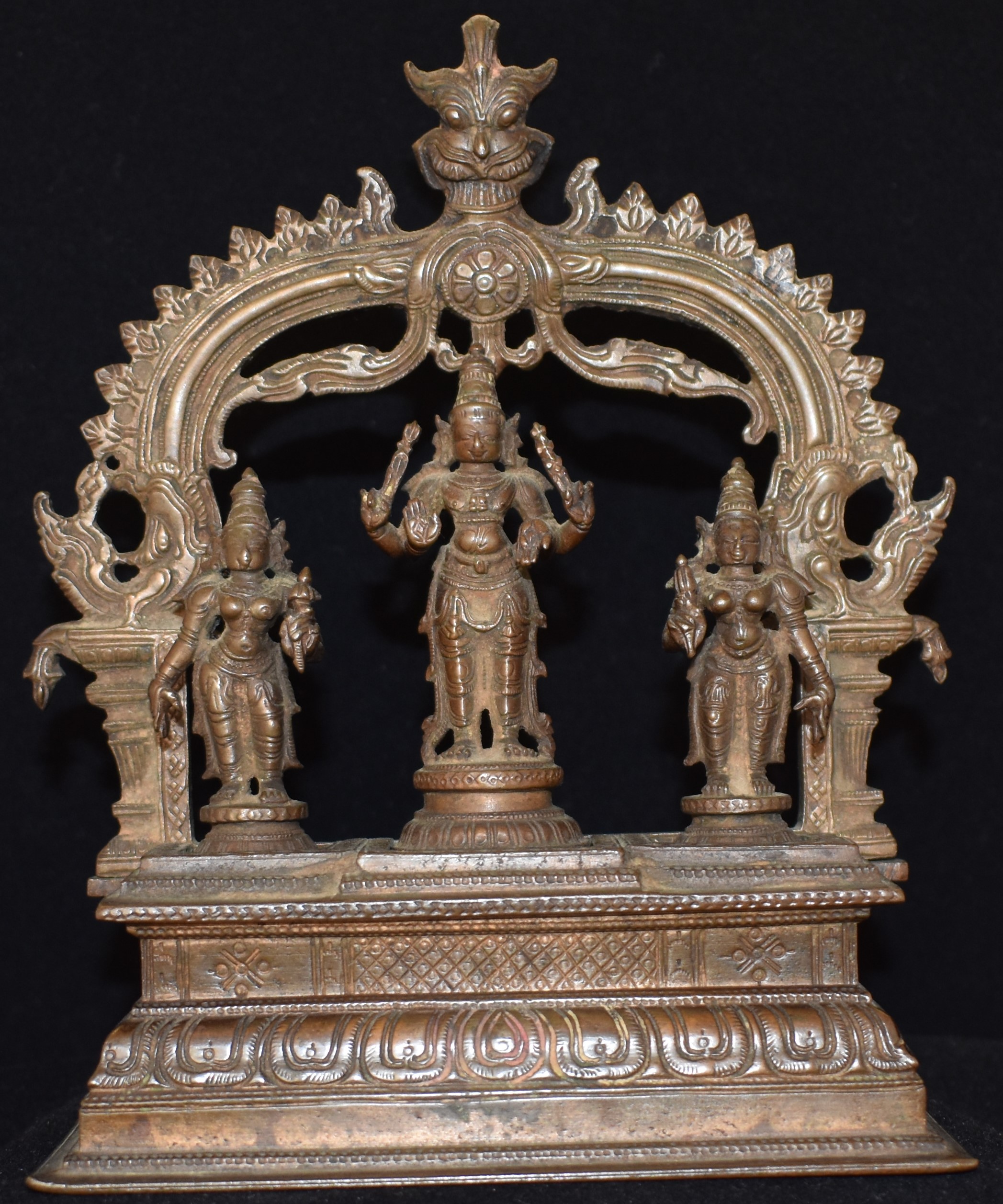
This is Subramanya, son of Siva and Parvati, standing with his consorts Valli and Deivani. Subramanya is an extremely popular and much-adored deity of South India. Subramanya is worshipped in North India and Nepal as Karthikeya. This form of Subramanya with Valli and Deivani is not known in North India. Subramanya, popularly known as Murugan, is also worshipped in Malaysia, Singapore, Mauritius and Sri Lanka, primarily by Tamil-speaking diaspora.
Here, Subramanya and his consorts are standing on a two-tiered Bhadra Peetham and are surrounded by prabhavali. The deities slide into slots made for them in Bhadra Peetham. This type of construction is typical of Karnataka.
Subramanya is standing in Samapada holding double Vajra and a vel (Shakti) in his rear hands. The front hands are in Varada and Abhaya mudra. As usual, he is appropriately jewelled, and his upper body is bare except for jewellery and yajnopavita. Lower garment, Dhoti, is wrapped around his legs. Waist girdle and side fold to the Dhoti complete the decoration.
Valli, the hunter girl, is holding a lotus in her right hand. Deivani, the daughter of Indra, is holding Nilopalam in her left hand. The other hand of the goddesses hang on the side like the tail of a cow (Govala). There is very little to distinguish Valli and Deivani from Sri Devi and Bhu Devi (Vishnu’s consorts). The only noticeable difference is, based on this example, Valli on Subramanya’s right is not wearing a breast band (Kacha bandha), unlike Sri Devi.
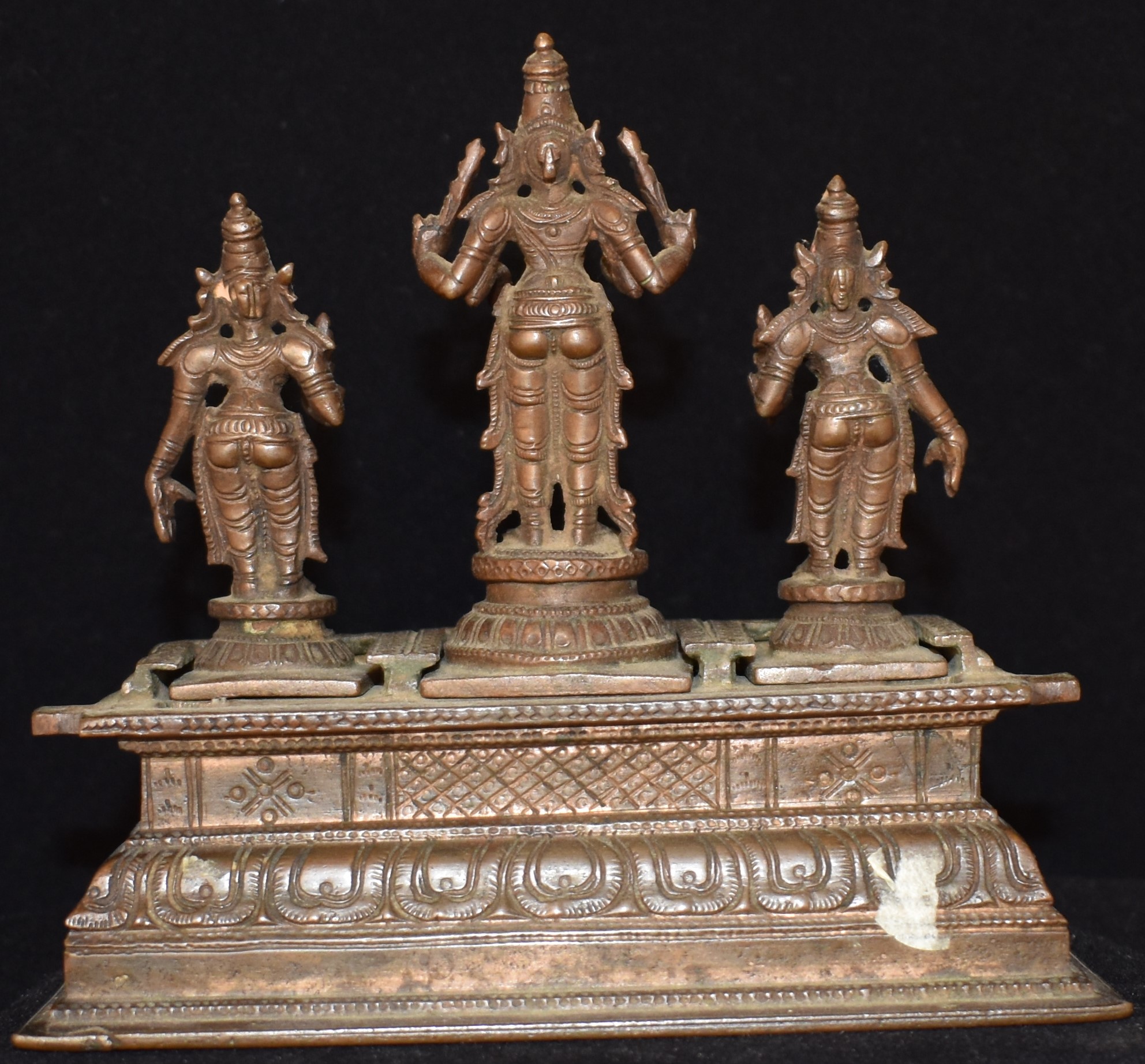
Bhadra Peetham and Prabhavali, with Makara and Kiritimukha, are well detailed. See the Subramanya, height of 7.5 cm, close-up images for the workmanship.
Subramanya bronzes with consorts are not common. Even rarer is a complete set like this one with Prabhavali and Peetham. The quality of the work makes it even more special.
This is from Tamil speaking region of South India, and most probably from Tamil Nadu. Valli and Deivani, as Subramanya’s consorts, the nature of the work and the metal used lead us to that geographic assignment. The bronze is about 16 cm in height, and the main deity, Subramanya, is about 7.5 cm in height.
The seller had assigned it to the 17th or 18th century. The bronze shows signs of worship, and there is no significant ritual-related wear. This may not be later than the 19th century.
.
 Bronzes of India - A personal collection