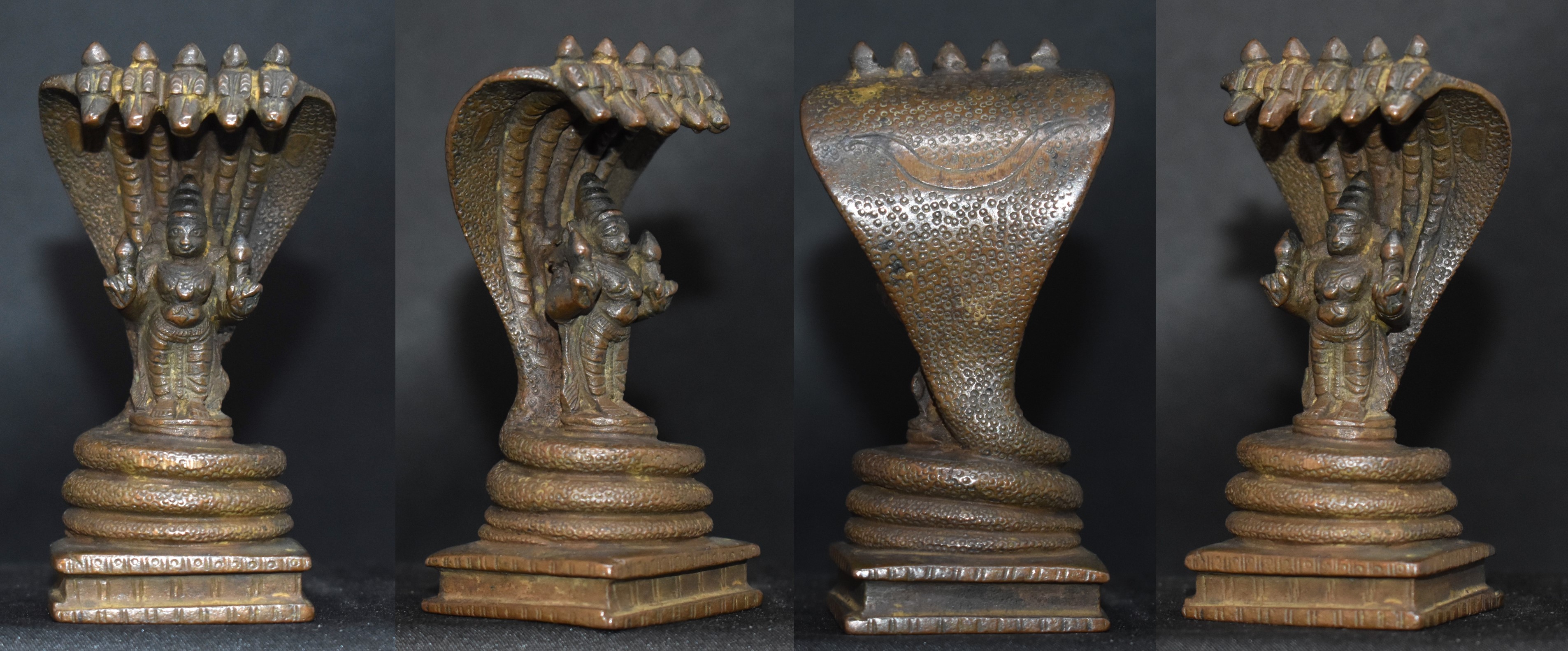
The post on standing Surya, protected by a five-hooded Naga, generated a lot more discussions than I expected. ‘It is good only’. The suggestions on the identity included Naga Deva, Subramanya (as Skanda in Somaskanda) and Suryanarayana, a syncretic form of Surya and Vishnu.
The alternatives were suggested mainly because of the five-hooded Naga. In South Indian sculptures Surya is usually shown with a circular disc, represents Sun, behind his head.
This post is to summarise my views and share additional input I gathered since then.
Yes, this could be a depiction of Naga Deva as it is common to see Nagakal with Human figures. I checked again and all the examples have Naga deva are in Anjali mudra and sometimes he has two cobras tucked between his arms and upper body. Naga Deva is never shown with lotus buds as is the case in our example.
Skanda has a stronger case as Subramanya is associated with Cobra and in Somaskanda sculptures, sometimes he is shown holding lotus buds. Two aspects of Somaskanda iconography preclude that possibility. As Skanda in Somaskanda, he is depicted as a young child and often naked. In this case, the figure is an adult and is wearing a lower garment. Also, the posture of Skanda is normally with the knee bent outwards, in a typical dancing pose. See the example below (From Norton Simon Museum, photo: John Alexander)

Suryanarayana has an even stronger case. The attributes of Surya and Vishnu include Padma (Lotus) and often it is buds for Narayana/Vishnu as well. The cobra could be Adisesha, associated with Vishnu.
Following the philosophy ‘ when the Internet does not give answers go to the books’, I checked some of the books I have. The payoff was almost immediate.
The monumental book, Bronzes of South India by P R Srinivasan mentions ‘Surya is also called Suryanarayana’ without any elaboration. Page 343 and the reference is to figure 211.
One of my favorites Studies in Tuluva History and Culture by Prof P Gururaja Bhatt has two examples of two-armed lotus bud holding figures being worshipped as Suryanarayana. Plate 286b and plate 287a. Photos reproduced below. The same book also has examples of four-armed Suryanarayana holding Vishnu’s and Surya’s attributes.

The clincher is from the book Vishnu Cult in Karnataka by Prof Shriniivas V Padigar. To quote him ‘ The Vedic concept of Vishnu as the Sun God perhaps lingered on in the Rashtrakuta period also, culminating in the Suryanarayana composite figures of the later Chalukya period”. The example he refers to is from the book Chalukyan Architecture, by Rea Alexander, Plate LXVI figure 2. That example, from Kuruvatti, Malikarjuna temple is reproduced below (Figure 2) for ease of reference.

Based on the above three references it is Suryanarayana.
Thanks to the feedback from Prof La Na Swamy which led me to research a bit more.
This showed me that even after years of collecting and iconographic study, there is always ‘a bit more’ to learn. This is a classic example of ‘the more you learn, the less you know’.
 Bronzes of India - A personal collection