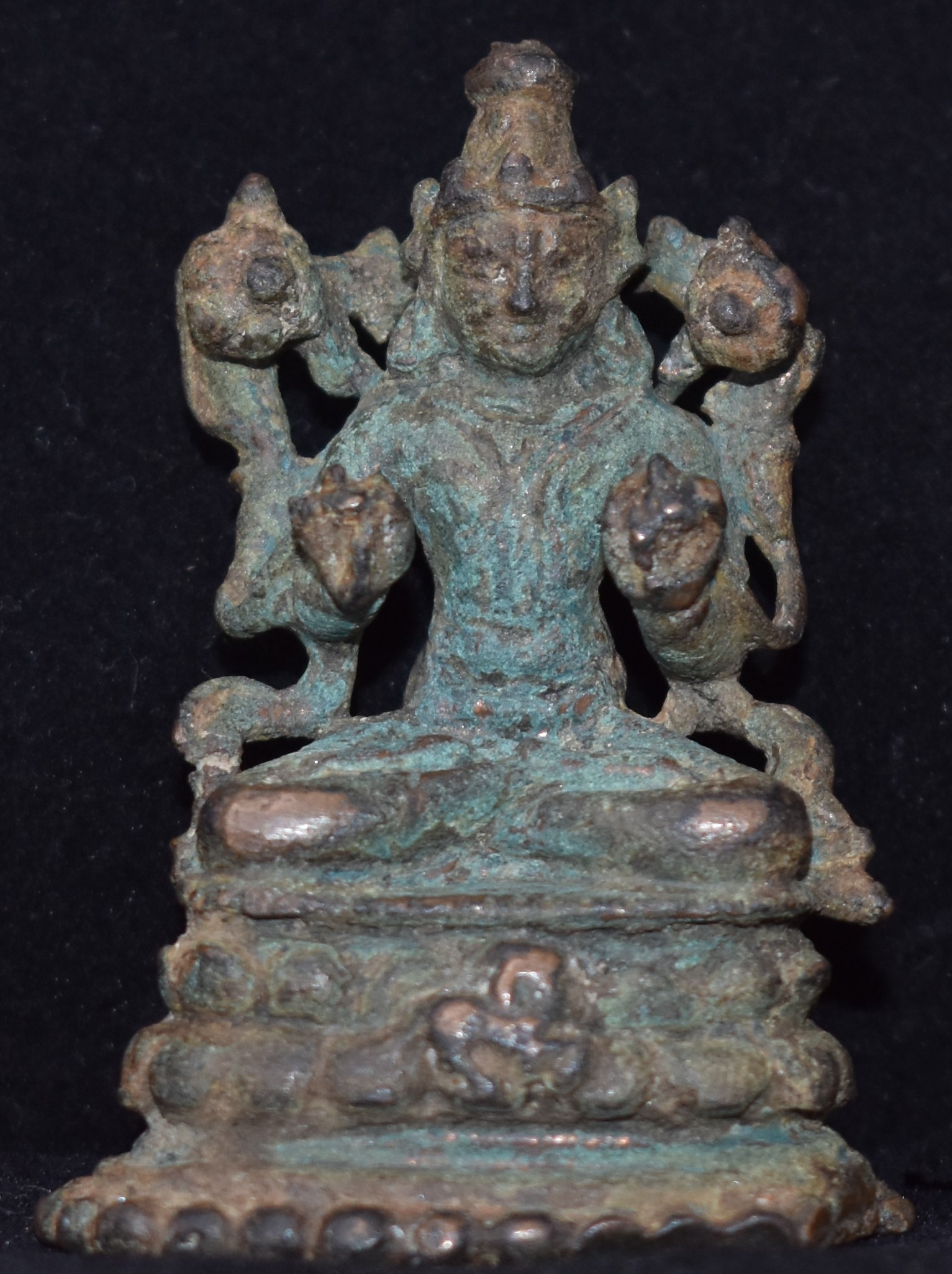
This is Surya, and in the Hindu belief system, Surya is considered the source of light and life. The origin of Surya worship can be traced to the early Indian text, the Rigveda. Worship of Surya as the primary deity used to be very prevalent during the Pala era (8th-12th centuries).

Even now, it is a Pan-India practice to chant Gayatri mantra, invoking the Sun god, in prayers and during some Hindu religious ceremonies. One translation of part of the mantra reads, ‘We meditate on the adorable glory of the radiant sun; may he inspire our
intelligence’.
In this example, two armed sun god is sitting in Padmasana on a double lotus pedestal. Surya’s hands are holding blossomed lotuses by their stem. Surya is wearing a conical crown. The details of the jewellery are not clearly visible. There is an oval base with a beaded rim supporting the Padmapeetha. The front pedestal shows a horse. A more common representation is Surya riding a chariot driven by seven horses.
Seated Surya is rarer. The Met Museum has some examples (2009.225 and 1.987.142.353). Those examples are slightly larger.
The double lotus pedestal is one of the characteristics of Eastern India bronzes, and another regional feature is the beaded rim.
This bronze is about 6.5 cms in height. The bronze is crusted, which may be the result of being buried for a long period. Experts’ views are welcome. Below is a picture of the lower part of the front.

 Bronzes of India - A personal collection