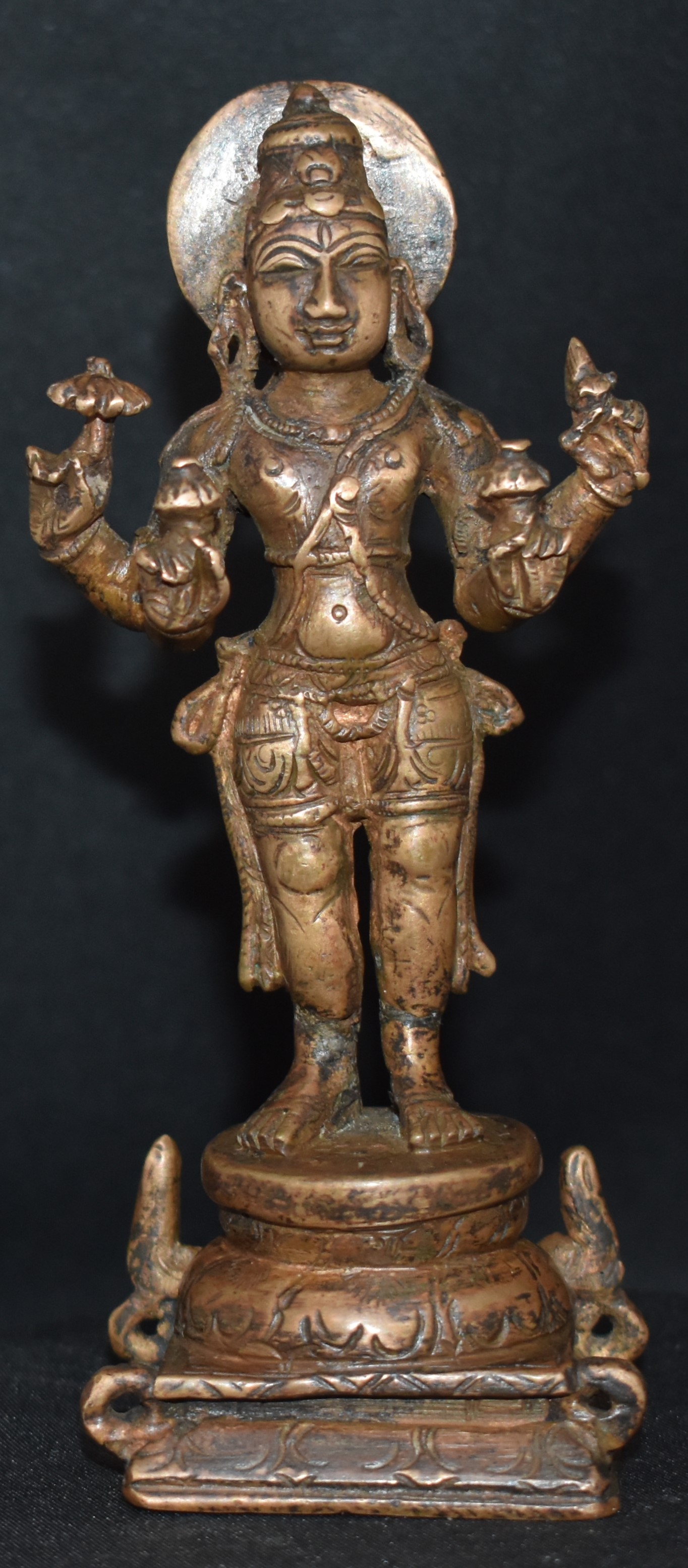
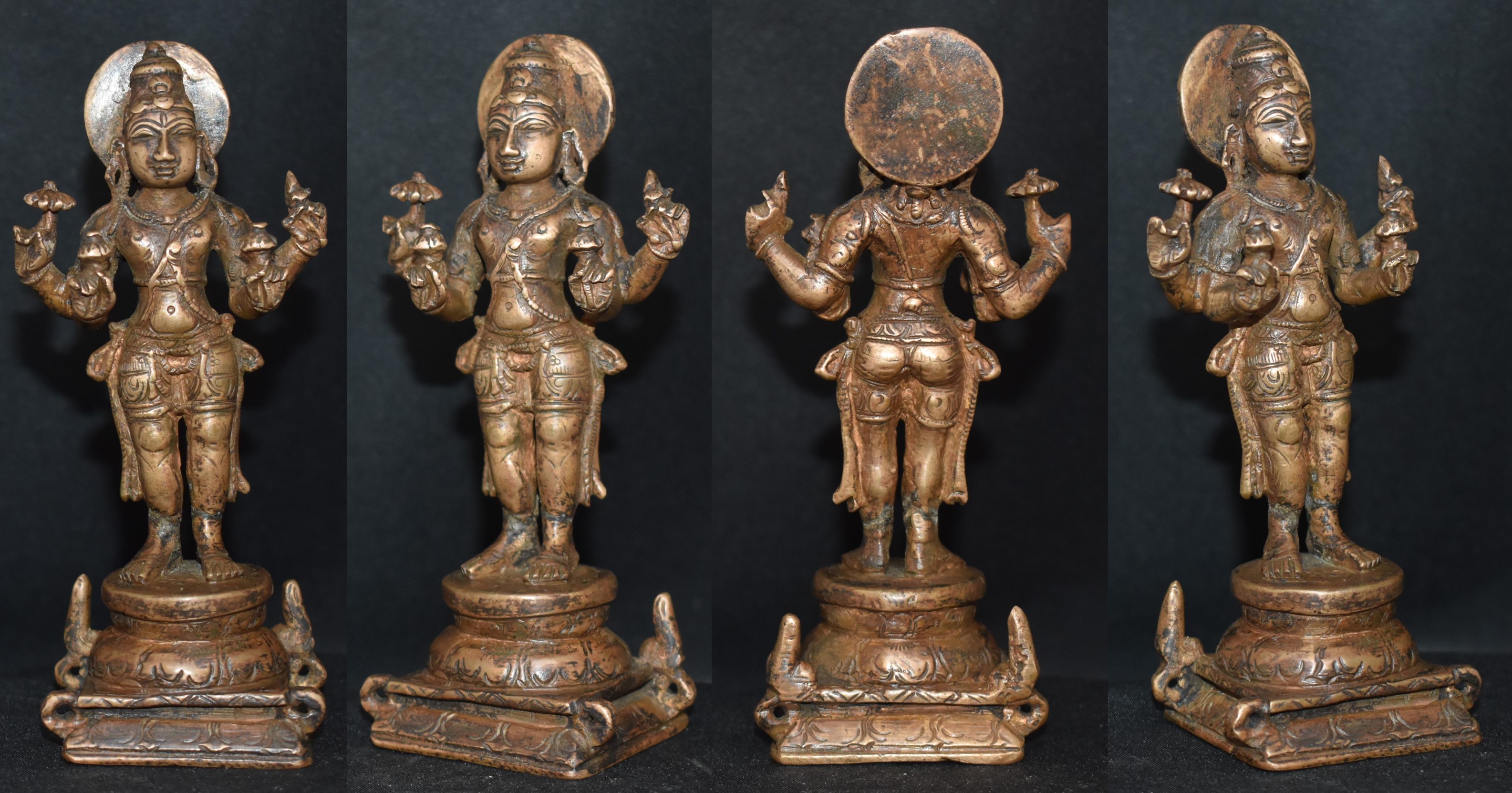
This is Suryanarayana, a combined form of Surya, the Sun God, and Narayana, Vishnu. The identification is based on the attributes; the lower hands hold two lotus buds, marking the Surya aspects, and the upper hands hold Chakra and Shanha, signifying Vishnu.
This Vighraha shows, as per the current iconography, a combined form of Surya and Vishnu, two deities. None of the literature I researched lists the combined form as a syncretic deity. For good reasons, I think.
Vishnu is a Solar deity and was closely identified with the Sun god during Vedic times. Vishnu’s Trivikrama form is seen as the Sun God, and Garuda, Vishnu’s vahana, is referred to as the sun-bird. Somewhere after the Vedic times, Surya and Vishnu took distinct identities. But the aftereffects of Vedic period thinking persist. Please see my other blog on Suryanarayana for additional discussions.

Here, Suryanarayana is standing in Sampada on a Padmapeetha, which in turn is supported by Bhadrapeetha. Strangely enough, the peetha is provided with four loops for tying this Vigraha to a processional platform. Given the size of this Vigraha, 12 cm, it was probably meant for homeworship. This is most likely a scaled-down copy of a Utsav Murthy from some temple.
The book Studies in Tuluva History and Culture by Dr Gururaja Bhatt has an example of a standing Suryanarayana, riding a horse-drawn chariot.
This Vigraha is influenced by the Tamil style. This is a repaired bronze, with a break near the ankle. That breakage and the repair explain the lack of wear. This Vigraha may be dated to the nineteenth century.
 Bronzes of India - A personal collection