 This is Madvacharya, one of the great philosophers of Vaishnavism, a major sect of Hinduism. He is a sanyasi, a person who renounced worldly belongings and embraced austerity. He is a historical fi…
Source: Madhvacharya
This is Madvacharya, one of the great philosophers of Vaishnavism, a major sect of Hinduism. He is a sanyasi, a person who renounced worldly belongings and embraced austerity. He is a historical fi…
Source: Madhvacharya
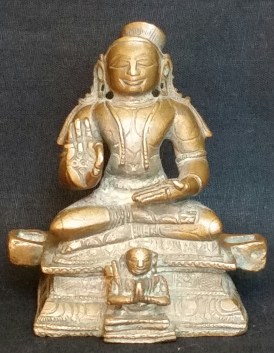 This is Nammalvar (larger figure) and Ramanujacharya. The relationship between them is expounder-follower. Nammalvar is one of the twelve Vaishnavite saints or alvars (saints who immersed themselve…
Source: Nammalvar and Ramanuja
 This is Vithoba or Vittala, the reigning deity of Maharashtra. He is also known as Panduranga. The worship of Vithoba is centered around Pandharpur. For more details of Pandharpur deity see Pandura…
Source: Vithoba (Ganga Jamuna)
 Delightful miniature bronze of a goddess sitting with ladle in her right hand and a bowl/container in her left hand. She sitting in Padmasana. She is supported by a rectangular Bhadrapeetha. There …
Source: Annapurna (Seated)
 This is Deepalakshmi (Deepa meaning light). Lakshmi is Vishnu’s consort. Despite the name including Lakshmi, Deepalakshmi is not subject of worship but is used in worship. The lamp is oil and…
Source: Deepalakshmi
 This folk bronze is Khandobha and his consort Mhalsa. He is identified as Khandobha with the horse standing on the right lower side of the pedestal. A simple ridged prabhavali defines the deities. …
Source: Khandobha and Mhalsa (seated)
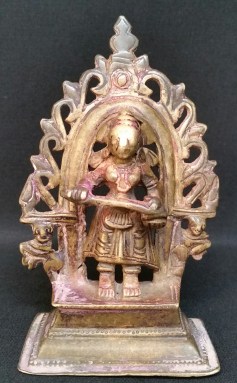 This is Annapurna standing in samapada. She is identified by the ladle and pot in her hands. She is standing on a two-tiered rectangular pedestal. An ornate prabhavali gives her the backdrop. The l…
Source: Annapurna (standing)
 Another miniature Durga, just about 5.5 cm. This one with with action and drama. It is eight armed Dura sitting astride her vahana, lion. A menacing looking lion. The attributes in her hands are no…
Source: Durga on her Vahana
 This miniature Mahishasuramardhini is just about 5.6 cm in height. But packs a punch with its features.This form of Mardhini is called Asta Bhuja, eight handed deity. The arms are carrying varying …
 This is Karthikeya, son of Siva and Parvati. Here Karthikeya is shown with six faces and twelve arms riding his vahana, peacock. This image could be called Arumukha or Shanmukha (who has six faces…
Source: Karthikeya
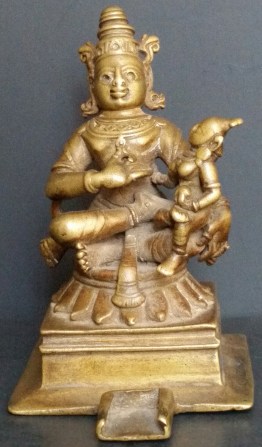 Here Rama is sitting on an inverted lotus with long petals, which in turn is supported by a square base with extended ridge. The niche in front would have had his vahana (carrier) and in this case …
Source: Yoga Rama Sita
 It is Umamaheshwara till you decide otherwise. Siva is holding battle axe and antelope in the rear hands. Typical attributes of Siva. The goddess, Uma, is holding lotus in her left hand and her rig…
Source: Uma Maheshwara (Is it?)
This is Vishnu standing next to Lakshmi. Vishnu is holding conch, lotus, mace and discuss/wheel, starting from lower right hand clockwise. Lotus and mace have long stem/handle. Conch and discuss ar…
Source: Lakshmi Narayana (Folk)
The above is a typical representation of Vishnu and his consorts in Bengal (including current Bangladesh) and Bihar areas during the Pala regime. Pala kingdom reigned that region between tenth and …
This is a classic representation of Vishnu with his consorts Sri devi and Bhu devi. Vishnu is identified by his attributes discuss/wheel (Chakra) and conch/Shell (Shankha). Sri devi, on VishnuR…
Source: Vishnu and Consorts (GJ)
 Bronzes of India - A personal collection