
This bronze, Tri Thirthika, is from the Jain Digambara faith and shows three of the twenty-four Tirthankaras. The identification is based on their cognisance, shown on the base just below their feet.
From our left to right, the Thirthankaras are Munisuvrata (Tortoise), Malli (Water jug) and Ara (Fish). The animal cognisances Tortoise and Fish are distinct enough, and the identification of the water jug is largely by elimination.
According to U. P. Shah in his book Jaina Rupa Mandana, the groups can be in twos, threes, fours, fives and so on. Other than groups of twenty-four, groups-of-three is the most common.
All three Thirthankaras are naked, as is expected for Digambara (sky-clad) bronzes, and there is very little to distinguish one from the other. All are standing in Kayotsarga posture and have curly hair and long ears.
The lines you see around their neck indicate neck folds, a sign of wisdom rather than chains.
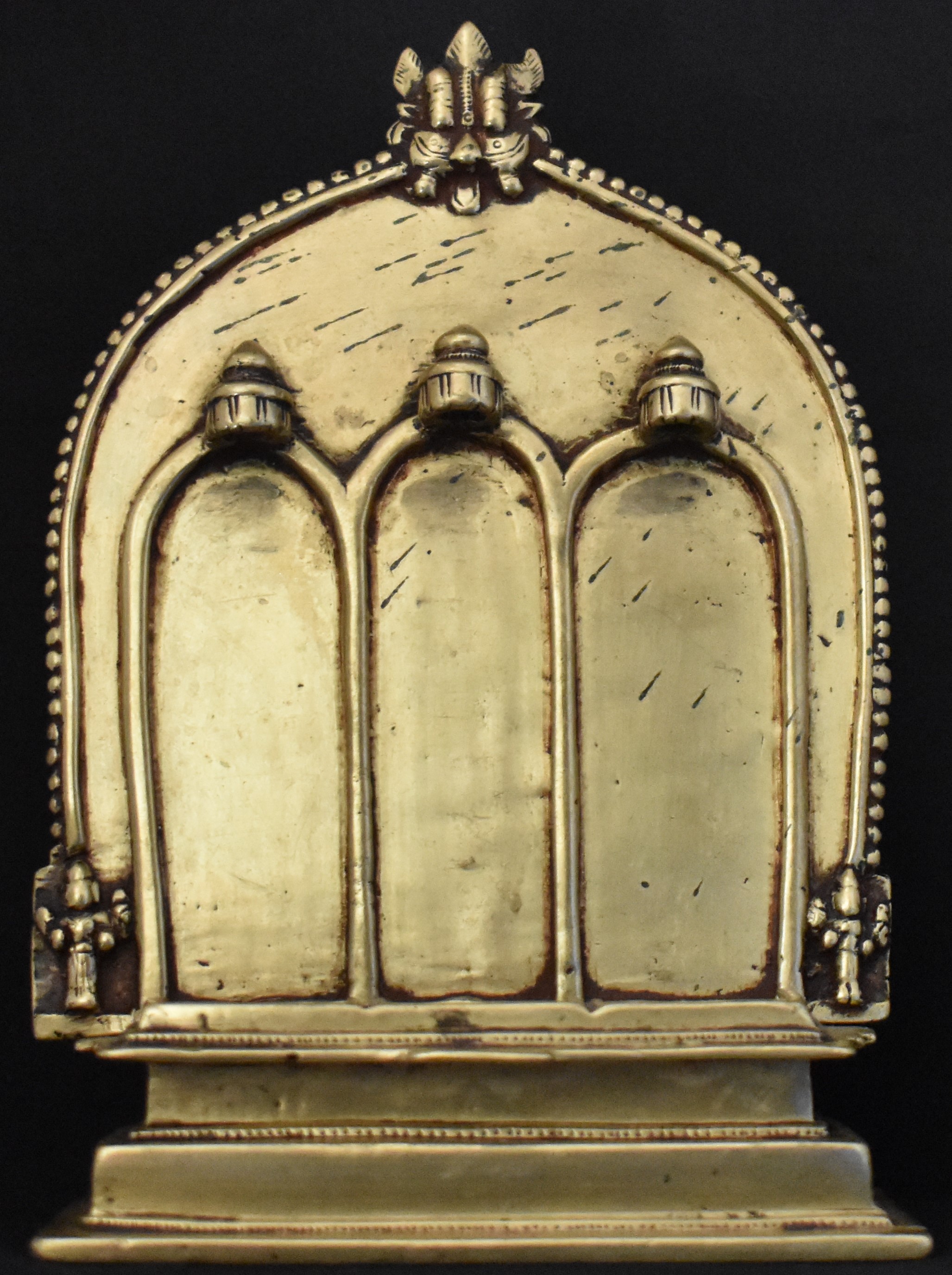
The Kiritimukha at the top of prabhavali, the attendant Yaksha and Yakshi at the base of prabhavali suggest this bronze is from South India. As in the photo below, the prabhavali has three niches, each topped by a parasol. The finish is smooth.
The linear lines, simple geometry and plain prabhavali (barring the beaded rim), and the plain stepped base are in sync with the simplicity of the main deities.
The bronze is about 17.5 cm in height, and the Thirthankaras are about 8 cm in height. It is probably from North Deccan and may date to the nineteenth century.
 Bronzes of India - A personal collection