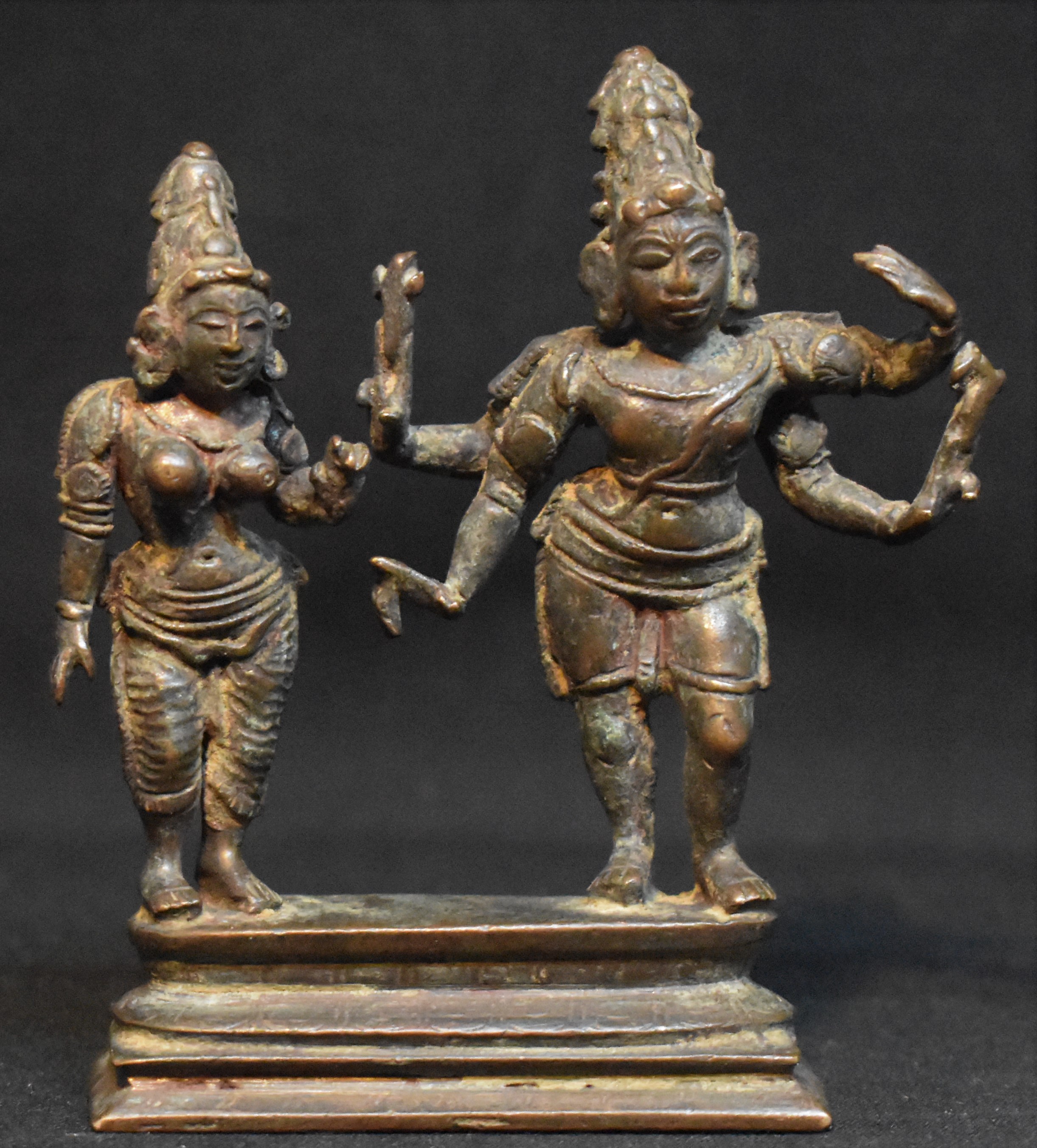
This is Siva as Tripura Vijaya, victor of the three cities, with his consort Uma/Parvati. In this context, she is Tripura Sundari.
Siva is identified by his attributes in his rear hands, Parasu (battle axe) and Mirga (antelope). His front hands are meant to be holding an arrow (right) and a bow (left).
The story: “The demons in the form of flying fortresses of iron, silver and gold were destroying everything. The celestials, comprising Devas, were unable to contain the demons and appealed to Siva for help. According to one version of the story, Siva destroys the three cities with a single arrow when the three cities are aligned along a straight line. Hence the name Tripura Vijaya.”
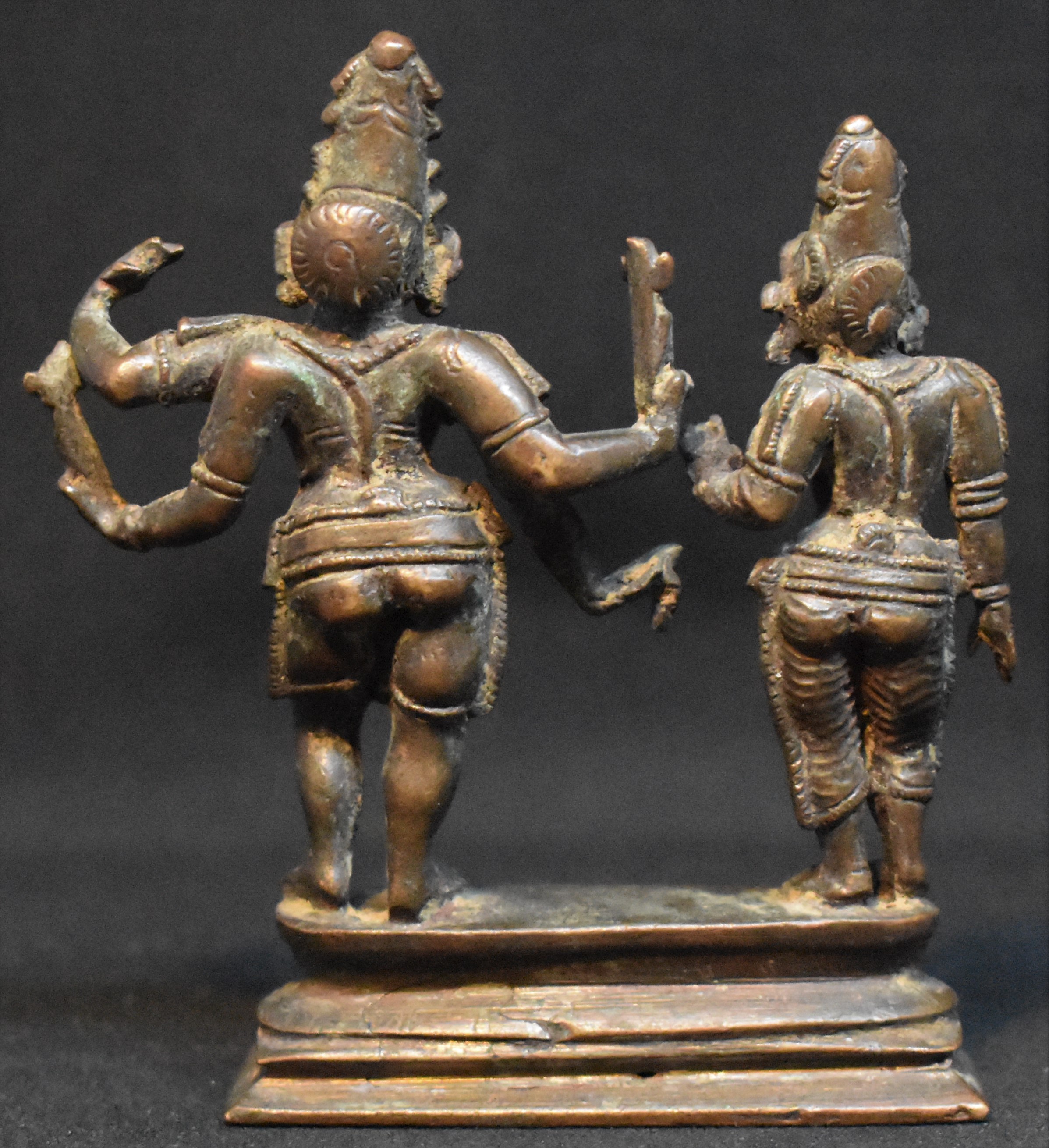
The worship of Tripura Vijaya reached its peak during RajaRaja chola’s time (roughly the 10th century CE) and continued until Nataraja became an important idol for worship.
Normally, Uma is shown on the left of Siva, and their marriage ceremony sculptures are an exception. Here, Uma being on Siva’s right is by design, going by her holding a lotus flower in her left hand. Her right hand is in lola hasta.
The figures are squattish, suggesting they belong to a later period. Take time to look at the way Siva’s Jata Makuta is sculpted. See the enlarged view for Siva’s third eye.
Both Siva and Uma are standing in Tribanga (with triple bends) full of grace and are in a benevolent mood to bless the devotees.
This Vigraha is about 8.5 cm in height, and it is from Tamil Nadu. This is the first Tripura Vijaya I have come across of this size. This may date to the seventeenth century or so.
For those who are keen to distinguish Tripurantaka from Tripura Vijaya and the way of differentiating Veenadhara, Tripura Vijaya Vs Kirathamoorthy, please see the article below. It is by the master himself, R Nagaswamy.
http://tamilartsacademy.com/journals/volume2/articles/tripurantaka.html
 Bronzes of India - A personal collection