
The identification of Vamana rests on the attributes he carries: Akshamala (Prayer beads) and Kamandala (Water pot) in his front hands. Vamana, an avatar of Vishnu, is linked to Vishnu through the attributes he holds in his rear hands: Chakra and Shankha.

Vishnu incarnated as Vamana in response to Bali Chakravarthi’s (King of the world) actions and aimed at reinstating Indira in his position. In this form, Vamana appears as a diminutive sanyasi. The attributes may include an umbrella, staff, Akshamala, and Kamandala. The well-documented tale of Vamana putting Bali in his place exemplifies this form.
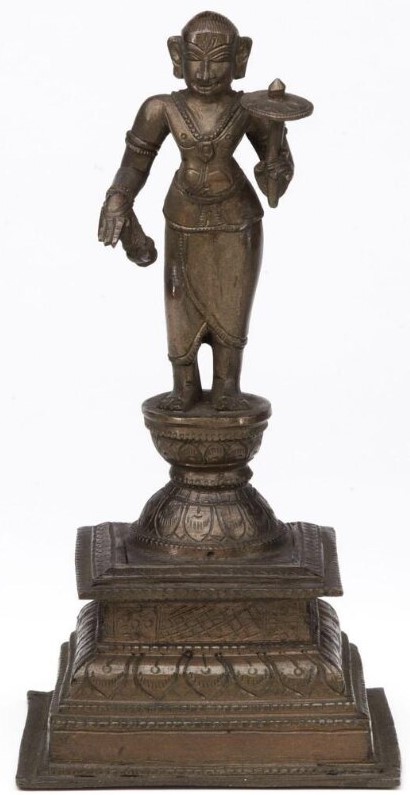
In the depiction presented here, Vamana sports a crown and a full set of ornaments — a unusual representation for an ascetic. The showcased Vamana avatar figure on our right, from the the V & A Museum, is a prime example of usual Vamana iconography.
Upon reviewing the pictures I took, I briefly questioned if I had unintentionally positioned the camera slightly above the Vigraha, deviating from the usual object-level alignment. However, I soon realized that the artist has rightly conveyed a compact and robust persona and depicted Vamana as a dwarf. To observe this, particularly the sturdy thighs, take a glance at the side view. Intrigued, I measured this Vamana and a standing Vishnu. The proportion of body to overall height is higher for Vishnu (68%) than for Vamana (62%). A dwarf indeed.

A brief diversion: Depending on the order in which the four attributes, Shankha, Chakra, Padma and Gada are held, Vishnu is identified by different names. There are twenty-four such forms and one of them is Vamana. In this manifestation, Vamana holds Chakra, Gada, Padma and Shankha (starting lower right hand in clockwise) in that specific sequence. Otherwise, the South Indian Vishnu-Vamana resembles any standing Vishnu depiction. The one of our left is an example from the Hoysala period.
On a related note, the Vamana portrayal from the Gangetic plain showcases a stout, pot-bellied figure clutching Vishnu’s four primary attributes — a midway representation. The one below is from the Walter’s Art Museum.

Getting back to the subject of this blog the Vigraha is 14 cm tall, hails from Karnataka and likely dates back to the early twentieth century. It’s plausible that this sculpture was crafted as part of a Dasavathara set during the British colonial period making it a Company School bronze.
PS: Some may recognize the writing style to be different, a bit artificial and formal, and it is because I experimented with ChatGPT. I wrote in my usual style and fed it to ChatGPT and asked it to improve readability. Maybe it did. But it still has a long way to go. In the second paragraph there is a reference to Indira and ChatGPT changed it to India. Maybe it has some intelligence and not the knowledge.
 Bronzes of India - A personal collection