
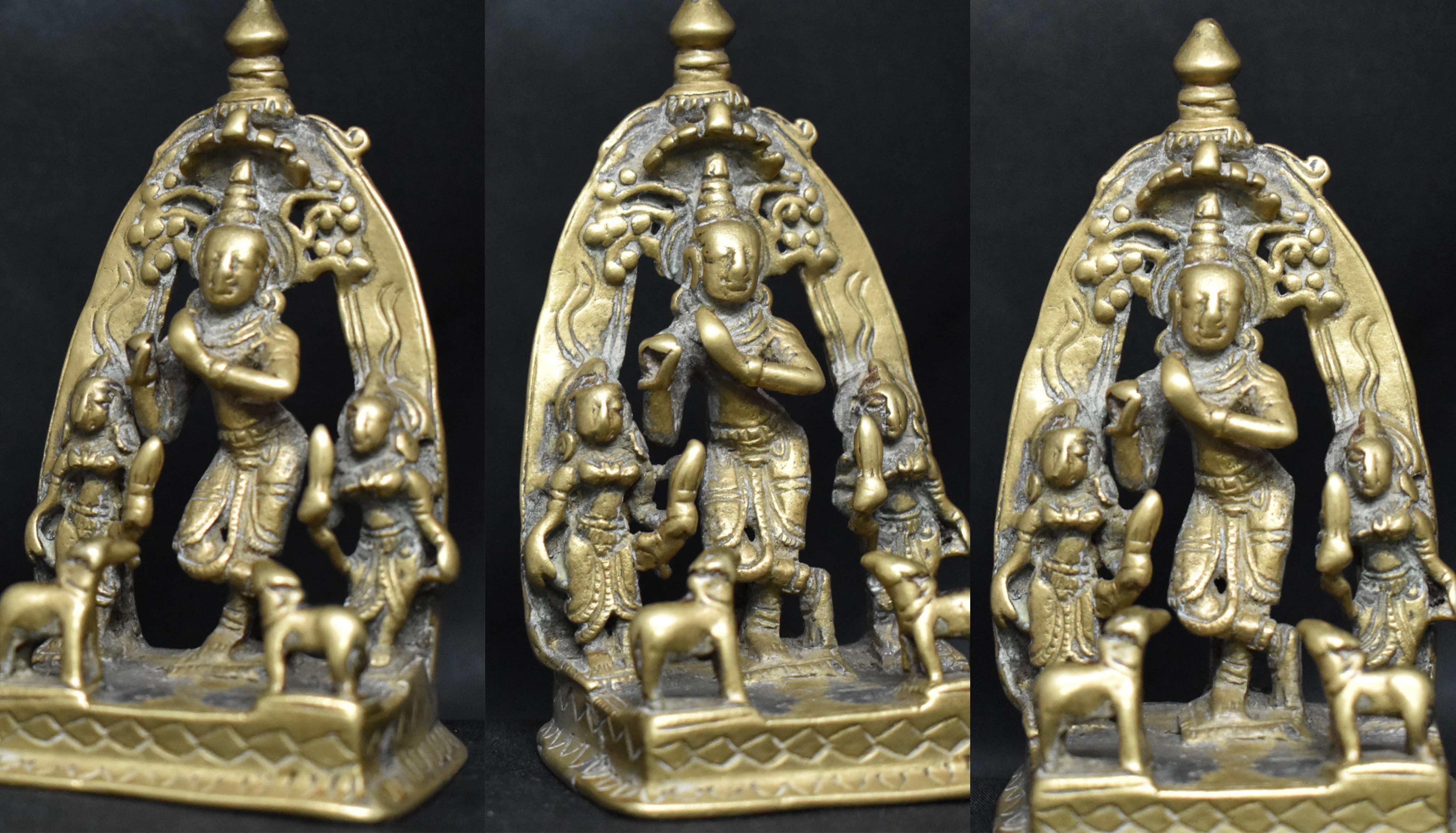
This is Venugopala, flute-playing Krishna. Here, Krishna is accompanied by his consorts, Rukmini and Sathyabama. The identification of the consorts is based on South Indian and Deccan traditions.
Venugopala has an audience; two cows are looking at him admiringly and listening to his flute. The ‘Gopala’ part in his name means cow-herd.
The artist has gone the extra distance to make this bronze a cherished one. Take note of the engraving on the Prabhavali and the base, including the seven-hooded Cobra protecting the deity, the tree (possibly a Kadamba tree) framing his head, the halo of the consorts, and the cow’s gaze.
On this website, there is also a version of Venugopala accompanied by two attendants rather than his consorts. The distinction is made as the attendants hold Chamara, and the consorts have a halo around their heads, marking their divine quality. See the side-by-side comparison below.

This Venugopala may be dated to the 18th-19th century, and it is possibly from Gujarat. It is about 10.5 cm in height.
Two other examples of Venugopala with consorts are included in the photo below.

17 Aug 2025: Comments from Jagdish Gandhi.
“This vigrah is from Akota, Gujarat. Gujarat had two metal working centers, one Akota near Vadodara and Paatan in north Gujarat. Patan was the capital city of the illustrious Solanki dynasty of Gujarat.It was also the military and cultural center of the Gurjar Pratihara Saamrajya.
Krishn being a Vishnu Avataar, is having here two Sahiyyars ( consortium) of Vishnu on either side, ie Sridevi and Bhudevi. This appears to be a 16th cen piece of art.”
 Bronzes of India - A personal collection