
Vishnu is one of the three main deities of Hinduism. Here he stands on his own, holding the Lotus, Chakra (wheel), Shankha (Conch shell), and Gada (mace). Starting from the lower right-hand, clockwise. It is interesting to see Satkona (two interlocking triangles) in his Chakra.
Vishnu is called by different names depending on the order in which the attributes are held. In this case, as per the Padma Purana, he is Vasudeva. The four attributes mean there are twenty-four combinations and names. These names are special among the 1,008 names by which Vishnu is addressed.
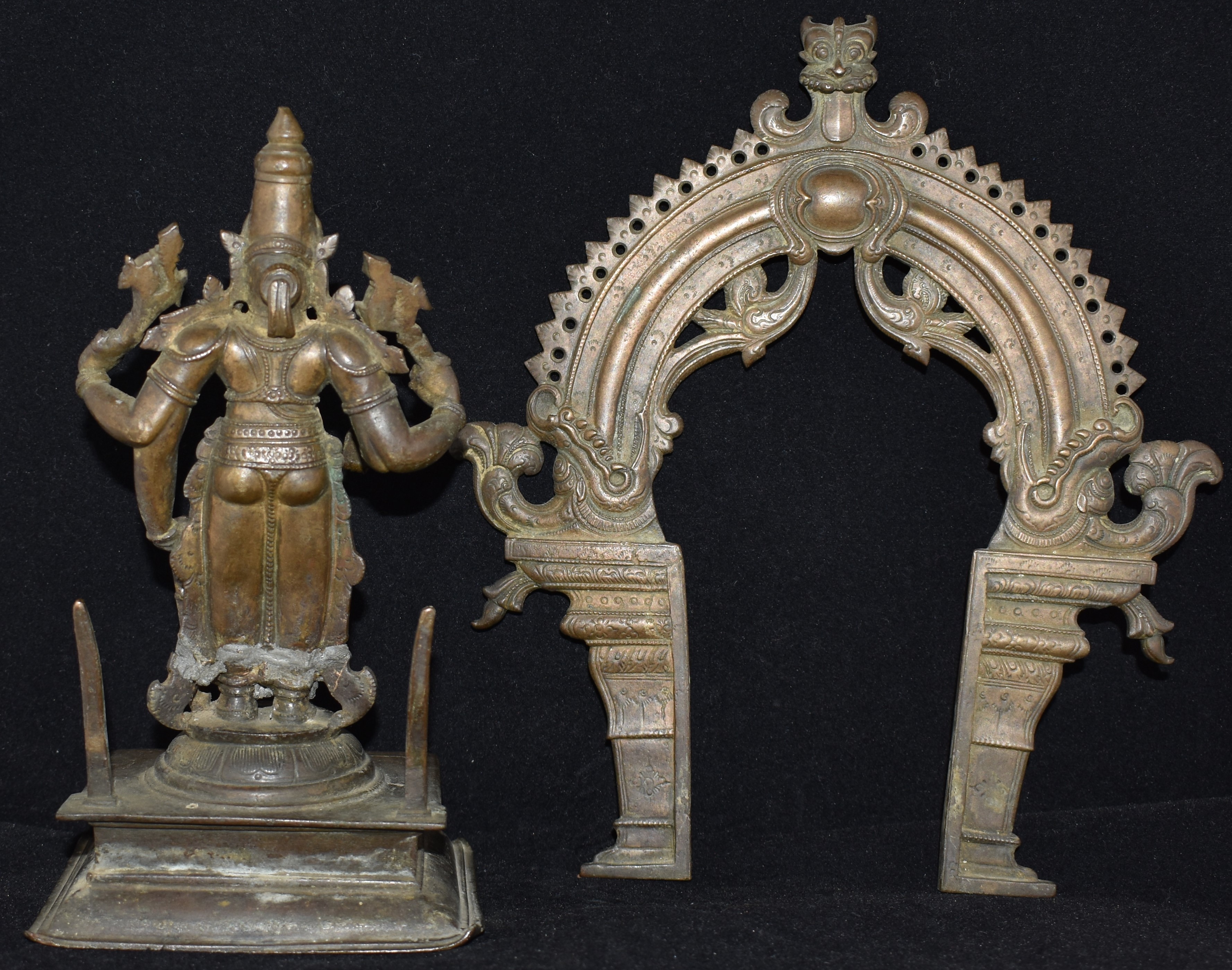
Normally, Vishnu is accompanied by his consorts, on the same or different pedestals. In this case, the consorts would have been on separate pedestals and would be separated.
The back is worked on, as is the case with South Indian bronzes. In a normal scenario, the back of the deity is never seen. The bronze is crudely repaired, as seen in the back view.
This Vishnu is from Kerala. The upright prongs from the base to attach the prabhavali are typical of Kerala. In bronzes from other parts of South India, the prabhavali has prongs and is inserted into slots in the base, peetham. It is from the 19th century. It is about 24 cm tall.
 Bronzes of India - A personal collection