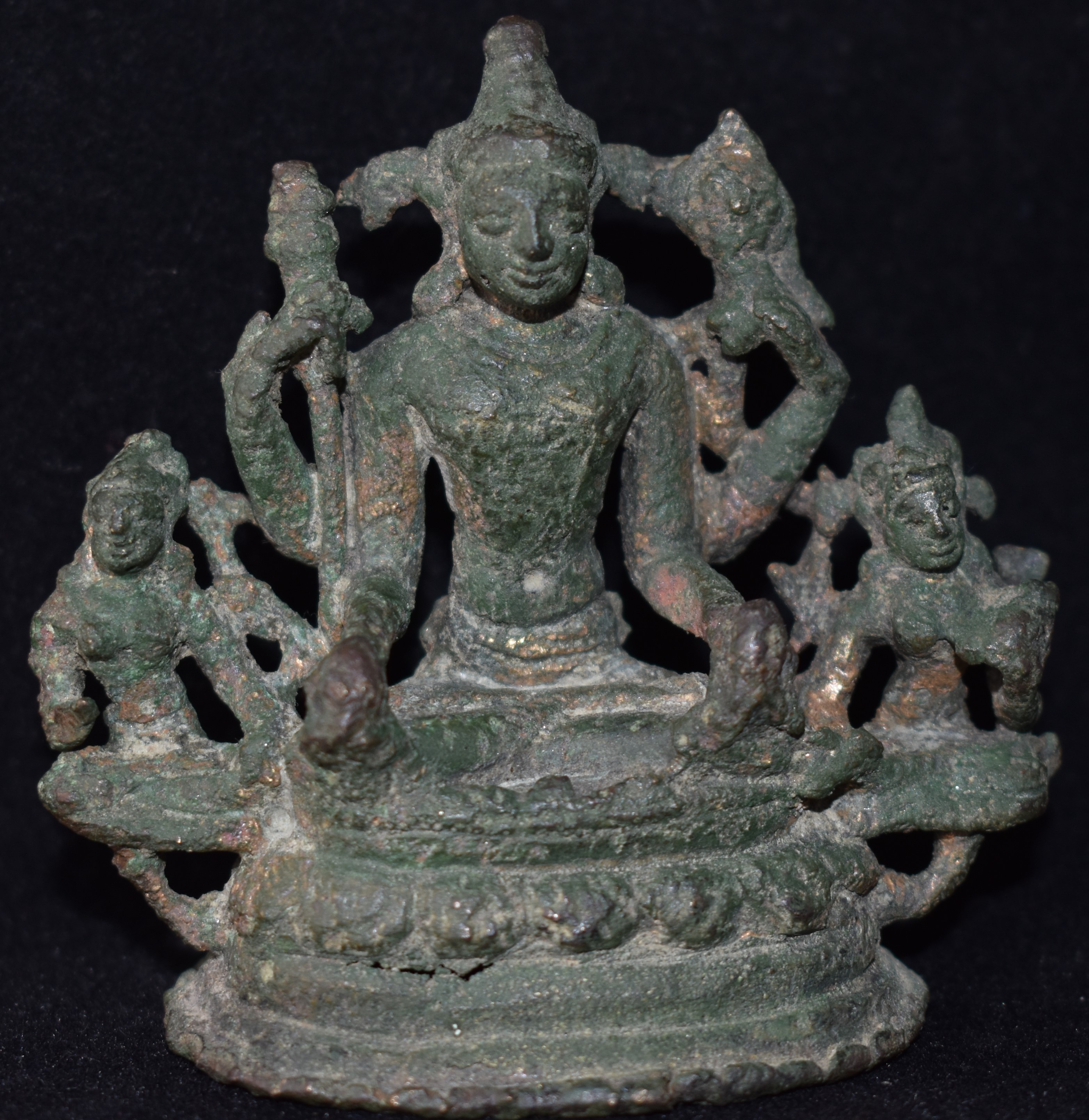
This is Vishnu with his consorts Lakshmi and Saraswati. All three are seated in padmasana. Images such as these, Vishnu seated flanked by seated consorts, are less common compared to the Sthana (standing variety). All three are sitting on a Lotus. The consorts’ pedestal is set a lower level and is supported by stems coming off the main pedestal. Notice the pedestal having a single lotus, as compared to a double lotus, which is more common in Nepal bronzes.
Vishnu’s attributes in the lower hands are indistinct and may be Shankha and Chakra. The rear hands hold Gada and Padma. Consort’s attributes are lost or damaged.
This bronze is about 6.5 cms in height and is damaged and crusted, probably a result of a long period of burial. It is likely to have come from the Bengal region.
A similar bronze of about the same size, 7 cms, is in the Los Angeles County Museum of Art. Refer to P. Pal’s Indian Sculptures Volume II page 201, Catalogue no 100 e and that bronze is dated to about the 12th century.
In South India, Vishnu’s consorts are always Sri Devi and Bhu Devi. Saraswati is associated with a god, it is Brahma.
In Eastern India, the associations seem to have varied over time. According to N K Bhattasali, ” The worship of Brahma fell into disuse, and Saraswati was generally assigned to Vishnu as his second wife. Pages 180-181 of Buddhist and Brahmanical Sculptures in Dacca Museum.
The texts that refer to Saraswati as a consort of Vishnu are of Eastern Indian origin. Three of them are referenced in an article by Gourishwar Bhattacharya, “How come Saraswati is a consort of Vishnu in Eastern India?”.
According to the above paper, during the Pala-Sena period (Eighth to the thirteenth century) Vishnu images were created with Lakshmi and Saraswati as the consorts of Vishnu, following or setting Eastern Indian convention.

 Bronzes of India - A personal collection