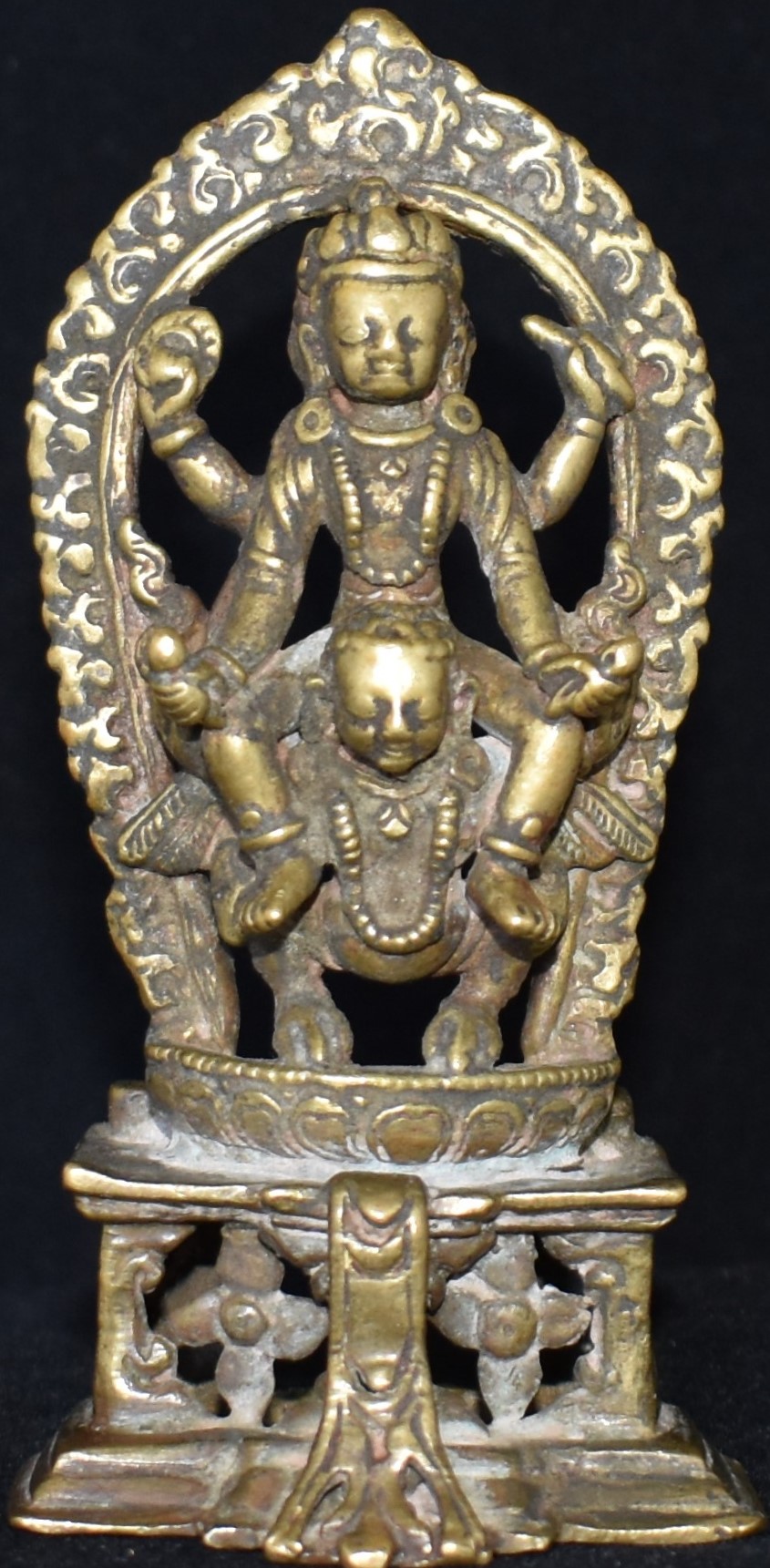
This is Vishnu seated on Garuda. Vishnu is identified by the attributes in his hands: Lotus, Chakra, Mace and Shankha. Starting from the lower right-hand clockwise. Garuda is identified by the avian features, spread wings and claws on his feet.
Garuda is supported by the lotus base, which in turn is on a rectangular base. The decoration of the lower base is unusual for Hindu bronzes, and you tend to see it in Buddhist bronzes. In Nepal, where the bronze is from, the line between Buddhism and Hinduism is often blurred.
The spread wings of Garuda are meant to capture him in flight, carrying Vishnu.
Among the interesting features are Garuda wearing a necklace, similar to the one Vishnu is wearing, and Vishnu’s scarf. The scarf runs around the neck, over the shoulder, around the arms and ends up fluttering against the prabhavali. This scarf is a special feature of Nepali bronzes. See Vasudeva Kamalaja and Sadakshari on this site.
Vishnu seated on Garuda is a Pan-India subject matter. In South India, it is referred to as Srikara Murti. The iconography of Vishnu on Garuda is particularly prevalent in North India and the Himalayas. Examples date back to the fifth century of the common era.
Probably this had another prabhavali. And the second prabhavali is not uncommon. See the Nepali lamp with donors and the Surya Lamp.
This bronze is about 11 cm in height and may date to the eighteenth century.
 Bronzes of India - A personal collection