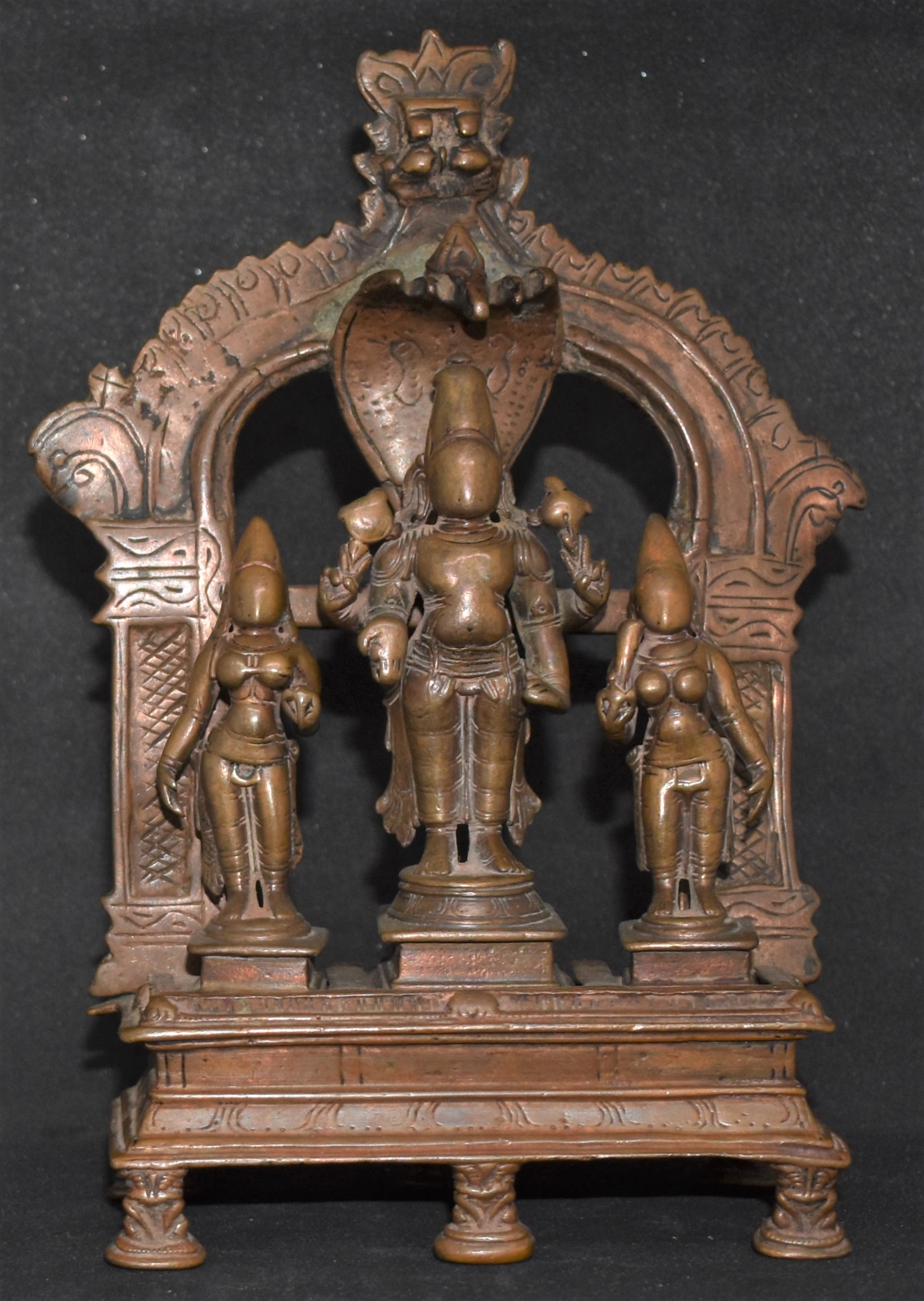
This Vigraha is a typical South Indian representation of Vishnu with his consorts Sri Devi and Bhu Devi.
Vishnu, the central figure, is identified by his attributes Chakra (discuss/wheel) and Shankha (conch/Shell). Sri Devi, on Vishnu’s right, is identified by the breast band and lotus in her left hand. Bhu Devi is identified by the Lilly in her right hand.
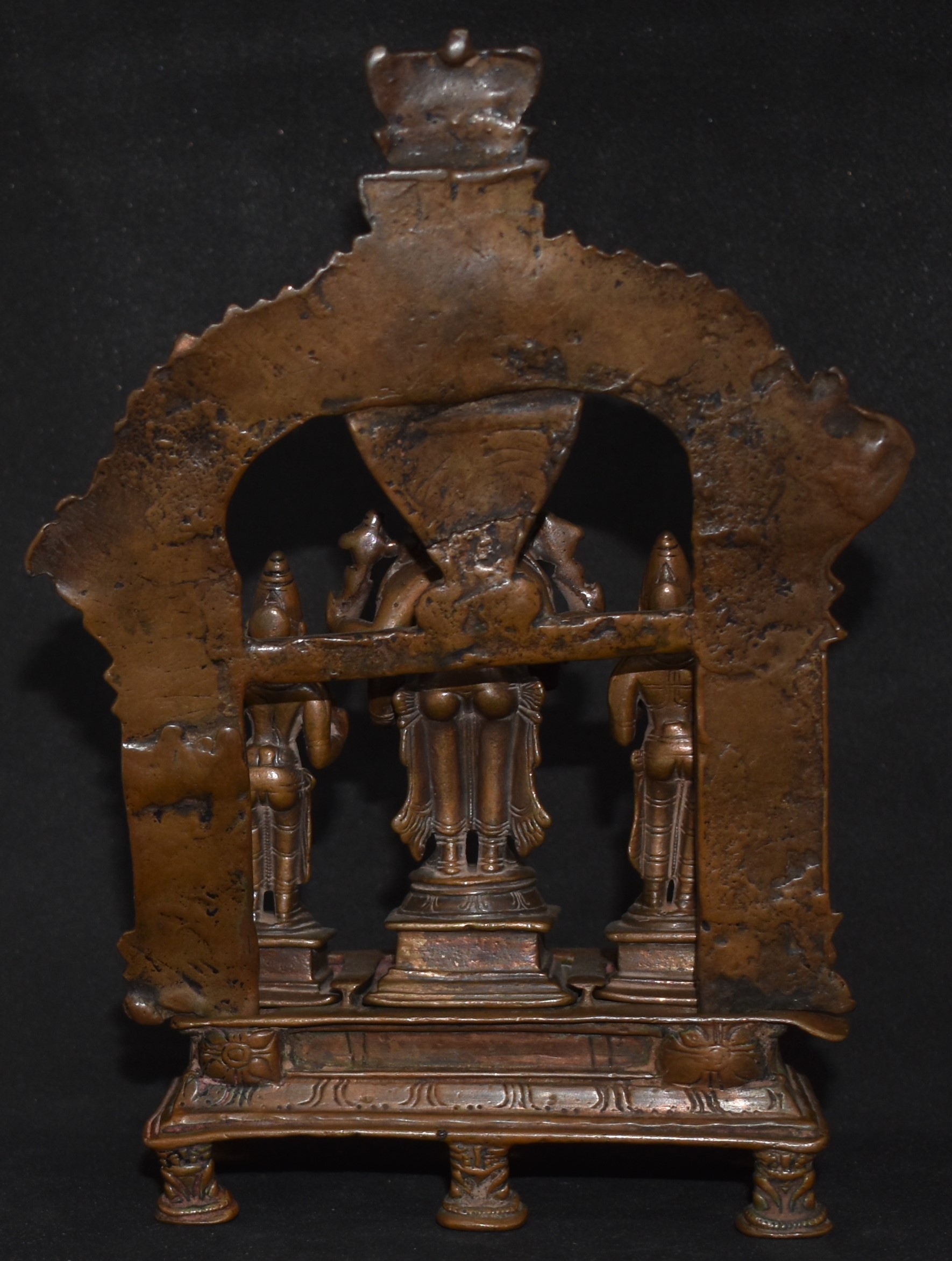
All three deities are standing on their individual Padmapeetha (Lotus base), and the deities, along with the base, slide into custom-designed slots in the Bhadhrapeetha. This form of construction of slots on the base is typical of the Karnataka region.
The deities are wearing the full set of ornaments. All three deities are wearing stylised ankle-length lower garments.

The backplate, Prabhavali, is complete with a five-hooded snake and Kirtimukha.
This is a five-piece construction. The full set is about 18 cm in height. This Vigraha is from Karnataka, probably South Karnataka.
The crouching lions on which the Bhadrapeetha helps us in identifying this as Vijayanagar or post-Vijayanagar vigraha. The ritual wear helps in dating this Vigraha to the eighteenth century or even earlier.
Despite the wear, this Vigraha has a strong presence. It was adorning my study table for a long time.
One of the features to note is the engraving on the Bhadrapeetha. It is called Kolam/Alpana. Normally, these decorative patterns are drawn in front of the house or in front of deities to welcome them. In this case, with Vigrahas in place, they will not be visible, and that has not stopped the metal-smith from doing it. Such is the power of devotion.

 Bronzes of India - A personal collection