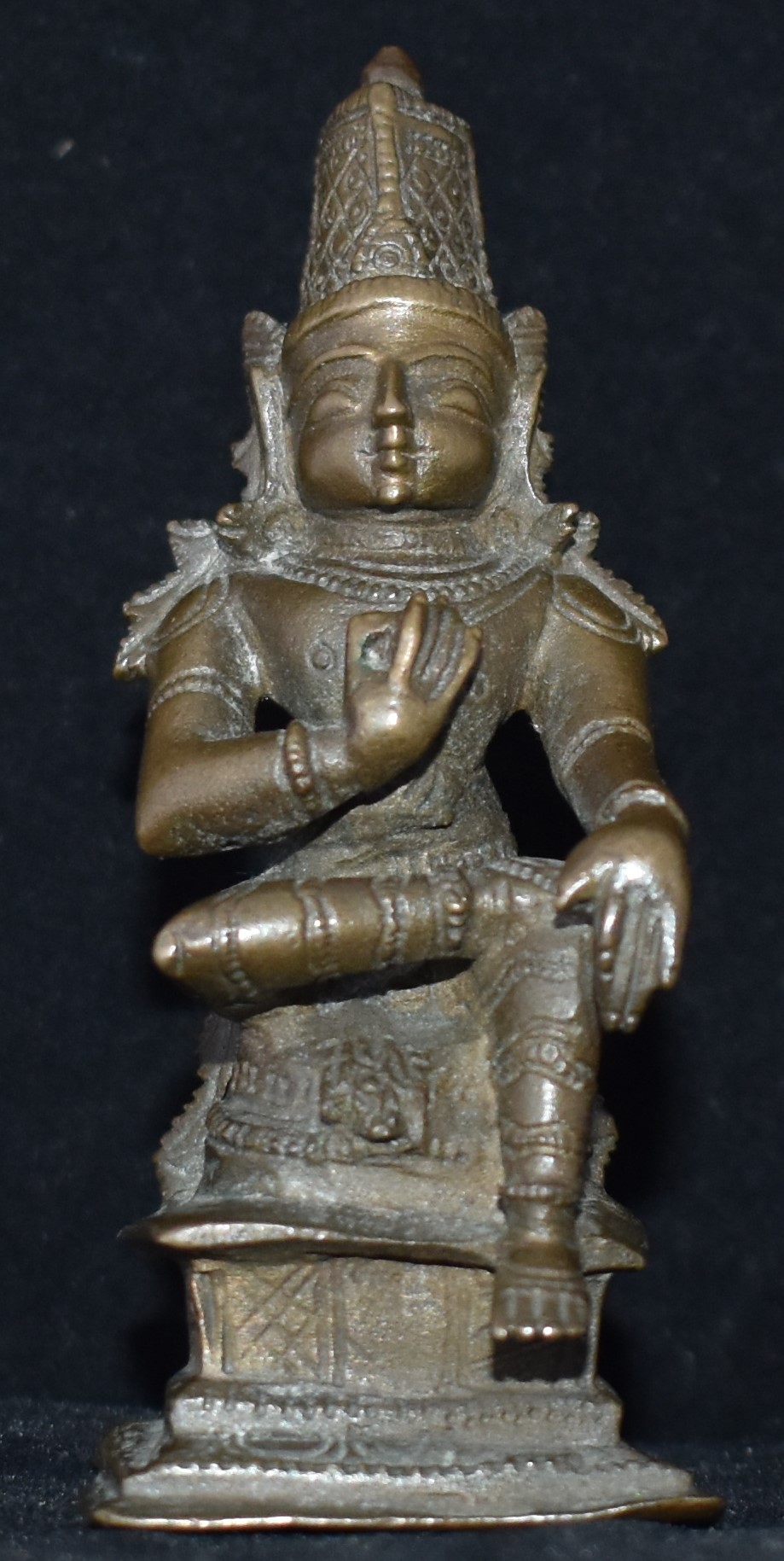
Rama, an avatar of Vishnu, is normally shown with only two arms. Rama is the hero of the Hindu epic Ramayana and is a Pan-Indian deity.

The figure sits on a round lotus base with the left hand resting on the left knee. The right hand is held level with the heart, with the palm facing inwards. This is called dahara vidya, contemplation of the Lord in the heart. This is a Yoga position/mudra, hence the name Yoga Rama. A girdle supports a dhoti with designs on it, and a long tassel hangs down in front. He is wearing earrings, armbands, bracelets, anklets and necklaces. The sacred thread passes from left to right across the chest and is clearly visible from the back. The ears are pendulous with earrings. He is wearing a tall crown. This crown is unusual, the cross-section is a triangle and not a circle.
Rama is sitting on Padmasana, which in turn is on a rectangular pedestal. From the back can be seen the Sirachakra, a sign of divinity.
Notice the amount of work done to the back of the icon, starting from the crown, Sirachakra, lower garments and the pedestal.
The figurine is bronze and is solid cast. Like most of the bronzes on this site, this is likely to have been cast individually.
Yogarama is a rarer bronze. Dr Gururaja Bhat’s book, Studies in Tuluva History and Culture (page 333), has a reference to one in worship in the Sri Rama temple in Basaruru. Here, Yogarama, Dr Bhatt refers to it as Rama in dhyana pose, which is a black stone sculpture. Rama, sitting in padmasana, is in a group with Lakshman and Sita. It is dated to the 13th century.
The earring and cascading shoulder ornaments suggest this is from the North Karnataka region. This may date to the post-Vijayanagara period, 1600-1700.
The icon is about 8 cm in height. Images of this size are produced for worship in household shrines.
 Bronzes of India - A personal collection