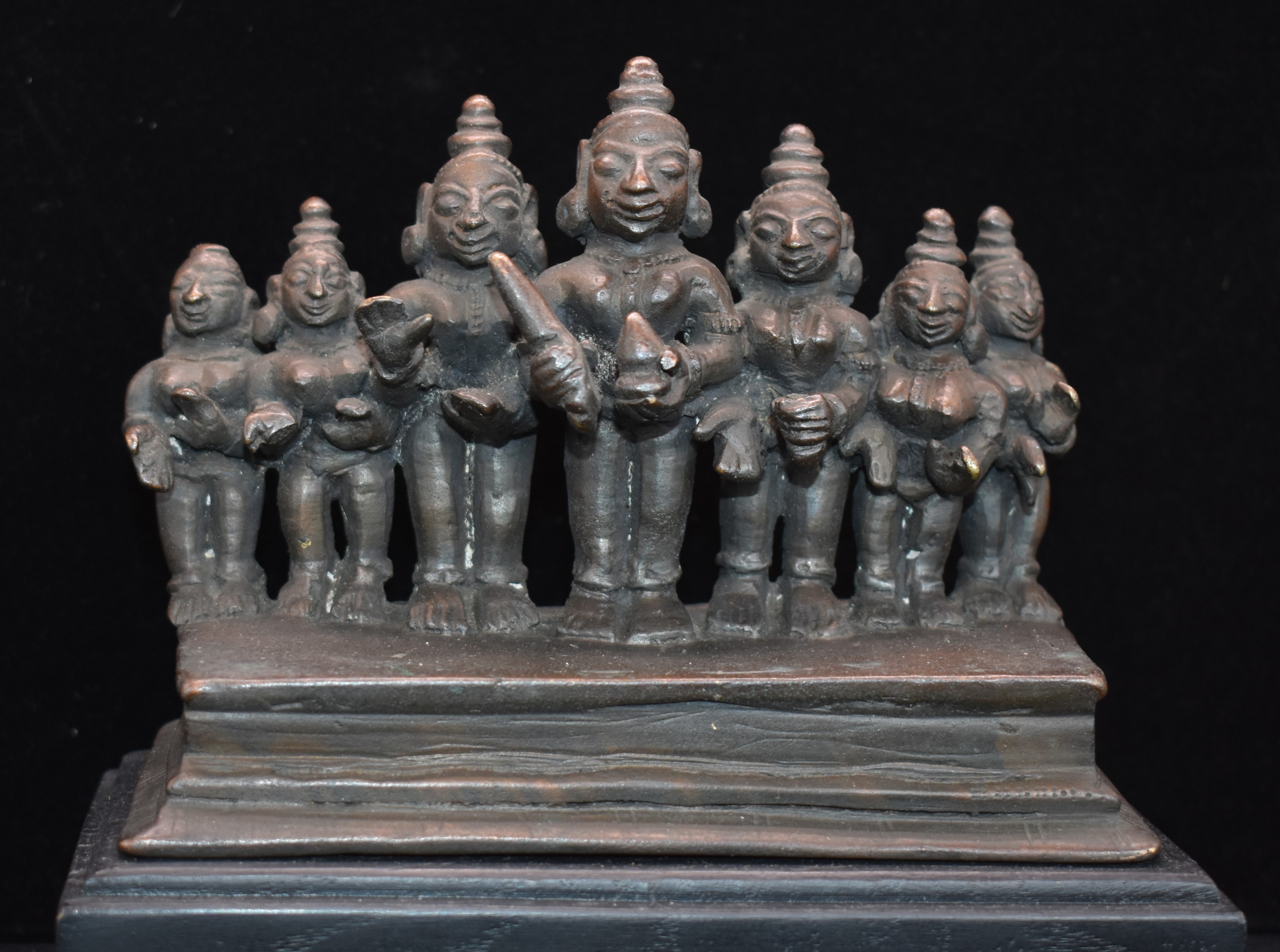
It is not often that you find classical bronzes with multiple figures. No wonder this bronze caught my attention.
It is a group of seven women on a single pedestal. An assembled figure. There is obviously a hierarchy among them, going by the differences in their height and placement. Only the central figure has attributes, and I am yet to identify the attributes.
The facial features and design of the crown suggest this Vigraha is from Western India. Worship of the Seven Sisters, as a protective deities, is common in Goa, Maharashtra, Gujarat and Rajasthan. There does not appear to be any standard iconography for them.
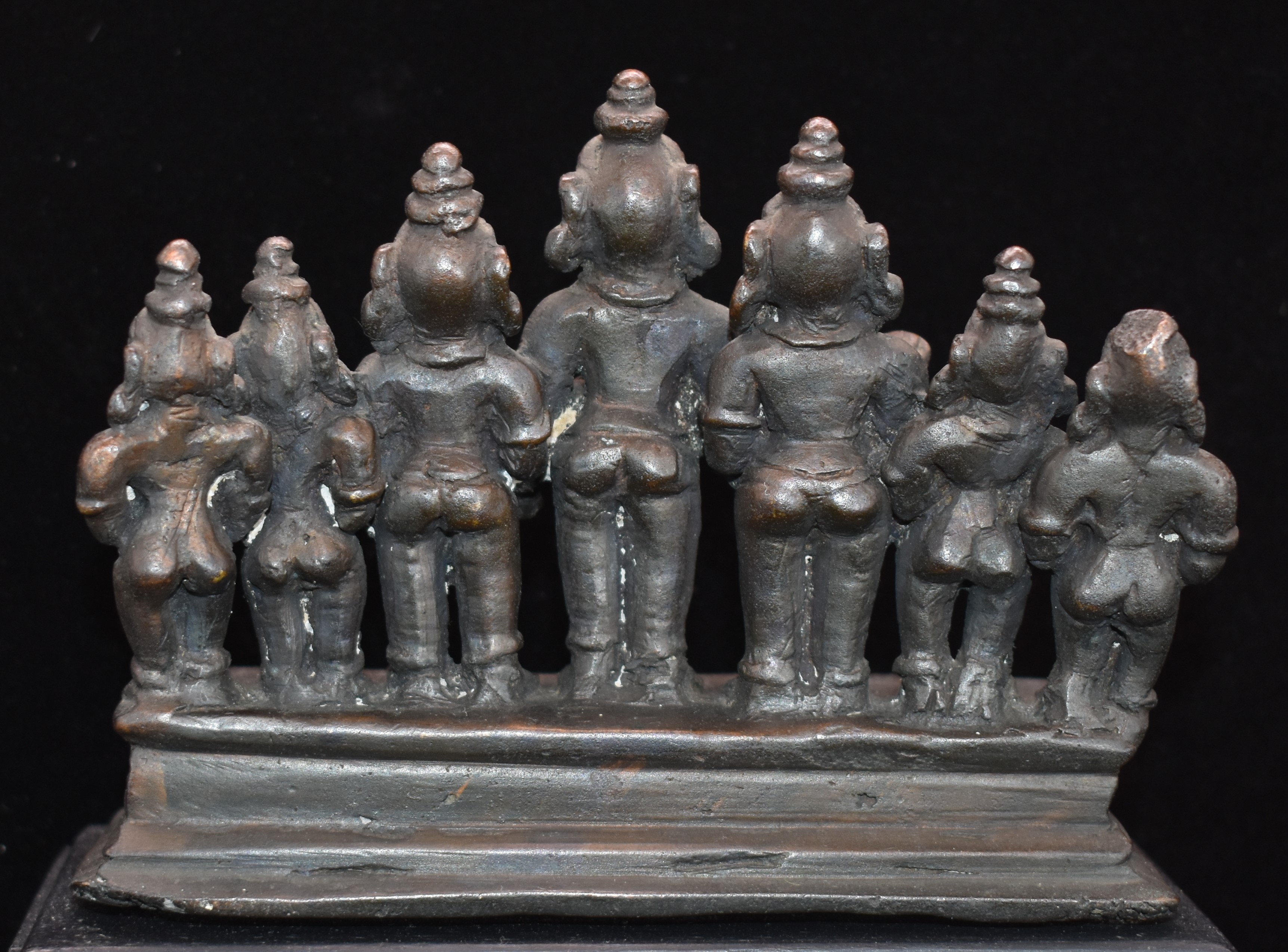
It is tempting to identify them as Saptamatrikas. The absence of attributes, Vahanas and the difference in heights preclude that possibility.
Seven Sisters have an identity of their own, and their names change by the region. The worship of the Seven Sisters as a group is far more common than the worship of Saptamatrikas.
As part of my research, I did a Google image search and came across a bronze, now in the British Museum, with seven figures on a single pedestal. It is identified as Seven Planets. The central figure’s attire is different from the others.
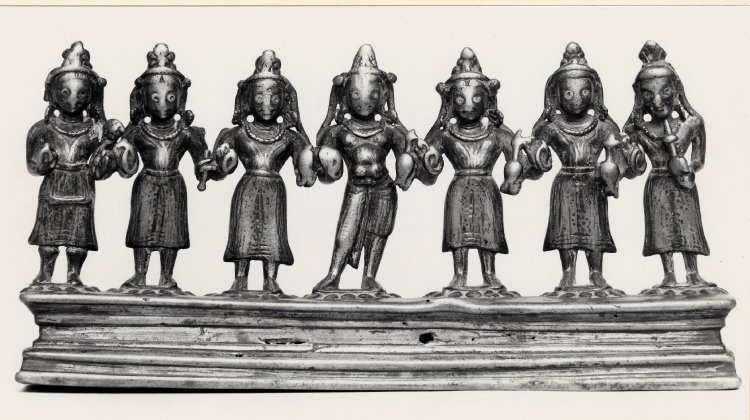
Not quite convinced about the gender attribution. But the question is, why Seven Planets? Hindu’s have always worshipped Nine Planets (Navagrahas).
Anyway, that is a different topic.
The Seven Sisters bronze may be about 150 years old. It is 13 cm wide and 9 cm tall. It is from the Western India.
3 Aug 2026: The following are the comments from Ranganath Srinivasan on the Seven planets. “The Kashmir piece in the british museum are all male and are Surya (Sun), Chandra (Moon), Mangala (Mars), Budha (Mercury), Brihaspati (Jupiter), Shukra (Venus), and Shani (Saturn). In early Puranic astronomy, Graha meant an observable wandering celestial body with physical movements across the zodiac constellations. Because Rahu and Ketu are invisible mathematical intersection points (the lunar nodes) rather than physical visual bodies, early iconographic sets left them out of standard linear physical lineups. The vishnudharmottara purana has multiple mentions of the construction of such saptagraha panels and this text was widely used in idol making in Kashmir at that time”
3 Aug 2026: The following comments are from Prathibha Nandakumar on the Seven Sisters: ” So they are not Saptamatrikas – Found this info – The presiding deity of Western odisha is maa Samalei (Goddess Samleswari). She is worshipped all over western odisha but the primary goddess of Sambalpur region. In other regions of odisha, other goddesses are worshipped. Together they are known as 7 Sister goddess (satpabhouni debi).
Maa Samleswari (Sambalpur)
Maa Patneswari (Bolangir)
Maa Manikeswari (Kalahandi)
Maa Sureswari (Sonepur)
Maa Ghanteswari (Sambalpur)
Maa Chandrahasini (Not worshipped that much in odisha, but in Chattisgarh)
Maa Stambeswari (tribal regions of Western odisha)/Maa Jhadeswari (Bargarh) etc
The 7th goddess can’t be identified. Because with traditions,it changes . But the above goddess are permanent.
Out of them, the cult of goddess Stambeswari is the oldest dating back to 500–300BCE. She was firstly worshipped in the hills of Niyamgiri by tribals and later on got popularity with all over tribals of Western odisha. She has tantric origins too.”

