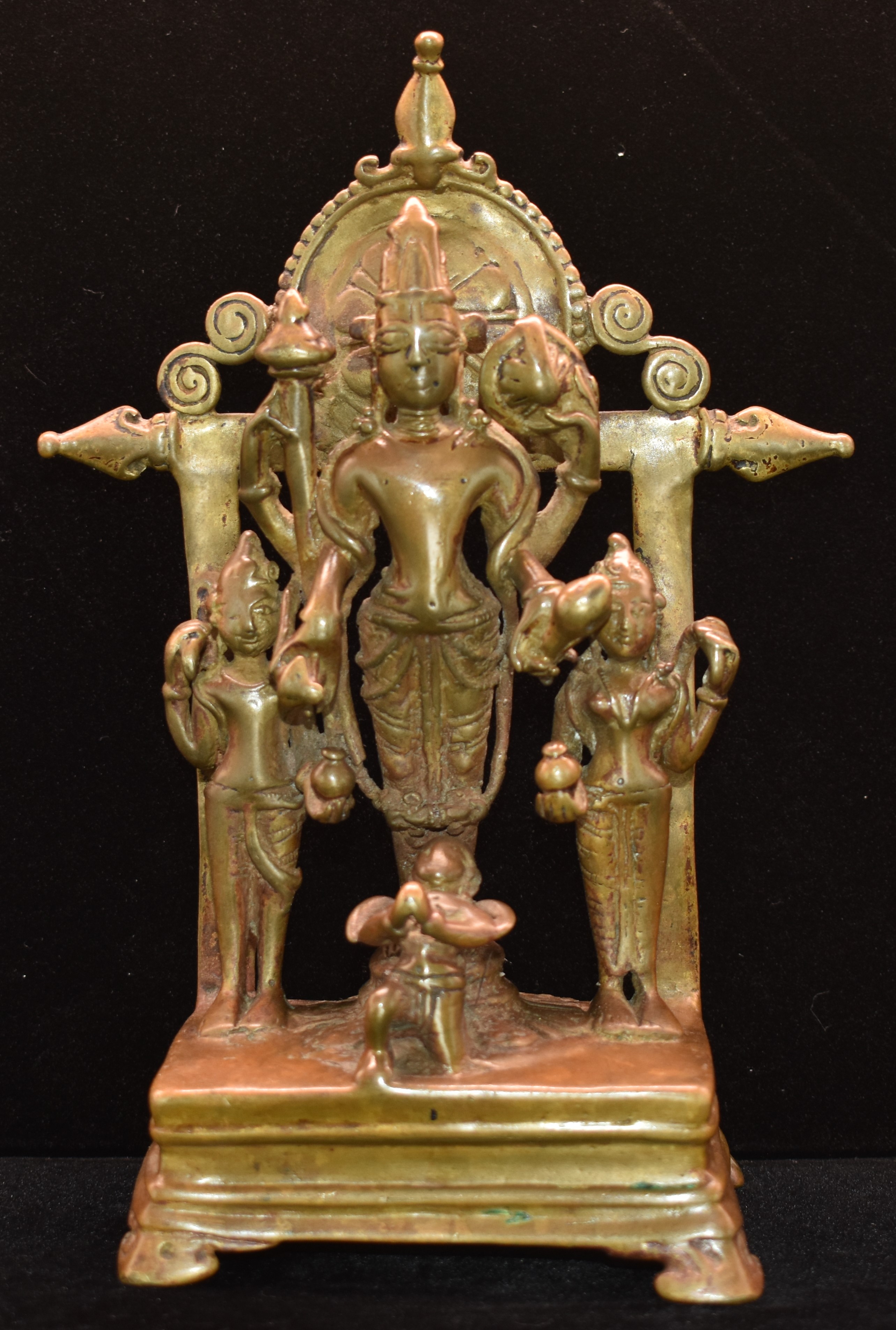
This is Vishnu, two of his attendants and Garuda (Vishnu’s vahana).
Vishnu is identified by his attributes: Padma, Gada, Chakra and Shankha. Clockwise, starting from his lower right hand. The attendants, one male and one female, are holding pots and a Chamara. Garuda is kneeling with his hands in Anjali mudra.
The iconography of standing Vishnu underwent significant changes, especially in North India, till about 1400 CE. Some of the significant forms we encounter, roughly in chronological order, are Vishnu Chaturanana, Vishnu with two of the Ayudhas held on the side, Vishnu with personified Ayudhas as attendants, Vishnu with all four major attributes but with attendants, Vishnu with Lakshmi as his consort, Vishnu with Lakshmi and Saraswati and the current form of Vishnu with two consorts, Lakshmi and Bhu.
Whereas in South India, Vishnu’s form has stayed more or less the same, Vishnu with his consorts Lakshmi and Bhu.
In this example, Vishnu is holding all four attributes; the attendants are the continuation of the Chakrapurusha and Gadanari tradition.
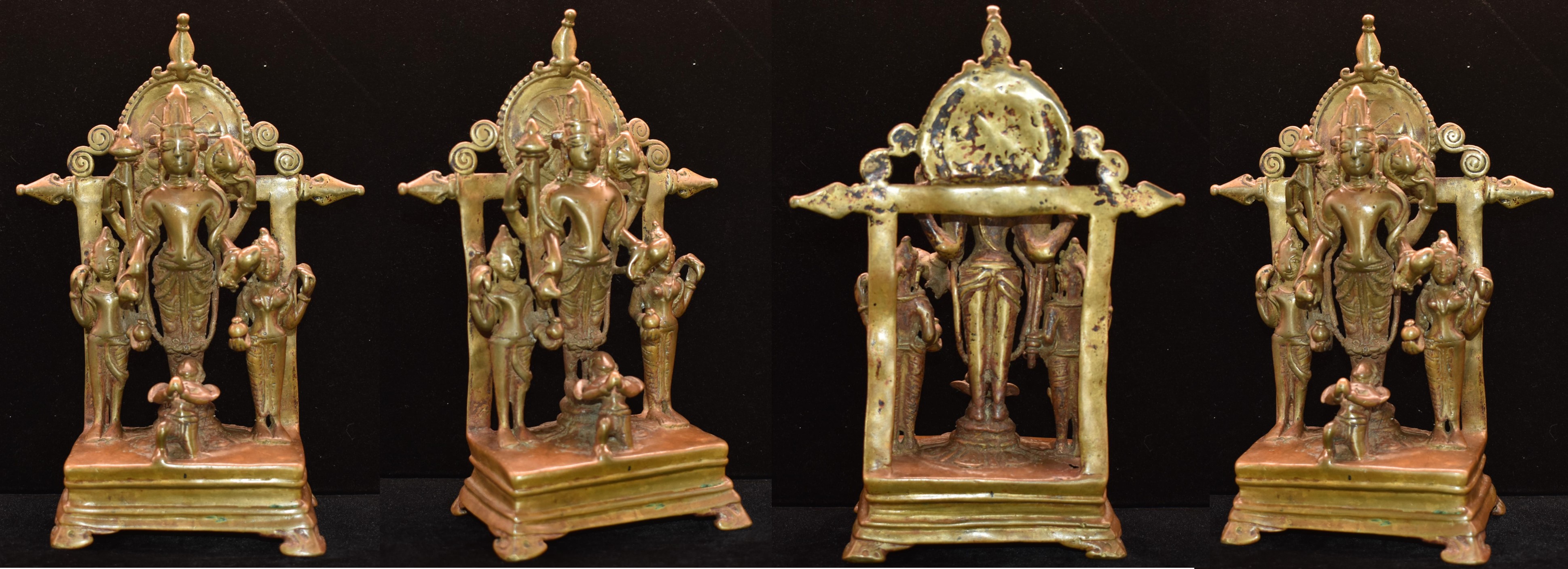
It is worth noting that, though Garuda’s body is turned towards the viewers, his head is bent backwards, looking up at his Lord. He is trying his best to get the darshan. Nice touch.
The Vigraha is nicely worn and has the right kind of wear that comes from prolonged devotional cleaning.
This vigraha, about 19 cm in height, may be dated to the twelfth century CE. It is from Uttar Pradesh. The book ‘Antiquities of Himachal’ by M Postel, A Neven and K Mankodi has several examples of Vishnu in this and related forms.
Backstory: A local dealer, Steve, listed this on his site, and I reached out to him on the same day. Before I could get there, another collector swooped down from the hills of Berkeley Heights and bought it. Fast forward eleven years, and that collector decided to part with the Vigraha. And I got lucky. As they say, you do not buy Deities, and they decide to reach you.

