
This is Shiva as Vishapaharana (Visha means poison; Paharana means to destroy or remove). Shiva is identified by the battle axe and antelope in his rear hands. The crescent moon, Vasuki (the cobra) and Ganga on his Jatamukuta complete the identification.
The story: To obtain Amrut, the elixir of eternal life, the Gods and the Asuras churned the Ocean of Milk. Kurma, the tortoise avatar of Vishnu, served as the base, the Mandara Hills as the churner and Vasuki, Shiva’s Cobra, as the rope.
In addition to Amruta, the Ocean yielded several treasures. But along with Amruta, a powerful poison, Halahala, capable of destroying the three Worlds, arose from the Ocean. Siva consumed the poison, Halahala, to save the Worlds. That scene is captured in this Vigraha.
But Parvati intervened and held Siva’s throat. The poison stayed in Siva’s throat, giving him the name Nilakantan (the blue-throated one).
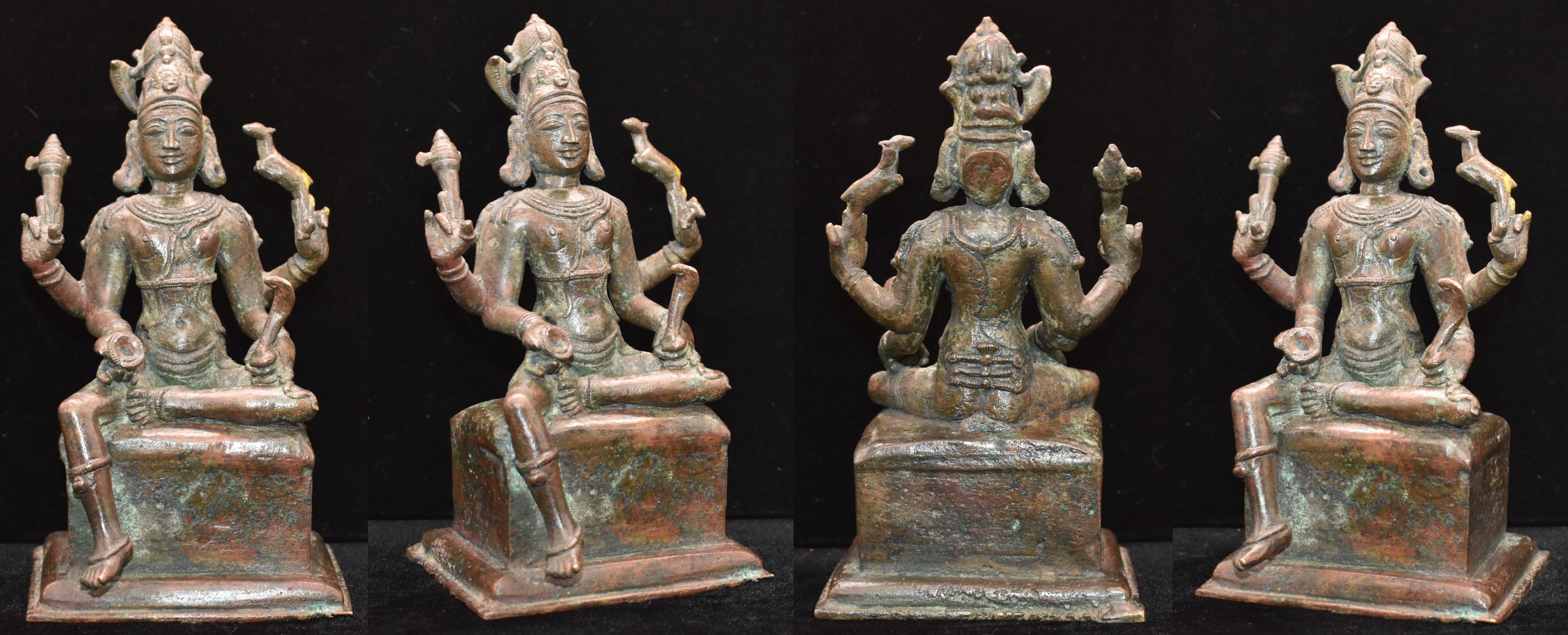
Back to the Vigraha: Here, Siva is holding a cup in his lower right hand, signifying the poison, and a cobra in his lower right hand, supporting the story above.
Siva is sitting in Sukhasana, at ease, bellying the drama that is taking place. Note that the two earrings are of different design; the right one is Makara kundala and the left one is Patra Kundala.
This Vigraha is about 15 cm tall, and it is from Tamil Nadu. The vendor had assigned the 17th century as the date.
It is rare to find older bronzes, like this one, on this subject.
Personal note: My first serious purchase was Shiva in Rudra Tandava. And the second one was Ardhanari. That was 40+ years ago. They launched me into collecting, and I have not been able to stop that obsession. Not that I want to stop.
My initial plan was to collect all the 64 forms of Shiva. Well, that may not happen as there are no antique bronzes for some of the forms. But my attempt to collect as many as possible will continue.
This Vishapaharana is a significant addition towards that quest.

